
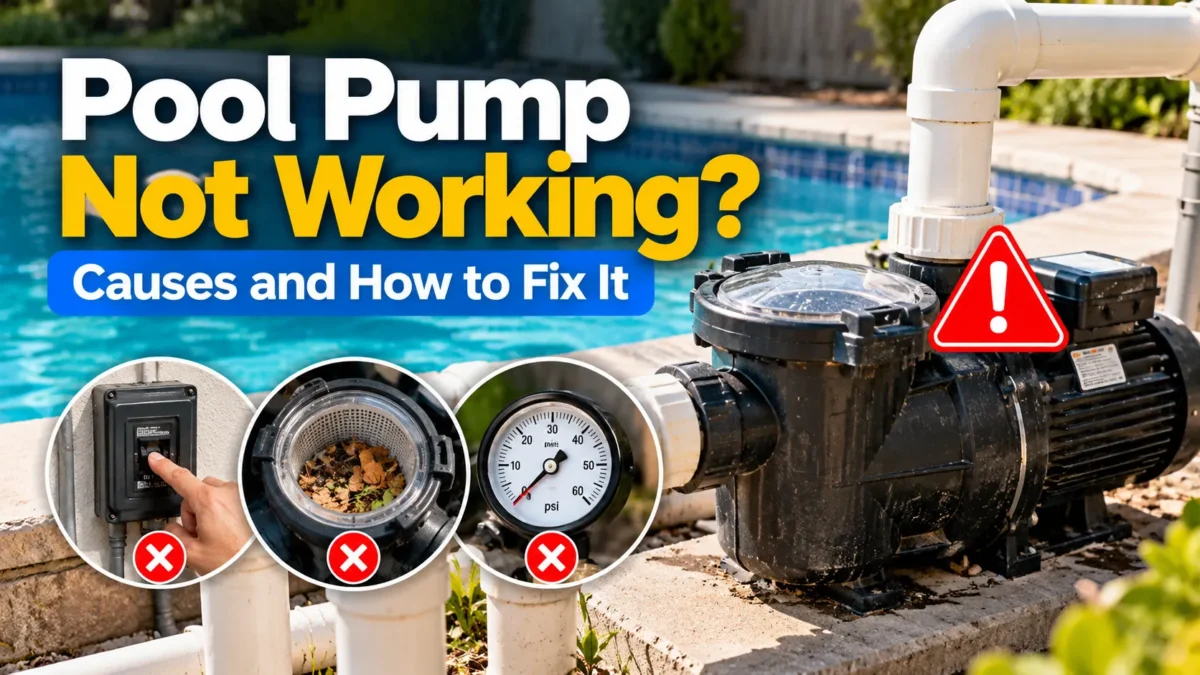
A pool pump that suddenly stops working can leave your swimming pool without proper circulation, filtration, and water treatment. Sometimes the cause is a simple clogged basket or incorrect timer setting. In other cases, a damaged capacitor, blocked impeller, air leak, or failing motor may be responsible. Following a regular pool maintenance checklist can help you identify potential problems before they become serious.
If your Pool Pump Not Working, start by identifying what the pump does when you switch it on. Does it remain silent, hum without starting, run without moving water, or shut off after a few minutes? Each symptom points toward a different problem.
This guide explains why your pool pump is not working, how to troubleshoot common problems, which checks homeowners can safely perform, and when professional repair is necessary.
Quick Troubleshooting: What Is Your Pool Pump Doing?
| Symptom | Possible cause | First step |
|---|---|---|
| Pump is completely silent | Power supply, timer, breaker, or control fault | Check accessible controls and power indicators |
| Pump hums but does not start | Seized impeller, failed capacitor, or motor fault | Switch it off and arrange an inspection |
| Motor runs but no water moves | Lost prime, low water, blockage, or air leak | Check the pool level, baskets, and visible valves |
| Weak return jets | Dirty filter, clogged basket, air leak, or restricted plumbing | Inspect baskets and compare filter pressure |
| Pump repeatedly shuts off | Overheating, electrical fault, or control problem | Turn it off and investigate before restarting |
Before troubleshooting further, check whether your pump is correctly sized using our Pool Pump Size Calculator. If you suspect high electricity consumption, use our Pool Pump Electricity Cost Calculator to estimate running costs. You can also follow our Daily Pool Maintenance Checklist to identify common maintenance issues before they lead to pump failure.
Safety first: Switch off the pump at its designated disconnect or breaker before opening the strainer housing or inspecting components. Keep electrical equipment dry. Never open a pressurized filter, touch exposed wiring, or repeatedly reset a tripping breaker. Electrical and motor repairs should be handled by a qualified professional.
Why Is My Pool Pump Not Working?
A swimming pool pump not working can indicate an electrical issue, a water-flow restriction, a priming problem, or mechanical damage. Before purchasing replacement parts, identify whether the motor starts and whether water actually circulates.
1. The pool pump has lost power
If your pool pump won’t turn on, first check the accessible power switch, timer display, automation schedule, and breaker position. A power outage, scheduled shutdown, tripped protection device, or faulty control can prevent the pump from starting.
If the breaker has tripped, do not repeatedly reset it. A persistent trip can indicate a short circuit, damaged wiring, moisture intrusion, a seized motor, or another electrical fault. Have a qualified electrician or pool technician diagnose the problem.
2. The pool pump will not turn on and makes no sound
When your pool pump is not turning on and makes no sound, possible causes include a disconnected power supply, faulty timer, failed relay, damaged wiring, or motor failure. Check whether the timer is displaying the correct time and whether the pump is scheduled to operate.
If the controls appear normal but the pump remains silent, professional electrical testing may be required. Do not remove the motor cover or test live terminals yourself.
3. The pool pump has power but will not turn on
A pool pump that has power but won’t turn on may have a failed start capacitor, damaged motor windings, a seized impeller, or a control fault. A lit display or illuminated indicator does not necessarily prove that the motor is receiving the correct supply under operating conditions.
Record any error code, warning light, or unusual sound and share it with your technician. The correct diagnosis depends on the pump model, motor design, and manufacturer’s troubleshooting instructions.
4. The pump hums but does not start
A pool pump humming but not pumping may have a seized motor, obstructed impeller, failed starting component, or another mechanical or electrical fault. If the motor hums without turning, switch it off promptly. Leaving it energized can cause overheating and additional damage.
The related symptom pool pump hums but won’t start should not automatically be treated as a capacitor problem. A technician can distinguish a failed capacitor from a jammed impeller or motor fault before replacing parts.
5. The pool pump stopped working suddenly
If your pool pump quit working while it was running normally, consider what happened immediately beforehand. A power interruption, unusual noise, leaking water, overheating, debris accumulation, or recent maintenance may provide useful clues.
Do not keep restarting a pump that stops unexpectedly. Turn it off, check for visible leaks or damage, and determine whether the issue involves power, water flow, or a mechanical component.
Pool Pump Runs but Is Not Pumping Water
Sometimes the motor runs normally, but the pool appears to have no circulation. If your pool pump is not pumping water, the problem may be a loss of prime, low pool water, a clogged basket, a closed valve, or a suction-side air leak rather than a failed motor.
6. The pool pump is not pulling water or has no suction
A pool pump not pulling water often means the pump cannot establish or maintain a continuous supply of water. Check that the pool water level is high enough for the skimmer to operate correctly. A low level can cause the skimmer to draw air instead of water.
With the pump switched off, inspect the skimmer basket and pump strainer basket for leaves and debris. Check accessible valve positions and look for visible damage to the pump lid seal or plumbing connections.
If the pool pump runs but has no suction, air may be entering through a damaged lid O-ring, loose suction fitting, leaking valve connection, or cracked pipe. A blocked impeller can also restrict water movement.
7. The pool pump is not pulling water from the skimmer
When a pool pump is not pulling water from the skimmer, begin by checking the water level and skimmer basket. Debris can restrict the opening, while a blocked suction line or incorrectly positioned valve can prevent water from reaching the pump.
If the pump basket contains persistent air bubbles, investigate a possible suction-side air leak or priming problem. Avoid dismantling underground plumbing without the appropriate equipment and experience.
8. The pump runs but does not circulate water
A pool pump running but not circulating water can have an empty pump housing, clogged impeller, blocked suction line, restricted filter, or closed valve. The sound of a running motor does not confirm that water is moving through the filtration system.
Check the return jets and the filter pressure gauge. Low or zero pressure combined with little flow can suggest a priming or suction problem. High pressure with weak return flow may indicate a dirty filter or restriction after the pump. Compare readings with the normal clean-filter baseline and your manufacturer’s guidance.
How to Fix a Swimming Pool Pump: Step-by-Step Checklist
Use this pool pump troubleshooting sequence to check common causes before deciding whether you need a repair.
- Switch off the pump. Isolate power before opening the strainer housing or touching accessible components.
- Check the pool water level. Maintain it within the range recommended for your skimmer, usually around the middle of the opening.
- Clean the baskets. Remove debris from the skimmer and pump strainer baskets after switching off the equipment.
- Inspect the pump lid seal. Look for a dirty, damaged, displaced, or hardened O-ring. Use only the lubricant recommended by the manufacturer.
- Check visible valves. Confirm that the appropriate suction and return valves are positioned correctly for normal circulation.
- Check the filter pressure. Compare the reading with the clean operating baseline. Clean or backwash the filter only according to its type and manufacturer’s instructions.
- Prime the pump if required. Follow the exact priming procedure in the owner’s manual. Never allow the pump to run dry.
- Observe the restart. Restore power only after reassembling the equipment correctly and confirming that it is safe to operate. Stop if the pump does not establish flow promptly or makes abnormal noises.
These pool pump problems and troubleshooting steps can identify straightforward issues, but they cannot safely resolve every electrical, plumbing, or mechanical fault. If the cause remains unclear, arrange a professional inspection.
Pool Pump Low Pressure, No Flow, or Weak Circulation
Pool pump low pressure can result from a clogged suction basket, low water level, air entering the system, or a restriction before the pump. However, a dirty filter more commonly causes rising filter pressure and reduced return flow. Pressure readings must be interpreted according to the filter design and system configuration.
If your pool pump is not building pressure, check whether the pump is fully primed and whether water is reaching the filter. A pump basket full of air, weak return jets, and a pressure gauge near zero may indicate a suction or priming problem.
A pool pump with no flow may have a blocked impeller or plumbing restriction. Turn off the equipment before arranging an impeller inspection. Never insert fingers or tools into a powered pump.
If circulation remains weak after basic checks, the pump may be incorrectly sized for the pool or plumbing. The Pool Pump Size Calculator helps estimate the required flow rate and account for pipe-size limits.
Why Does My Pool Pump Keep Shutting Off?
If your pool pump keeps shutting off, overheating, electrical protection, motor damage, or an automation setting may be responsible. A pump that stops and restarts repeatedly should not be left running unattended.
- Overheating: Restricted ventilation, excessive heat, or motor problems may trigger thermal protection.
- Electrical faults: Repeated breaker trips or burning smells require immediate shutdown and professional inspection.
- Timer or automation issues: Incorrect schedules or control settings may interrupt operation.
- Mechanical resistance: A damaged bearing or obstructed impeller may place additional load on the motor.
Record how long the pump runs before stopping, any error codes, and whether it restarts after cooling. Do not repeatedly force it to run.
How to Tell If Your Pool Pump Is Bad
Not every pool pump problem means you need a replacement. A clogged basket, damaged seal, or control fault may be repairable without replacing the entire unit.
Signs of possible major pump failure include persistent grinding noises, a motor that cannot start, repeated overheating, water leaking near the motor shaft, damaged housing, or failure to circulate water after basic checks. A technician should inspect the motor, impeller, seals, and electrical components before recommending replacement.
If the repair cost is high, compare it with the cost of a suitable replacement, expected service life, energy consumption, and warranty. The Pool Pump Electricity Cost Calculator helps estimate operating expenses using your pump’s wattage, runtime, and electricity rate.
Above-Ground Pool Pump Not Working
An above-ground pool pump not working may have a blocked hose, low water level, air leak, clogged cartridge, faulty timer, or power issue. Many above-ground systems use compact pumps that depend on the installation height and plumbing arrangement, so follow the manufacturer’s priming instructions rather than assuming every pump is self-priming.
Inspect hoses and connections for kinks, leaks, or loose fittings. Clean the strainer and filter according to the product manual. If the motor runs but water does not move, switch it off before checking for lost prime or a restriction.
For system-specific guidance, see the site’s guide to choosing the right pool pump.
How to Prevent Pool Pump Problems
Regular maintenance can help identify restrictions, leaks, and unusual motor behavior before they cause more expensive damage.
- Keep skimmer and pump baskets free of debris.
- Maintain the correct pool water level.
- Inspect accessible seals, hoses, and fittings for leaks.
- Monitor filter pressure and return-jet flow.
- Follow manufacturer instructions for priming, cleaning, and winterization.
- Investigate unusual noises, overheating, or repeated shutdowns promptly.
Use the Daily Pool Maintenance Checklist to organize routine equipment inspections and other pool-care tasks.
Frequently Asked Questions
Why is my swimming pool pump not working?
Common causes include loss of power, a faulty timer, a clogged basket, lost prime, a suction-side air leak, a blocked impeller, or motor failure. Identify whether the motor starts before troubleshooting water flow.
Why won’t my pool pump start?
A pump that will not start may have a power supply issue, control fault, failed capacitor, seized impeller, or damaged motor. Electrical and internal motor checks should be performed by a qualified professional.
Why is my pool pump running but not pumping water?
The pump may have lost prime, be drawing air, have a clogged basket or impeller, or be affected by a closed valve or plumbing restriction. Check the water level and accessible components first.
Can I run my pool pump if it is not pulling water?
No. Running a pump without sufficient water can overheat it and damage seals. Switch it off and follow the manufacturer’s priming procedure before restarting.
Should I repair or replace my pool pump?
The decision depends on the fault, repair estimate, pump age, replacement cost, warranty, and energy efficiency. Obtain a diagnosis before replacing the entire unit.
Final Thoughts
When a pool pump is not working, the most effective approach is to identify the symptom before replacing parts. Check accessible controls, water level, baskets, valve positions, and filter pressure, while leaving electrical and internal motor repairs to qualified professionals.
Once circulation is restored, monitor the pool water and filtration system. If the pool becomes cloudy or green, test the water and correct the underlying cause rather than adding chemicals blindly. The right diagnosis can save money, protect your equipment, and help keep your swimming pool clean and ready to use.