
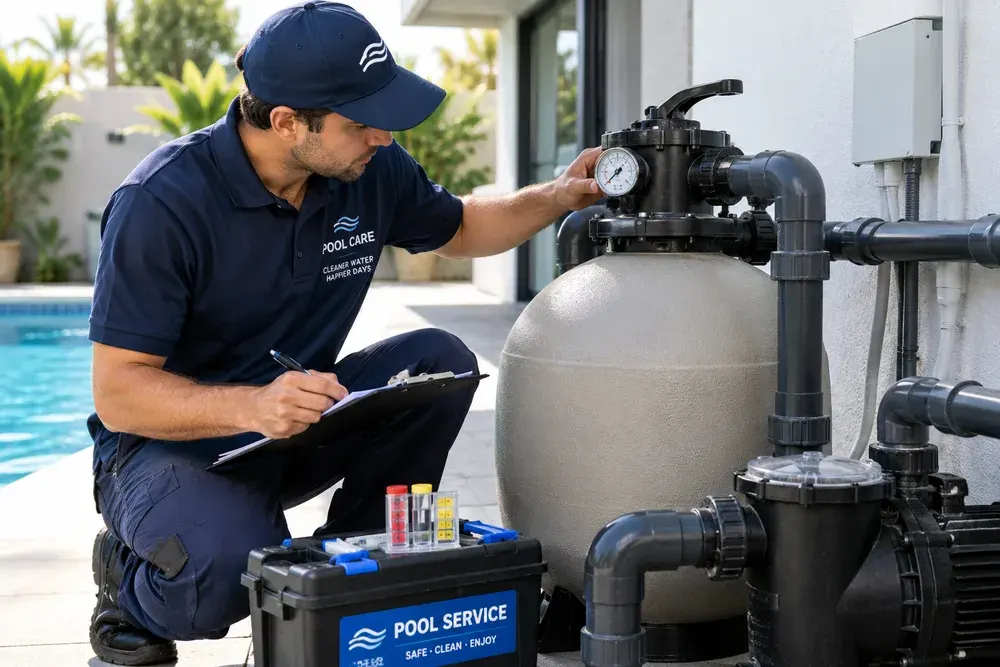
Pool maintenance is mostly a rhythm rather than a skill. A few minutes several times a week keeps water clear; letting it slide turns a ten-minute job into a weekend and a large chemical bill.
The weekly rhythm
Almost everything that goes wrong with a pool announces itself early. These are the checks that catch it.
| How often | What to do | Why |
|---|---|---|
| Daily | Skim the surface, check the water is moving | Debris that sinks is far harder to remove than debris that floats |
| Twice a week | Test free chlorine and pH | These two move fastest and matter most |
| Weekly | Brush walls and steps, empty skimmer and pump baskets, vacuum | Algae starts where water moves slowly |
| Monthly | Full test including alkalinity, calcium and stabiliser | These drift slowly, but they set what chlorine and pH will do |
| As needed | Backwash or clean the filter | By pressure reading, not by calendar |
Run the pump long enough to turn the water over
Filtration only works on water that reaches the filter. The measure that matters is turnover: how long the pump needs to push the entire pool volume through the system once. Most residential pools are set up to turn over in six to eight hours.
Required flow is simply your volume divided by your target turnover time in minutes. A 20,000 gallon pool on an eight-hour turnover needs about 42 gallons per minute. Run time below that leaves parts of the pool effectively unfiltered, and it usually shows up first as cloudiness or as algae in the corners.
The order to fix chemistry in
Pool chemistry is not a list of independent numbers. Each one changes how the others behave, so correcting them in the wrong order means doing the job twice.
- Total alkalinity first. It is pH’s shock absorber. With alkalinity in range, pH drifts slowly and predictably; with it out of range, pH will not stay where you put it.
- Then pH. It decides how much of your chlorine is in its active form. At pH 7.5 roughly half the free chlorine is working; by pH 8.0 that has fallen to about a quarter.
- Then chlorine. Only now is a chlorine reading meaningful, because only now does it reflect sanitising power rather than just quantity.
- Then stabiliser. Cyanuric acid protects chlorine from sunlight, but it also slows it down — so the more you have, the higher the chlorine level you need to hold.
- Calcium hardness last. It moves slowly and mainly protects surfaces and equipment rather than sanitation.
Test before you add anything. Most pool problems have two or three plausible causes with completely different answers, and adding the wrong thing can make the problem permanent — a metal stain treated with chlorine is the classic example.
Filter care
Backwash when the pressure gauge reads about 8 to 10 PSI above its clean baseline — not on a schedule. Backwashing early wastes water and actually reduces filtration, because a sand filter cleans best when it is slightly dirty. Write down the clean reading when the filter is fresh; without it the gauge tells you nothing.
Seasonal changes
Warm water consumes chlorine faster, sunlight destroys more of it, and more people are in the pool — so summer needs more frequent testing and longer run times, not the same routine. In cold weather the reverse applies, and run time can come down provided the water still turns over.
The tools for the job
Maintenance Schedule
A task list built for your pool — print it and stick it by the equipment.
CalculateWater Health Check
Enter your test results and see what is in range, what is not, and what to do first.
CalculateHow often should I really test the water?
Free chlorine and pH twice a week in swimming season, weekly otherwise. The full set — alkalinity, calcium hardness and cyanuric acid — monthly, because those drift slowly.
Do I need to run the pump 24 hours a day?
No. You need to run it long enough to turn the water over completely, which for most pools is six to eight hours. Beyond that you are paying for electricity without improving the water.
Why does my pool go cloudy after I shock it?
Usually because the shock has oxidised something that is now suspended in the water, and the filter has not yet removed it. Keep the pump running and give the filter time. If it persists for more than a day or two, check the filter pressure and your chemistry.
Is brushing really necessary if I have a robot cleaner?
Yes, in the places the robot misses — steps, corners, behind ladders and the waterline. Algae takes hold where water moves slowly, and those are exactly the spots.