
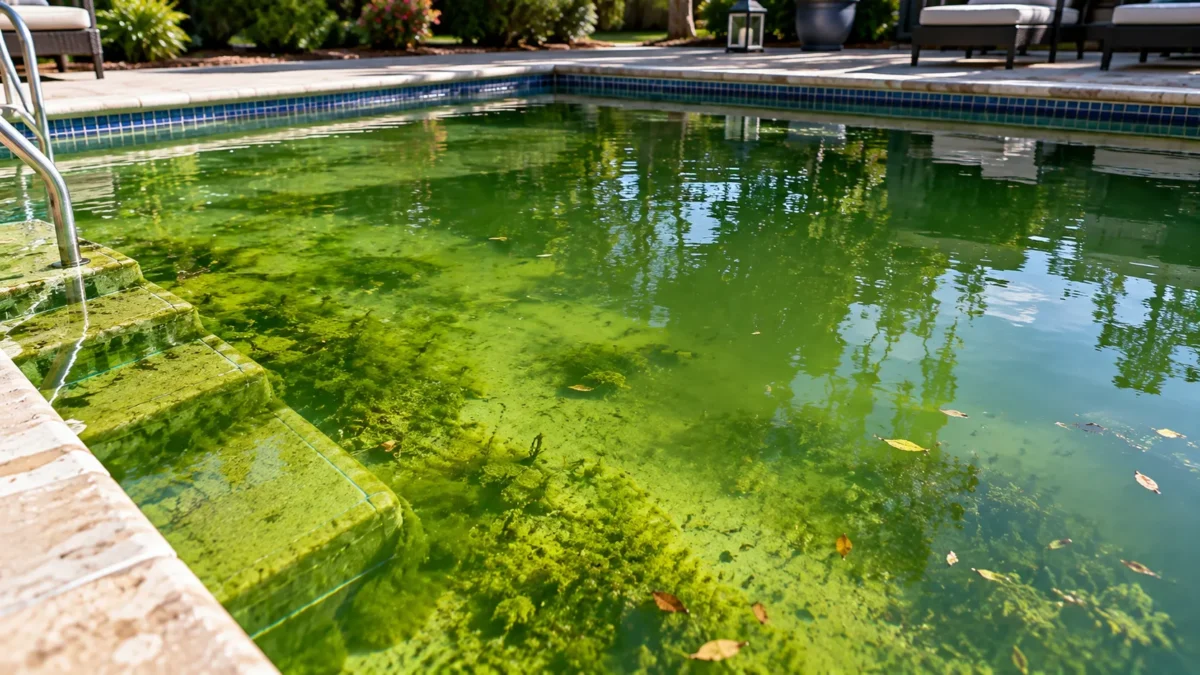
A green pool is algae. It grows when chlorine runs out, and once it takes hold it consumes chlorine faster than a normal dose can replace it — which is why topping up as usual makes no difference.
The shade tells you roughly how far it has gone. A faint green tint that appeared overnight is a new bloom and usually clears in a day or two. Deep green where you cannot see the bottom is days of growth and will take most of a week. Water that looks like a pond, with the floor invisible, often needs a partial drain because there is more organic matter in it than chlorine can realistically burn through.
Clearing it is not one dose. It is holding a high chlorine level continuously until the algae stops consuming it — which is the part most people get wrong.
What causes it
- Chlorine ran out. By far the most common cause. A few hot days, a rainstorm or a week away is enough.
- Cyanuric acid is too high. Above roughly 60 ppm chlorine works slowly. The test shows plenty of chlorine and the pool still goes green.
- Cyanuric acid is too low. Below 30 ppm in an outdoor pool, sunlight destroys chlorine within hours of adding it.
- The pump is not running long enough. Still water in the corners is where algae starts.
- Phosphates and organic load. Heavy rain, leaves, fertiliser runoff and swimmer load all feed algae and consume chlorine.
- A worn-out or undersized filter. Dead algae has to be filtered out; a filter that cannot do it leaves the water green-grey for days.
What to test first
Before adding anything, take a reading. Guessing at this stage is how a small problem becomes an expensive one.
| Test this | Why it matters |
|---|---|
| Free chlorine | Almost certainly at or near zero. This is the cause, not a symptom. |
| Cyanuric acid | Sets how high you have to take chlorine to clear the algae — 40% of the CYA reading. |
| pH | Chlorine works poorly above 7.8. Bring pH down before shocking or you waste most of the dose. |
| Total alkalinity | Holds pH steady while you are adding large amounts of chlorine. |
How to fix it
- Brush the whole pool. Walls, steps, corners, behind the ladder. Algae clings to surfaces and brushing exposes it to chlorine. Do this before every dose.
- Get pH to about 7.2. Chlorine is far more effective at the lower end of the range. Use the pH calculator for the dose.
- Clean the filter. It is about to do a great deal of work.
- Shock to the level your CYA calls for — roughly 40% of the CYA reading for a normal shock, higher for a serious bloom. Add it at dusk so sunlight does not destroy it.
- Run the pump 24 hours a day until the water is clear. This is not optional.
- Re-test morning and evening and top back up to shock level. Keep doing this until the level holds overnight — usually three to five days.
- Vacuum the dead algae off the floor. Grey or white debris means the algae is dead and just needs removing.
- Clean the filter again once the water is clear, then bring chlorine back to its normal range before anyone swims.
Do not swim in a green pool. Algae itself is mostly harmless, but water green enough to hide the bottom is a drowning risk, and the same conditions that let algae grow let bacteria grow too. Never mix pool chemicals, and never add two products to the water one after the other without circulating in between. Chlorine and acid together release chlorine gas. Always add chemical to water, never water to chemical.
Work out the numbers
These calculators give the figures for your pool rather than a rule of thumb.
Stopping it coming back
- Hold free chlorine in range every week, not most weeks. Algae only needs one gap.
- Keep cyanuric acid between 30 and 60 ppm so chlorine is protected but still effective.
- Run the pump for at least one full turnover a day in warm weather.
- Brush the corners and steps weekly — algae starts where water moves least.
- Test after heavy rain and after any busy weekend.
Questions people ask
How long does it take to clear a green pool?
A light green tint often clears in 24 to 48 hours. Deep green usually takes three to five days of holding shock level. Anything that looks like a pond can take a week or more, and sometimes a partial drain is cheaper in chemicals and time.
Can I just shock it once?
Almost never. Algae consumes chlorine, so a single dose is gone within hours. The level has to be held at shock, topped up twice a day, until it stops falling overnight.
Should I use an algaecide?
Chlorine does the work. Algaecide can help prevent a bloom starting, and can be useful against stubborn black or mustard algae, but it is not what clears a green pool. Some copper-based algaecides also stain plaster.
Why is my pool still cloudy after the algae died?
Dead algae is fine white or grey particles that the filter has to remove. Keep the pump running, clean the filter when pressure rises, and it will clear. See the cloudy pool page.
Is it cheaper to drain and refill?
Sometimes, for a pool that has been left for months. Work out the refill cost with the filling cost calculator and compare it against several days of shock chemicals. For a normal bloom, treating is cheaper.