
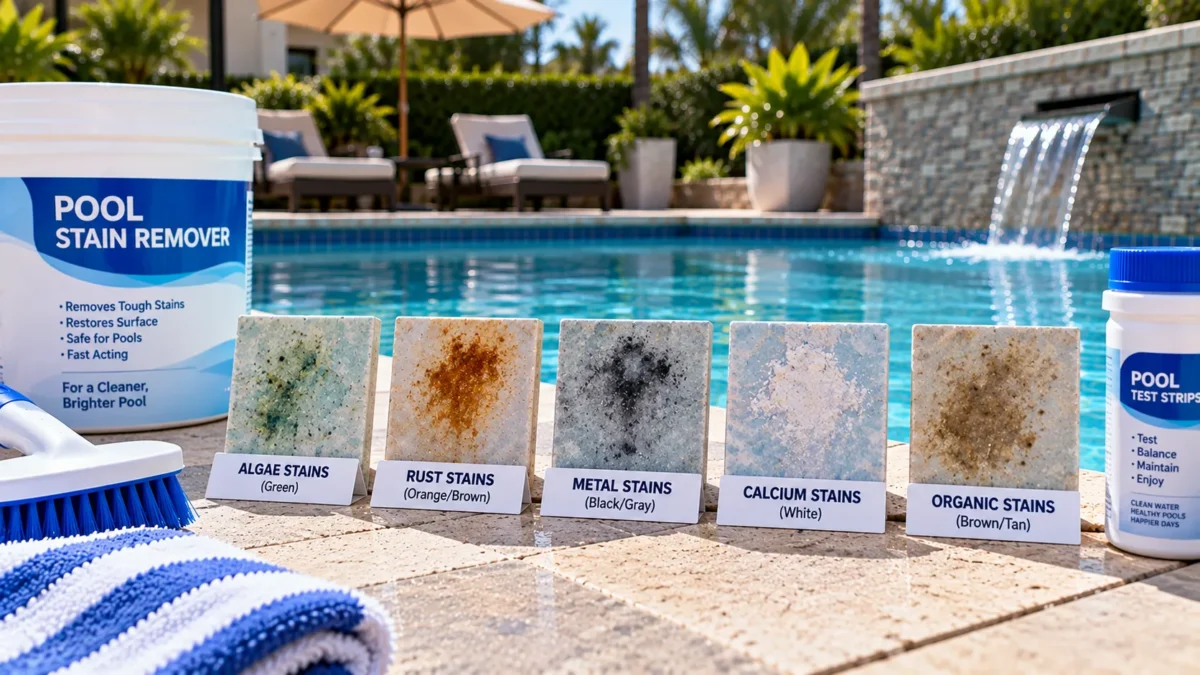
There are two kinds of pool stain and they need opposite treatments. Organic stains come off with chlorine. Metal stains get worse with chlorine and need ascorbic acid instead. Guessing wrong makes the stain permanent.
The colour is a clue but not proof. The reliable test is to treat a small patch and see what happens: hold a chlorine tablet against the stain for a minute, and separately rub a crushed vitamin C tablet on another part of it. Whichever lifts the colour tells you which type you have.
What causes it
- Organic: leaves, acorns, berries, worms and algae left sitting on the surface. Usually brown, green or reddish.
- Iron: well water, old steel pipework or a corroding fitting. Rusty brown or orange.
- Copper: a copper heat exchanger corroding in low-pH water, or copper-based algaecide. Blue-green or teal.
- Manganese: some well water supplies. Purple-black or brown.
- Scale with trapped dirt, which can look like a stain but is a deposit sitting on top of the surface.
What to test first
Before adding anything, take a reading. Guessing at this stage is how a small problem becomes an expensive one.
| Test this | Why it matters |
|---|---|
| The chlorine tablet test | Hold one on the stain for a minute. If it lightens, the stain is organic. |
| The vitamin C test | Rub a crushed tablet on the stain. If it lightens, the stain is metal. |
| Free chlorine and pH | Both matter for the treatment, and low pH is often what released the metal in the first place. |
| A metals test | If you suspect metal, test the water for iron and copper before treating. |
How to fix it
- Identify the type first with the two tests above. This step is not optional — the treatments conflict.
- For organic stains: brush the area, then shock the pool and hold chlorine at shock level. Most organic stains lift within a day.
- For metal stains: lower free chlorine to near zero and pH to about 7.2 first. Chlorine will lock a metal stain in permanently.
- Then add ascorbic acid (vitamin C) — broadcast it over the stained area with the pump running. The colour usually fades within an hour.
- Immediately add a metal sequestrant to hold the released metal in solution, or it will simply stain somewhere else as chlorine returns.
- Bring chlorine and pH back up slowly over the following days, keeping the sequestrant topped up.
- Find the source. A metal stain that returns means metal is still entering the water — well water, a corroding heater, or a copper algaecide.
Never treat a metal stain while chlorine is present. It sets the stain permanently. Ascorbic acid treatment leaves the pool with almost no sanitiser for several days — keep people out until chlorine is back in range. Never mix pool chemicals, and never add two products one after the other without circulating in between. Chlorine and acid together release chlorine gas. Always add chemical to water, never water to chemical.
Work out the numbers
These calculators give the figures for your pool rather than a rule of thumb.
Stopping it coming back
- Skim leaves and debris before they sit long enough to stain.
- Keep pH above 7.2 so metal fittings and heat exchangers do not corrode.
- Use a sequestrant if you fill from a well or live in a high-iron area.
- Avoid copper-based algaecides on a plaster pool.
Questions people ask
How do I tell what kind of stain it is?
Hold a chlorine tablet on it for a minute, and rub a crushed vitamin C tablet on another part. Chlorine lightens organic stains; vitamin C lightens metal stains. Whichever works identifies the type.
Will shocking remove my stain?
It removes organic stains. On a metal stain it does the opposite — chlorine oxidises the metal and sets the stain in for good.
Why did a stain appear after I shocked the pool?
There was metal dissolved in the water and the chlorine oxidised it out onto the surface. That points to iron or copper entering the pool from somewhere.
Do stains come back?
Metal stains do, unless the source is dealt with and a sequestrant is kept topped up. Organic stains stay away as long as chlorine is held in range and debris is removed.