
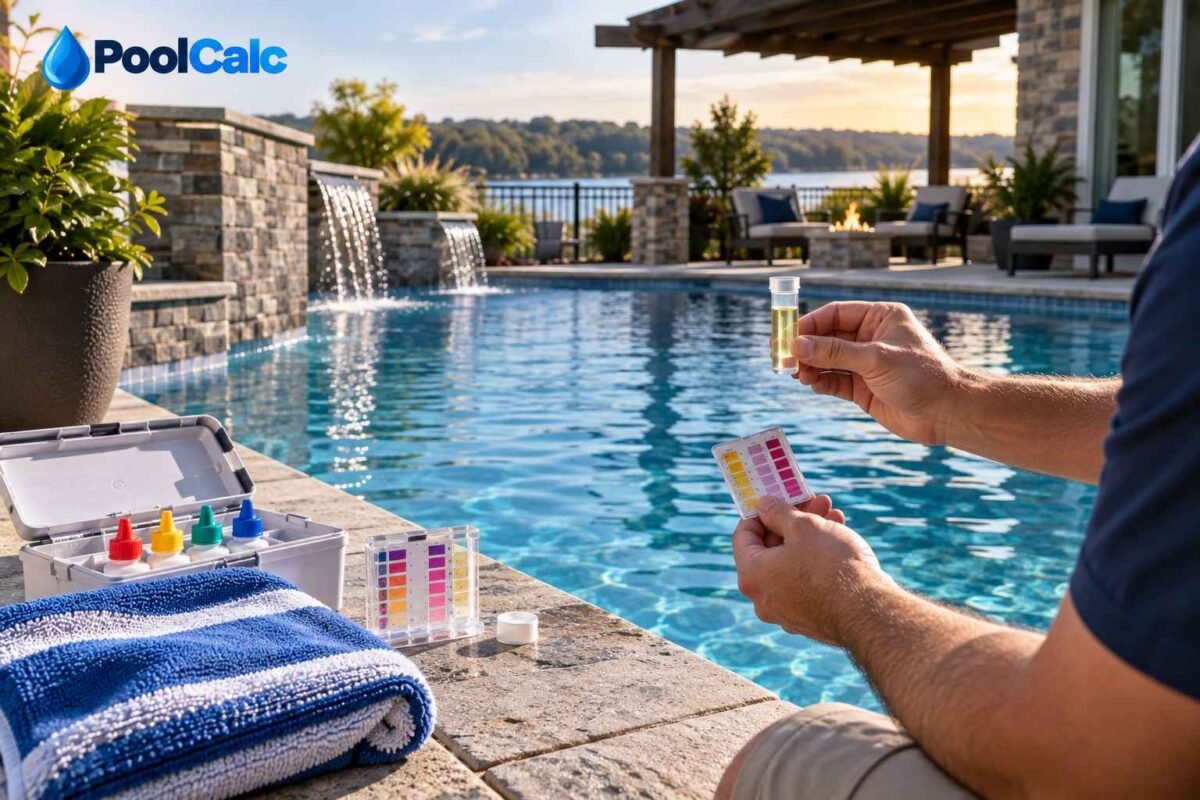
Calcium hardness is the reading that damages things. Chlorine and pH problems ruin a weekend. Calcium problems ruin a plaster surface, a heater core or a set of tile grout lines — and unlike almost everything else in pool care, they do not reverse.
What it measures, and why a pool needs any at all
Calcium hardness is simply the amount of dissolved calcium in the water. Unlike chlorine, it is not there to do anything for swimmers. It is there to protect the pool itself, which is why it is so easy to ignore and so expensive to get wrong.
Water is a solvent, and water short of calcium goes looking for it. In a plaster or concrete pool the nearest available source is the surface, and the water takes it. The finish etches, roughens, and eventually fails. Grout washes out from between tiles. Metal corrodes. This is why a plaster pool needs calcium in the water even though nobody is swimming in calcium.
The reverse is equally true. Water that holds more calcium than it can keep in solution deposits the excess as scale — on tile, on the waterline, inside pipes and, most expensively, inside a heat exchanger.
So calcium is a balance rather than a target to maximise, and the acceptable band is wider than most readings but the consequences at each end are worse.
Target ranges by surface
| Surface | Target | Why |
|---|---|---|
| Plaster, pebble, quartz | 250–400 ppm | The surface itself is a calcium compound, and soft water dissolves it |
| Concrete with tile | 250–400 ppm | Protects grout lines as well as the shell |
| Vinyl liner | 175–250 ppm | No calcium surface to protect, but equipment still benefits |
| Fiberglass | 175–250 ppm | As above |
| Any pool with a heater | Lower half of the range | Heat exchangers scale first and worst |
| Saltwater | Lower half of the range | Salt cells scale readily and lose output as they do |
The vinyl and fiberglass figures surprise people, because the usual advice is that these pools “do not need calcium”. They do — just less of it. There is no calcium surface to dissolve, but very soft water is still aggressive toward ladders, rails, light housings, heater components and pump seals. Running a vinyl pool at 50 ppm is not saving you anything.
The one-way problem
Calcium is easy to raise and effectively impossible to lower. Calcium chloride raises it in an afternoon. Nothing takes it back out except replacing water — reverse-osmosis services exist and do the job properly, but they are expensive and not available everywhere.
This asymmetry should change how you dose. Aim for the low end of your range and creep up across two or three additions, rather than aiming for the middle and overshooting. An overshoot is permanent until you drain.
It also means watching what else adds calcium without your noticing. Cal-hypo shock is the main one: at 73% strength it adds roughly 0.8 ppm of calcium hardness for every 1 ppm of chlorine it delivers. Shock a 20,000 gallon pool by 15 ppm with cal-hypo and you have added about 12 ppm of hardness. Do that eight or ten times over a summer and a pool that started the season at 300 ppm finishes it near 400.
Some clarifiers and flocculants are calcium-based as well, and hard fill water adds more every time you top up. None of it is dramatic on its own. All of it accumulates, and none of it leaves.
Too little: etching and corrosion
Below about 150 ppm the water is aggressive. The signs build slowly enough that most owners do not connect them to a chemistry reading at all:
- Plaster that feels rough or chalky underfoot where it used to be smooth
- Grout lines recessed below the face of the tile
- Small pits in the surface, usually appearing first on steps and the shallow floor
- Corrosion at metal fittings, ladder anchors, light rings and rails
- Heater failures — the heat exchanger is copper, and it goes first
- Water that looks fine but never quite stops needing “a bit more” of everything
Etching in particular is often blamed on age or on the original plaster job. Sometimes that is fair. More often the plaster was fine and the water spent several seasons dissolving it, a little at a time, while chlorine and pH were kept perfectly.
The cost of getting this wrong is not theoretical. Resurfacing a plaster pool is one of the largest single expenses in pool ownership, and the water chemistry that causes premature failure costs a few dollars a season to avoid.
Too much: scale
Above roughly 400 ppm — sooner if pH and alkalinity are also high — calcium comes out of solution and deposits.
- A white or grey crust at the waterline that will not brush off
- Rough deposits on tile, particularly on the sunny side of the pool
- Cloudy water that no amount of filtration clears, because the particles are forming continuously
- Reduced flow, and a heater that costs more to run each year
- A salt cell producing less chlorine than it used to, because the plates have scaled over
The waterline crust is the visible part and the part people try to fix. The expensive part is invisible: scale inside the heat exchanger insulates it, so the heater burns more fuel for the same temperature rise. That inefficiency does not announce itself; it just quietly raises the bill and shortens the unit’s life. Our calcium scaling guide covers removal — this article is about not getting there in the first place.
Why the number alone is not enough
Calcium does not act in isolation. Whether it deposits as scale or dissolves your plaster depends on five things together: calcium hardness, pH, total alkalinity, water temperature and total dissolved solids. The relationship is expressed as the saturation index, and it is why two pools with identical calcium readings can behave in completely opposite ways.
In practical terms:
- Warm water scales more readily than cold. A heated pool, or any pool in a hot climate through August, needs calcium nearer the bottom of its range.
- High pH pushes toward scaling. So does high alkalinity. A pool at 400 ppm calcium and pH 7.4 may be perfectly stable; the same pool at pH 8.0 will scale.
- Everything low pushes toward etching. Low calcium plus low pH plus low alkalinity is the most aggressive combination there is, and it is what a pool looks like after a season of trichlor tablets and no attention.
- Total dissolved solids rise over time in every pool, and faster in salt pools. High TDS shifts the balance slightly toward scaling.
This is the practical reason to keep pH genuinely in range rather than “close enough”. Of the five factors, pH moves fastest and furthest, so it is the one that tips an otherwise balanced pool into scaling or etching. Getting pH right is most of getting calcium right.
Testing, and how often
Calcium moves slowly, so it does not need frequent testing. Monthly is ample for an established pool, plus a test after any significant water replacement, and one test of your fill water so you know what you are starting from.
That fill-water test is the one worth doing today if you have never done it. If your supply arrives at 400 ppm, you will exceed your target simply by topping up through a hot summer, and no amount of careful dosing changes that. Knowing the number turns an unexplained annual problem into a planned partial drain.
Test strips are poor at calcium specifically. The colour blocks sit close together and the reading is easy to misjudge by 50 ppm or more, which is a meaningful error on a reading with this much consequence. A drop-based titration kit is far more reliable. When choosing equipment or chemicals, certification to NSF standards is a reasonable filter; NSF International publishes the listings of what has actually been certified.
Raising it correctly
- Test, and work out the dose from your real volume rather than the number on the box the pool came in. If you are not sure, measure it — the volume calculator handles irregular shapes.
- Dissolve calcium chloride in a bucket of water first. Chemical into water, never water into chemical. It generates real heat — enough to be uncomfortable to hold.
- Add it slowly with the pump running, poured around the perimeter rather than in one place.
- Wait a full turnover, then re-test. Water added to a bucket takes hours to distribute through 20,000 gallons.
- Creep up on the target across two or three doses rather than aiming for it in one. There is no penalty for taking three days and a permanent penalty for overshooting.
Expect the water to go temporarily cloudy after a large calcium addition. That is normal and it clears within a day with the filter running. Cloudiness that persists past that is a different problem — see cloudy water.
What to do when it is already too high
Replacing water is the answer, and the arithmetic is simple: replacing a third of the water with fill water at half the concentration brings the reading down by roughly a sixth. It is worth calculating before you start, because on very hard fill water a partial drain achieves much less than people expect.
Two things make the interim manageable while you plan a drain. Keep pH at the lower end of range — around 7.2 to 7.4 — because that is the single largest lever on whether high calcium actually deposits. And keep alkalinity toward 80 rather than 120, for the same reason.
A sequestrant will also hold calcium in solution temporarily. It does not remove anything and it needs re-dosing, but it buys time until a drain is practical — which in many regions means waiting for a season when water is neither scarce nor expensive. The EPA’s WaterSense programme is a reasonable starting point if you want to think about the water cost of pool ownership more broadly.
Reading the saturation index without the arithmetic
Formal water balance uses the Langelier Saturation Index, which combines calcium, pH, alkalinity, temperature and dissolved solids into a single figure. Zero means balanced; negative means the water will dissolve calcium from surfaces; positive means it will deposit it.
Most owners never calculate it, and for day-to-day purposes they do not need to. What is worth carrying instead is the direction each factor pushes, because that lets you reason about a problem without a spreadsheet.
Raising any of calcium, pH, alkalinity or temperature pushes toward scaling. Lowering any of them pushes toward etching. That is the whole of it, and it means a pool that is scaling has four possible levers rather than one — and the fastest-moving of them, by a wide margin, is pH.
So the practical response to scale is rarely “lower the calcium”, which is difficult and slow. It is “lower the pH and the alkalinity”, which is straightforward and takes a day. The calcium reading may be perfectly acceptable; it is the company it is keeping that causes the deposit.
The same logic applies in reverse to etching. A pool with 180 ppm calcium is not necessarily aggressive. A pool with 180 ppm calcium, pH 7.0 and alkalinity 50 certainly is, and raising alkalinity will do more, faster, than adding calcium chloride.
What a scaled heat exchanger actually costs
Scale inside a heater is the most expensive consequence of poor calcium management, and the one nobody sees.
A heat exchanger transfers heat from a flame or a refrigerant into water through a thin metal wall. Scale on that wall is an insulator. The heater compensates by running longer, burning more fuel to reach the same temperature, and running hotter internally while it does so.
Two things follow. The running cost rises, quietly, by a percentage that grows each season. And the unit itself is stressed: higher internal temperatures shorten the life of the exchanger, which is the component that determines whether a heater is worth repairing when it fails.
A heater that fails at six years old rather than twelve has usually been telling you something about the water for years. Keeping calcium in the lower half of its range on a heated pool, and keeping pH genuinely in range rather than approximately in range, is what prevents it. See choosing a pool heater for the wider picture.
Calculators
Work out your own numbers
Water Health Check
Enter your test results and see what is in range, what is not, and what to do first.
CalculateHow do I lower calcium hardness?
By replacing water. Drain part of the pool and refill with water lower in calcium than what is in there now. Reverse-osmosis services can do it without draining but they are costly and not available in every area. No chemical removes calcium from pool water.
Does a vinyl pool need calcium at all?
Less than a plaster pool, but not none. There is no calcium surface to protect, but very soft water is still corrosive to metal fittings, ladders, heater cores and pump components. 175 to 250 ppm is a sensible range.
Why is my water cloudy even though chlorine is fine?
High calcium combined with high pH is a common cause: calcium coming out of solution shows as a haze too fine for the filter to catch. Check calcium, pH and alkalinity together before reaching for a clarifier, because a clarifier treats the symptom.
Does a saltwater pool need different calcium levels?
The targets are the same, but salt cells scale readily, so the lower half of the range is safer. A cell producing less chlorine than it used to is usually scaled rather than worn out, and cleaning it is far cheaper than replacing it.
Can hard fill water be a problem?
Yes, and it is common in much of the US. If your supply arrives at 400 ppm you will exceed target simply by topping up. Test your fill water once; if it is very hard, plan for periodic partial drains as routine maintenance rather than treating them as a failure.
Is calcium hardness dangerous to swimmers?
No. At pool concentrations it has no health effect at all. Very hard water can feel different and may leave a film on skin, but the reason to control it is the pool and the equipment, not the people in it.
How much does cal-hypo shock raise my calcium?
At 73% strength, roughly 0.8 ppm of calcium hardness for every 1 ppm of free chlorine it adds. Over a season of regular shocking that can be 50 to 100 ppm, which is enough to matter if you started near the top of the range.
My calcium is fine but I still have scale. Why?
Almost always pH and alkalinity. Calcium at 300 ppm will scale happily if pH sits at 8.0 and alkalinity at 150. Bring both down and the scaling usually stops without touching the calcium reading at all.