
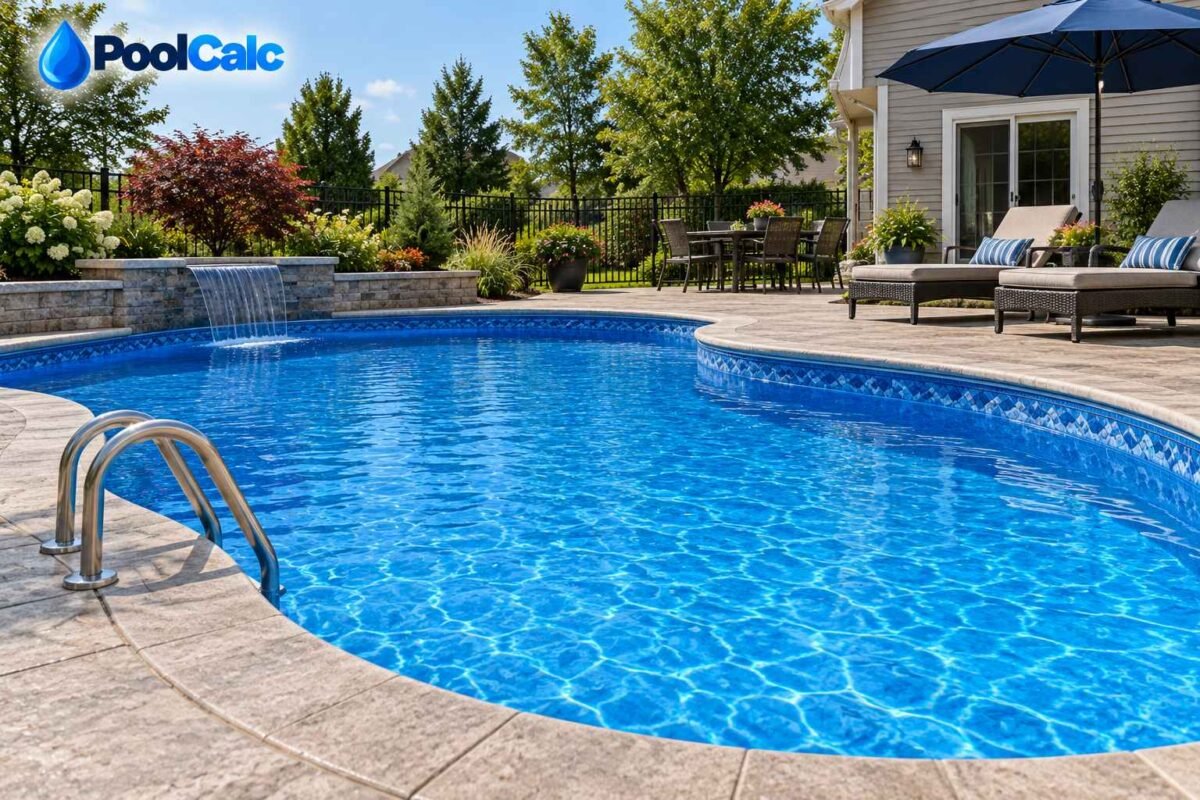
A vinyl liner pool has a supporting wall and floor with a flexible vinyl sheet fitted inside it, holding the water. It is the least expensive in-ground pool to build, and the liner is replaced on a cycle rather than lasting the life of the pool.
The liner is the whole design. It is smooth and comfortable, it comes in dozens of patterns, and it is completely non-porous — which means low chlorine demand and no calcium being leached out of the surface.
It is also the vulnerability. A dog’s claws, a dropped tool, or a sharp toy can put a hole in it, and long-term exposure to sun and out-of-range chemistry shortens its life.
At a glance
| Characteristic | Typical |
|---|---|
| Construction | Steel, polymer or concrete wall with a vinyl liner |
| Surface | Smooth, non-porous vinyl in a printed pattern |
| Liner life | Typically around a decade, depending on sun and chemistry |
| Installation | Weeks — faster than concrete, slower than fibreglass |
| Shapes | Rectangular and standard shapes; custom liners are possible |
Advantages and limitations
What works well
- The lowest up-front cost of any in-ground pool.
- Smooth and comfortable — no rough plaster underfoot.
- Non-porous, so chlorine demand is low and algae struggles to take hold.
- A liner change is also a redecoration: new pattern, new-looking pool.
- No resurfacing cycle and no etching to worry about.
What to weigh up
- The liner is a consumable and will need replacing.
- Punctures and tears happen, though small ones are patchable.
- Sunlight, high chlorine and out-of-range pH all shorten liner life.
- Fewer shape options than concrete.
- Draining the pool without professional advice can let the liner shrink or float.
Looking after one
- Keep free chlorine in range but not persistently high — sustained high chlorine bleaches and brittles vinyl.
- Hold pH at 7.4 to 7.6. Low pH is hard on liners and on metal wall panels.
- Calcium hardness of 150 to 250 ppm is enough; there is no plaster to protect.
- Use a soft brush only. Stainless or stiff brushes will damage the liner.
- Check the liner monthly for wrinkles, stretching and small tears — early ones are cheap to patch.
What it costs to own
Installation is the least expensive of the in-ground options, which is why vinyl liner pools are common where budget is the deciding factor.
The running costs are low — non-porous surface, modest chemical demand — but the liner replacement is a real, recurring expense that has to be planned for. Treating it as an annual set-aside rather than a surprise every decade is the sensible approach.
Prices for pools vary enormously by region, access, ground conditions and specification, so no figure is quoted here. The Ownership Cost Calculator uses your own numbers instead of an average that would be wrong for most people.
Calculators for this pool
Questions people ask
How long does a pool liner last?
Around a decade is typical, with strong sun, high chlorine and out-of-range pH all shortening it. Balanced water is the main thing within your control.
Can a liner be repaired?
Small tears and punctures patch well, including underwater. A liner that has hardened with age, or shrunk after being drained, generally needs replacing.
Can I drain a vinyl pool?
Not without advice. An older liner can shrink once dry and no longer fit, and groundwater can float it away from the walls. This is one of the most common expensive mistakes with vinyl pools.
Does high chlorine damage the liner?
Sustained high chlorine does — it bleaches the pattern and makes the vinyl brittle at the water line. A short spike after shocking is fine; weeks at 10 ppm is not.