
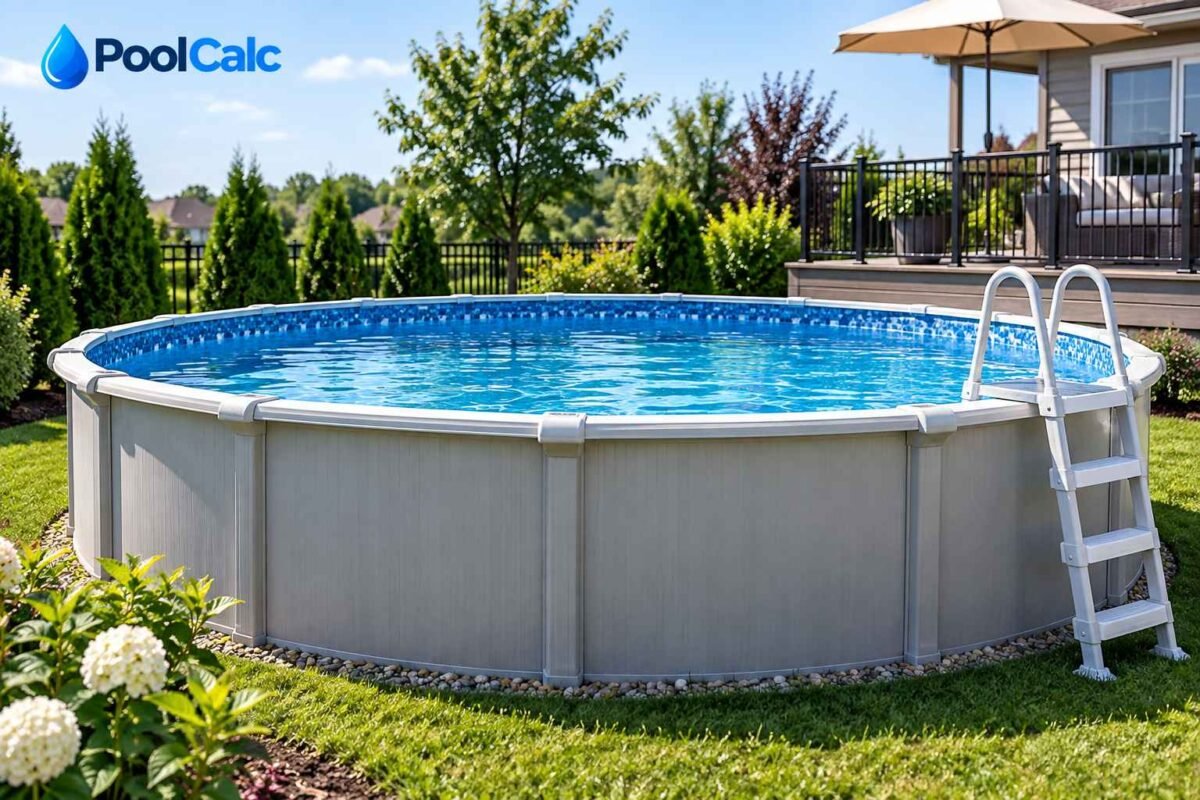
An above-ground pool sits on the ground inside a supporting wall, usually steel or resin, with a vinyl liner holding the water. It costs a fraction of an in-ground pool, goes up in days, and can be taken away again.
The water chemistry is identical to any other pool — chlorine, pH and alkalinity behave the same way in 15,000 gallons whether the walls are steel or concrete. What differs is the equipment, which is usually smaller, and the fact that the structure itself is a consumable.
Most above-ground pools are round or oval and a uniform depth, which makes volume easy to calculate accurately — one advantage over a sloping in-ground pool.
At a glance
| Characteristic | Typical |
|---|---|
| Construction | Steel, aluminium or resin wall with a vinyl liner |
| Typical size | 15 to 30 ft round, or oval |
| Typical depth | 48 to 54 inches, uniform |
| Installation | Days, often without heavy machinery |
| Liner life | Usually under a decade, sooner in harsh sun |
Advantages and limitations
What works well
- A fraction of the cost of an in-ground pool.
- Installed in days rather than months.
- Can be dismantled and taken with you, or removed if you change your mind.
- Often needs no planning permission, though fencing rules usually still apply.
- Uniform depth makes volume — and therefore every chemical dose — easy to get right.
What to weigh up
- Shorter life than an in-ground pool; the wall and liner are both consumables.
- Usually too shallow for diving, and no deep end.
- The liner can be punctured, and a failed wall empties the pool quickly.
- Less forgiving of an uneven base — the ground underneath has to be genuinely level.
- Sunlight degrades the wall and liner over time.
Looking after one
- Same chemistry as any pool: chlorine and pH twice weekly, alkalinity and calcium monthly.
- Check the liner for wrinkles, stretching and small tears each month.
- Watch the base and supports for settling or rust, particularly after heavy rain.
- Keep calcium hardness in range — low calcium is not a liner problem but does attack metal parts.
- In freezing climates, follow the manufacturer’s winterising instructions exactly; many walls fail in winter, not summer.
What it costs to own
The pool itself is the cheapest way into pool ownership by a wide margin, and a simple kit can be installed without a contractor. Budget separately for the base preparation, which matters more than people expect, and for fencing if your local rules require it.
Running costs are lower simply because the pools are smaller — less water to heat, fewer chemicals, a smaller pump. The cost that catches people out is replacement: the liner and eventually the wall are consumables, not permanent structures.
Prices for pools vary enormously by region, access, ground conditions and specification, so no figure is quoted here. The Ownership Cost Calculator uses your own numbers instead of an average that would be wrong for most people.
Calculators for this pool
Questions people ask
How many gallons is an above-ground pool?
A 24 ft round pool at 4 ft deep holds roughly 13,500 gallons; a 15 ft round holds around 5,300. The Pool Volume Calculator gives the figure for your exact size, which matters because every chemical dose depends on it.
How long do above-ground pools last?
The liner typically lasts several years and the wall longer, with strong sunlight and hard winters both shortening the life considerably. Good winterising makes a real difference.
Do they need the same chemicals?
Yes — identical chemistry, just less of everything because there is less water. The only meaningful difference is that there is no plaster, so calcium hardness is less critical.
Can I leave it up over winter?
In mild climates, yes, with a winter cover and the plumbing drained. In hard-freeze regions, follow the manufacturer’s instructions — ice is what destroys above-ground pools.