
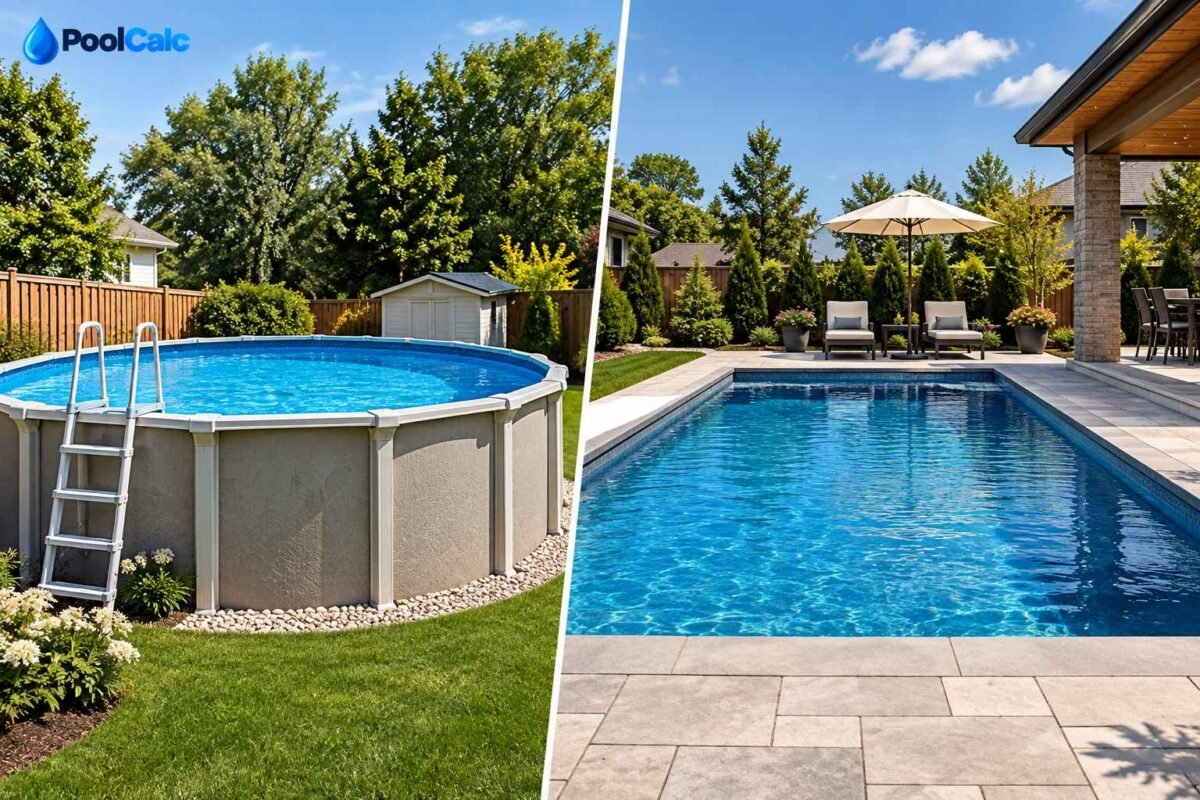
The gap between an above-ground pool and an in-ground one is far wider than the hole in the garden. They differ in cost by a factor of ten, in lifespan by a factor of five, and in what they do to the value of a house — and the right answer depends on questions most buyers are not asked.
What actually separates them
An above-ground pool sits on the surface. Its walls are steel, resin or aluminium panels holding a vinyl liner, supported by the water inside and by the frame around it. It is delivered, assembled, filled, and — importantly — can be taken away again.
An in-ground pool is excavated and built into the ground, in concrete, fiberglass or a vinyl-lined steel or polymer wall. It is a permanent structure, it becomes part of the property, and removing it is a construction project in its own right.
Everything else — cost, lifespan, resale, maintenance, what it feels like to swim in — follows from that single structural difference.
Cost, honestly
This is the reason most people are reading, so it is worth being specific about the shape even though exact figures vary enormously by region and by year.
An above-ground pool is an order of magnitude cheaper to buy and install. A basic kit with a pump and filter is within reach of most households as a discretionary purchase. Add professional levelling and assembly, a deck and a fence and the figure rises, but it remains in a completely different category from excavation.
An in-ground pool involves excavation, structure, plumbing, electrical work, decking, fencing and permits. It is a significant home construction project, and the final cost is influenced heavily by site access, soil conditions and what the local authority requires.
What that comparison hides is running cost, which is far closer than the purchase prices suggest. Both need the same chemistry, the same filtration and the same attention. A 15,000 gallon above-ground pool costs roughly what a 15,000 gallon in-ground pool costs to sanitise and pump, because the water does not know what is holding it. Our guide to what it costs to run a pool applies equally to both.
Above-ground pools do tend to be smaller, and smaller means cheaper to run — but that is a volume effect, not a type effect.
Lifespan, and what “lifespan” means
An above-ground pool typically lasts somewhere between seven and fifteen years, with the liner replaced every six to ten within that. The wall is usually what ends it: steel corrodes, particularly at the base where it meets damp ground, and once the wall goes the pool is finished.
An in-ground pool lasts decades, but it is not maintenance-free. A plaster surface needs resurfacing roughly every ten to fifteen years, a vinyl liner every seven to twelve, and equipment on its own cycle regardless. Fiberglass shells last longest with the least intervention.
The way to compare them fairly is annual cost of ownership rather than purchase price: total spend over the life of the pool, divided by the years you get from it. On that basis the two are closer than the headline numbers suggest, though in-ground still costs more per year for most households.
What each does to your house
An in-ground pool is a permanent alteration to the property, and its effect on value depends on where you are. In warm regions where a pool is expected, a well-maintained one is generally an asset. In cooler regions, or on a small lot where the pool consumes the entire yard, buyers frequently see it as a liability — an ongoing cost and a safety concern rather than a feature.
An above-ground pool almost never adds value, and is not usually treated as part of the property at all. What it does instead is leave no trace: it can be dismantled and removed in a weekend, which is a genuine advantage if you might move, or if you are not certain the household will use it.
That reversibility deserves more weight than it usually gets. A substantial number of in-ground pools are used far less after the first two summers than their owners expected, and there is no undo. An above-ground pool that turns out to be unwanted is a problem that solves itself.
Installation and time
An above-ground pool goes up in a day or two. The critical part is the base: it must be genuinely level, and level means level to within an inch across the whole footprint. A pool set on an uneven base puts uneven pressure on the wall, which is the most common cause of premature failure and, occasionally, of sudden collapse.
Do not skip proper ground preparation to save a weekend. Removing turf, levelling, compacting and laying a sand or foam base is what determines whether the pool lasts ten years or three.
An in-ground pool takes weeks to months. Permits, excavation, structure, cure time, plumbing, electrical, decking and inspection all take their turn, and weather delays each of them. Most owners describe the process as longer and messier than they were told.
Swimming in them
Above-ground pools are almost always a uniform depth, typically 48 to 54 inches. That is fine for cooling off, for children and for standing around, and it is useless for diving. It also means the whole pool is shallow, which in a hot climate is why above-ground water heats up quickly and, in a cool climate, why it cools quickly too.
In-ground pools can have a shallow end and a deep end, which allows diving, proper swimming and a lap pool layout. They can also be any shape, which matters more for a garden than people expect, and they accommodate steps, benches, tanning ledges and spa integration.
Getting in and out is a real difference too. An above-ground pool requires a ladder, which is awkward for older swimmers and for anyone with limited mobility. Steps into an in-ground pool are simply easier.
Maintenance: more similar than different
The chemistry is identical. Free chlorine, pH, alkalinity, stabiliser and calcium behave the same way in both, and the routine in our maintenance guide applies unchanged.
Three practical differences are worth knowing.
Calcium. Above-ground pools are vinyl-lined, so there is no plaster to protect and the target range is lower — 175 to 250 ppm rather than 250 to 400. Very soft water is still corrosive to fittings, so “none” is not the answer. See calcium hardness.
Granular chemicals. Undissolved shock sitting on a vinyl liner bleaches it permanently, in the shape of the pile. Pre-dissolve everything, always.
Equipment. Above-ground pumps and filters are usually smaller and less capable, so filtration takes longer and the filter needs cleaning more often. Turnover still matters just as much — see how long to run a pool pump.
Safety differs in one important way
The wall of an above-ground pool is itself a barrier, which is a genuine safety advantage — but only if the ladder is removed or locked when the pool is not in use. A ladder left in place turns the barrier into a staircase.
An in-ground pool has no such wall and relies entirely on fencing. The recommendation from the CPSC is a four-sided isolation fence separating the pool from the house, with a self-closing, self-latching gate — because most young children who drown in home pools reach them from inside the house during a brief gap in supervision. The Pool Safely campaign covers the full set of layers, and our pool safety guide goes through them.
Local code often treats the two types differently, and above-ground pools above a certain height may be exempt from some fencing requirements. Exempt from code is not the same as safe, and the ladder rule still applies.
Choosing between them
Five questions settle it for most households.
- How long will you be in this house? Under five years argues strongly for above-ground, because an in-ground pool will not repay its cost in that time and may not help the sale.
- How certain are you the pool will be used? If it is an experiment, make it a reversible one.
- What is your climate? A long warm season makes an in-ground pool far easier to justify. A ten-week northern summer makes it an expensive ten weeks.
- Do you want to swim, or to cool off? Lengths and diving need depth. Cooling off does not.
- What can you genuinely afford, including running costs? The purchase is once; the chemicals, electricity and eventual resurfacing are every year.
There is a middle option worth knowing about: a semi-inground pool, set partly into a slope. It costs more than above-ground and much less than in-ground, and on a sloping site where a fully above-ground pool would look awkward it can be the sensible answer.
The three in-ground constructions, briefly
If you have decided on in-ground, the next decision is what it is made of, and the three options differ more than the brochures suggest.
Concrete or gunite can be any shape and any depth, which is its entire advantage. It is the most expensive to build and the most expensive to maintain: the plaster surface needs resurfacing every ten to fifteen years, and that is a significant recurring cost. The surface is also porous enough to give algae somewhere to hold on, so concrete pools need more brushing than the alternatives.
Fiberglass arrives as a single moulded shell and is installed in days rather than weeks. The surface is smooth and non-porous, which means less algae, less brushing and lower chemical use over time. The constraints are that you choose from available moulds rather than designing freely, and the shell has to be transported to the site — which rules it out where access is tight.
Vinyl liner is the cheapest in-ground option to build. The liner is soft underfoot and non-porous, but it needs replacing every seven to twelve years, and that recurring cost should be in the comparison from the start rather than discovered at year eight. Liners are also vulnerable to sharp objects and to undissolved chemicals.
Over twenty years the total costs converge more than the purchase prices suggest, because each type has a different recurring cost built into it. Fiberglass usually comes out lowest on maintenance; concrete highest on flexibility.
Questions to ask before signing anything
Whichever direction you choose, these separate a straightforward project from an expensive one.
- What does the quote exclude? Decking, fencing, electrical, gas line, landscaping restoration and permits are frequently outside the headline figure.
- Who pulls the permits, and what does local code require? Fencing requirements in particular vary and are not optional.
- What is the site access like? A pool that needs equipment through a narrow side gate costs more, and a fiberglass shell may not fit at all.
- What is the water table? High groundwater affects construction, and it affects whether the pool can ever safely be drained.
- What is the warranty on the structure, separately from the equipment? They are usually different lengths from different parties.
- What will it cost to run? Ask for the pump specification and work it out yourself with the ownership cost calculator rather than accepting a figure.
That last one is worth insisting on. Running costs are rarely part of a sales conversation, and they are the number you live with every month for twenty years.
Calculators
Work out the numbers for either
Is an above-ground pool much cheaper to run?
Not per gallon — the chemistry and pumping costs are the same for the same volume. Above-ground pools tend to be smaller, so the total is lower, but that is a size effect rather than a type effect.
How long does an above-ground pool last?
Typically seven to fifteen years, with the liner replaced every six to ten within that. The steel wall usually ends it, corroding first at the base where it meets damp ground.
Does a pool add value to a house?
An in-ground pool may, in warm regions where buyers expect one and the pool is well maintained. In cooler regions or on a small lot it is often seen as a cost and a safety concern. An above-ground pool almost never adds value, but it also leaves no trace when removed.
Can I put an above-ground pool on a slope?
Not without levelling the site properly first. An unlevel base puts uneven pressure on the wall, which is the most common cause of premature failure and occasionally of collapse. On a real slope, a semi-inground installation is the better answer.
Do above-ground pools need a fence?
Requirements vary by locality, and pools above a certain height are sometimes exempt. Whatever the code says, remove or lock the ladder when the pool is not in use — otherwise the wall that serves as a barrier is simply a staircase.
Is the chemistry different in an above-ground pool?
The same, with one adjustment: calcium hardness targets are lower because there is no plaster to protect, typically 175 to 250 ppm. And always pre-dissolve granular chemicals, because undissolved shock will bleach a vinyl liner permanently.
Can you heat an above-ground pool?
Yes, with the same three options — gas, heat pump or solar. Because they are shallow they heat quickly, and because they are shallow they also lose heat quickly, so a cover matters even more than usual.
What is a semi-inground pool?
A pool set partly into the ground, often into a slope. It costs more than above-ground and considerably less than fully in-ground, and it suits sloping sites where a surface-mounted pool would look and sit awkwardly.