
Drowning is the leading cause of death from unintentional injury for children aged one to four in the United States. It is also almost entirely preventable, and the measures that prevent it are well established, inexpensive, and routinely half-implemented.
Why drowning does not look like drowning
The most important thing most adults do not know is what drowning actually looks like, because films have taught everybody the wrong thing.
A drowning person almost never shouts, waves or splashes. The respiratory system is being used for breathing, which means there is no air available for calling out. The arms press downward instinctively to lever the mouth above the surface, which means they cannot be raised. The body stays upright with no kicking. It is silent, it is nearly motionless, and it lasts perhaps twenty to sixty seconds before submersion.
This is why children drown at busy pools with adults nearby. There is no noise to alert anybody, and a quiet child in water simply does not register as an emergency against a background of noisy children who are fine.
The practical consequence: supervision means watching, not being present. A supervising adult who is reading, looking at a phone, or holding a conversation is not supervising. The gap between “an adult was there” and “an adult was watching” is where most incidents happen.
Layers of protection
The framework the CPSC and the CDC both use is layers: several independent measures, each of which can fail, arranged so that a failure in one is caught by another. No single layer is sufficient, and the fact that no layer is sufficient is the whole point.
The Pool Safely campaign run by the US Consumer Product Safety Commission is the authoritative source, and its guidance for parents sets out the layers in detail. What follows is how they apply to a private residential pool.
Layer one: the barrier
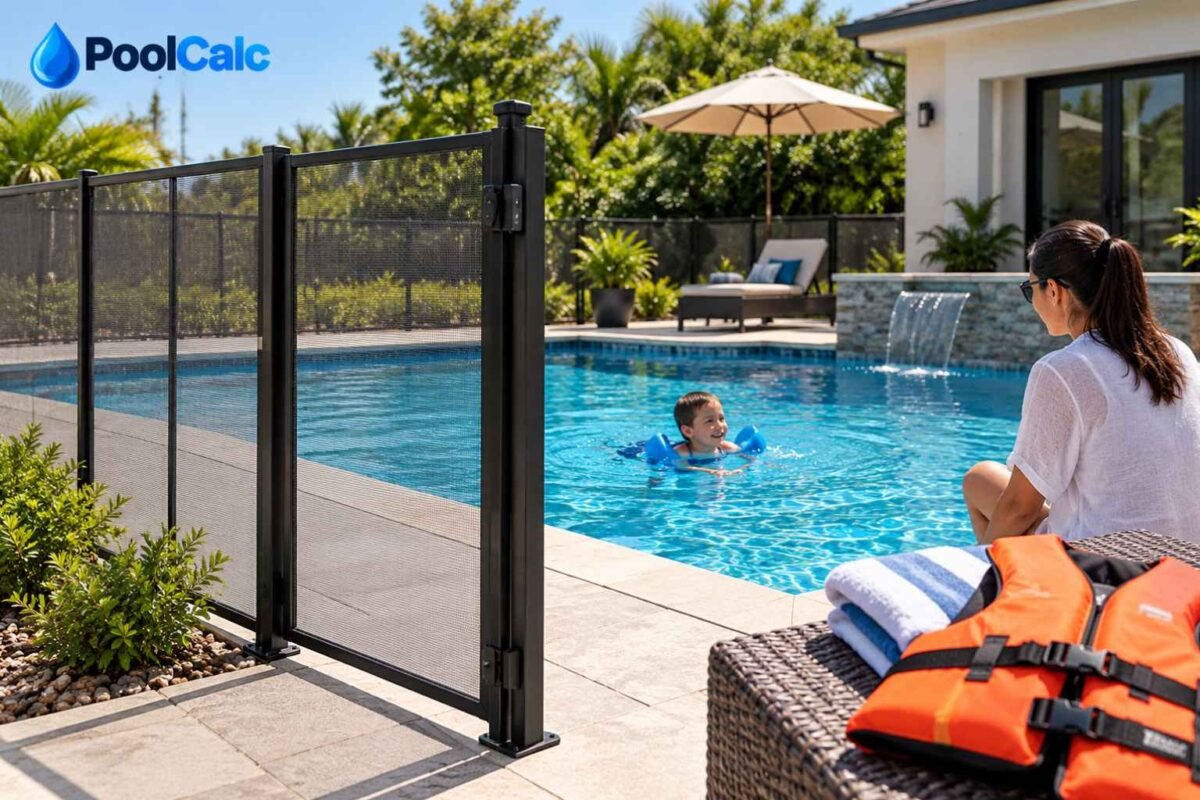
A fence is the single most effective measure, and the research on this is consistent and long-standing. Specifically, it should be a four-sided isolation fence that separates the pool from the house, not a three-sided fence that uses the house as the fourth wall.
The distinction matters enormously. Most young children who drown in home pools get there from inside the house, during a gap in supervision measured in minutes. A fence that leaves the house side open does not address the route that is actually used.
What a barrier needs:
- At least 4 feet high, and higher is better
- No gaps a small child can squeeze through, and no horizontal rails on the outside that work as a ladder
- A self-closing, self-latching gate that opens away from the pool
- A latch placed high — out of a small child’s reach from either side
- Nothing climbable next to it: no chairs, planters, coolers, bins or toys
Local code will specify the exact requirements, and they vary by state and municipality. Code is a minimum rather than a target.
The failure mode to watch for is the gate. A self-closing gate that has been propped open, or whose spring has weakened so it no longer latches every time, is the most common way a barrier stops being a barrier. Test it every few weeks by letting it go from fully open and checking it latches on its own.
Layer two: supervision
When children are in the water, one adult should have the explicit job of watching them, with nothing else to do. The common recommendation is to name that person out loud and hand the role over deliberately when swapping.
That sounds excessive until you consider the alternative, which is diffusion of responsibility: four adults present, each assuming one of the others is watching, and nobody actually watching. This is an extremely well-documented pattern and it is how incidents happen at gatherings rather than when a child is alone.
For children who cannot swim confidently, supervision means within arm’s reach — close enough to touch. Not poolside. Not on the steps. Within reach.
Layer three: swimming ability
Formal swimming lessons reduce drowning risk in young children, and the evidence for this is good. They do not eliminate it, and a child who has had lessons still requires every other layer — lessons are a layer, not a replacement for the fence.
Adults are worth mentioning here too. A meaningful proportion of US adults cannot swim well, and an adult who cannot swim competently cannot perform a rescue. If the supervising adult is not a confident swimmer, that is worth knowing in advance rather than discovering in an emergency.
Layer four: knowing what to do
CPR performed immediately, before emergency services arrive, substantially improves outcomes in drowning. The minutes before help arrives are the ones that matter most, and they are the minutes in which only the people present can act.
Anyone who supervises at a pool should know CPR, and it should be refreshed rather than remembered from a course a decade ago. Keep a phone at the poolside — not for entertainment, but so that calling for help does not require leaving the water’s edge.
Keep rescue equipment where it can be reached without thinking: a reaching pole and a ring buoy, mounted, not stored in a shed.
Drains and entrapment
A hazard specific to pools and spas, and the reason for a federal law.
A suction outlet with a missing or broken cover can produce enough force to hold a person underwater, and the suction is powerful enough that it cannot simply be pulled away from. Several deaths and serious injuries led to the Virginia Graeme Baker Pool and Spa Safety Act, which mandates compliant drain covers and, in many configurations, a secondary safety system.
For a home pool, the practical checks are simple. Every drain cover should be present, unbroken and properly secured. A cracked or missing cover means the pool does not get used until it is fixed — this is not a repair to postpone. If your pool has a single main drain, an anti-entrapment system is worth discussing with a professional.
Chemical safety
The chemicals that keep the water safe are the most hazardous substances most households store, and pool chemical injuries send thousands of Americans to emergency rooms each year — the majority of them at home rather than at public pools.
The two rules that prevent nearly all of them: never mix chlorine with acid, in any form or container, because the combination releases chlorine gas immediately. And never mix two different chlorine products, because calcium hypochlorite combined with trichlor is a genuine fire hazard rather than a theoretical one.
Our guide to handling pool chemicals safely covers storage, dosing and what to do if something has already been mixed.
Water quality is a safety issue too
Less dramatic than drowning, and easier to ignore, but a pool that is not properly sanitised makes people ill.
Free chlorine at proper levels kills most of the germs responsible for recreational water illness within minutes. Some — cryptosporidium in particular — are far more resistant and survive routine chlorination for days, which is why a diarrhoeal incident has its own procedure rather than being treated as an ordinary contamination.
The practical safety measures are ordinary maintenance: hold free chlorine at the level your stabiliser reading demands, keep pH in range so the chlorine actually works, and test rather than assume. Our guide to what chlorine kills and what it does not covers the detail, and the CDC’s healthy swimming pages are the reference.
One point worth repeating: clear water and safe water are different things. A pool can be perfectly transparent and carry no free chlorine at all.
Covers, alarms and the things that help at the margin
A safety cover is a genuine barrier when it is a rated, anchored safety cover. A solar cover or a winter tarpaulin is not, and can be a hazard in its own right because it looks solid and is not. See pool covers for the distinction.
Door alarms on the house doors leading to the yard address the exact route most young children take, and they are inexpensive. Gate alarms and surface wave alarms add another layer. None of these replaces the fence; all of them make a gap in the fence less likely to be fatal.
Removing ladders from an above-ground pool when it is not in use is the equivalent measure for that type, and it is effective precisely because it removes the only route in.
A seasonal safety check
Worth running at opening, and again halfway through the season.
- Gate self-closes and self-latches from fully open, every time
- Fence has no gaps, no climbable items against it, nothing stacked nearby
- All drain covers present, intact and secured
- Rescue pole and ring buoy in place and reachable
- CPR knowledge current for everyone who supervises
- Chemicals stored separately, locked, in original containers
- Pool lights and any electrical equipment working, with the GFCI tested
- Door alarms on house doors working, batteries fresh
- Rules agreed and stated to anyone using the pool
Rules worth stating out loud
Household pool rules work better when they are said rather than assumed, and better still when they are said to every visitor rather than only to children who live there.
- Nobody swims alone. This applies to competent adult swimmers as much as to children; medical events do not check swimming ability first.
- No running on the deck. Wet concrete and tile are genuinely slippery, and head injuries at poolsides are common.
- No diving unless the pool is designed and marked for it. Shallow-water diving injuries are catastrophic and permanent.
- No breath-holding competitions. Hyperventilating before a breath-hold can cause blackout underwater without warning, and it has killed strong swimmers.
- Nobody in the water while chemicals are being added.
- Stay out during thunderstorms, and out of the water for thirty minutes after the last thunder.
- Long hair tied back near any suction outlet.
The breath-holding rule is the one most people have never heard. Hyperventilation lowers carbon dioxide, which is what triggers the urge to breathe, so a swimmer can stay under past the point where oxygen runs low without ever feeling the need to surface. It is not a children’s problem specifically; it has killed trained adults.
Electrical safety around water
Less discussed than drowning and worth its own attention, because the failure mode is not obvious and the consequence is severe.
Electric shock drowning happens when faulty wiring energises the water. A swimmer may be paralysed by the current and drown without anybody recognising what has happened. It is rare in private pools and considerably less rare around docks and boat lifts, but the preventive measures are the same.
What matters: the pool structure, ladders, rails and surrounding metalwork should be properly bonded, so there is no voltage difference between them. Pump and lighting circuits should be on GFCI protection, and the GFCI should be tested — pressing the test button monthly takes seconds and is the only way to know it still works.
Pool lights deserve particular care. A cracked lens or a failing seal lets water into a fitting that carries current. If a light looks damaged, or if anybody reports a tingling sensation in the water, everybody gets out and the power goes off until an electrician has looked at it. A tingle is not a curiosity; it is the warning that precedes the serious event.
None of this is DIY territory. Pool electrical work is specialised, code-governed and unforgiving.
Calculators
Keep the water right
Water Health Check
Enter your test results and see what is in range, what is not, and what to do first.
CalculateWhat is the single most effective pool safety measure?
A four-sided isolation fence that separates the pool from the house, with a self-closing, self-latching gate. It addresses the route most young children actually take, which is from inside the house during a brief gap in supervision.
Is a pool cover enough to keep children safe?
Only a rated, anchored safety cover counts as a barrier, and even then it is one layer among several. A solar cover or winter tarpaulin is not a safety device and can be a hazard, because it looks like a solid surface and is not.
At what age should children learn to swim?
Formal lessons reduce drowning risk in young children and are widely recommended from around age one, with readiness varying by child. Lessons are a layer of protection, never a substitute for the fence or for supervision.
How close do I need to be when children are swimming?
For a child who cannot swim confidently, within arm’s reach — close enough to touch. For confident swimmers, watching continuously with no competing task. Drowning is silent, so listening is not supervision.
What is entrapment and should I worry about it?
A suction outlet with a missing or damaged cover can hold a person underwater with a force they cannot escape. It is the reason for federal drain cover requirements. Check every cover is present, intact and secured; a broken one means the pool is out of use until it is replaced.
Do I need to know CPR to own a pool?
It is strongly advised for anyone who supervises. The minutes before emergency services arrive are the ones that matter most in a drowning, and they are the minutes in which only the people present can act.
Are pool alarms worth having?
As an additional layer, yes — particularly door alarms on the house doors leading to the yard, which cover the most common route. They do not replace a fence; they reduce the consequences of a fence failing.
Is clear water safe water?
No. A pool can be perfectly transparent and carry no free chlorine at all. Clarity is about filtration; safety is about sanitiser level, and only a test tells you that.