
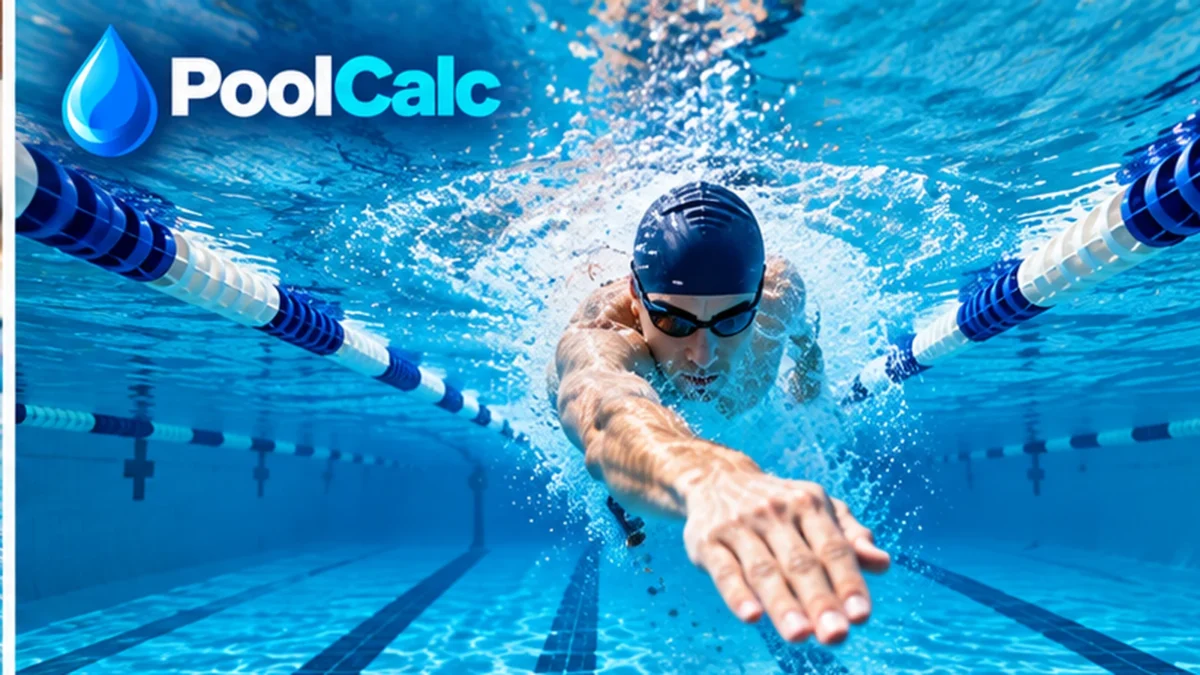
In competitive swimming a lap is one length of the pool — wall to wall, once. In everyday use most people mean down and back, which is two lengths. Both are in common circulation, which is why counting laps with someone else usually ends in an argument.
Where the confusion comes from
The word was borrowed from running, where a lap is a circuit of the track that brings you back to where you started. Carried into a pool, that logic gives you down and back — two lengths.
Competitive swimming went the other way. In the pool, distances are measured and timed in lengths, and in US swimming usage a lap and a length are the same thing. A 100-yard race in a 25-yard pool is four laps, not two.
The practical answer: if you are following a training plan or a coach, a lap is one length. If you are chatting at the side of the pool, assume the other person means down and back — and say “lengths” when it matters.
How many laps make a mile
Counted as lengths, in the pool sizes you will actually meet:
| Pool length | Lengths in a mile | Down-and-backs |
|---|---|---|
| 25 yards | 70 | 35 |
| 25 metres | 64 | 32 |
| 50 metres | 32 | 16 |
| Home pool, 40 ft | 132 | 66 |
Swimmers often call 1,650 yards a mile in a 25-yard pool — the “swimmer’s mile” — because it is a standard race distance and it is 66 lengths, which is tidier to count. A true mile is 1,760 yards.
Calculators
What makes a pool a lap pool
A lap pool is shaped for swimming in a straight line rather than for lounging: long, narrow, and usually a constant depth so the turns are the same at both ends.
| Dimension | Usual range | Why |
|---|---|---|
| Length | 40–75 ft | Under 40 ft is more turning than swimming |
| Width | 8–10 ft | One lane; two needs 16 ft |
| Depth | 3.5–4 ft, constant | Even push-offs, less water to heat |
Forty feet is the practical minimum for a stroke to settle before the next wall arrives. Below that the swim becomes a sequence of turns, which is fine for exercise but does not feel like swimming.
The narrow shape has a useful side effect: a lap pool holds far less water than a rectangular family pool of the same length, so it costs less to heat and takes fewer chemicals. Lap pools as a pool type covers build cost and what to look for.
Common questions
Is a lap one length or two?
One length in US competitive swimming, where lap and length mean the same thing. Two lengths in ordinary conversation, by analogy with running a lap of a track. Neither is wrong; they belong to different contexts. Say “lengths” if the number matters.
How long does a lap pool need to be?
Forty feet is the usual minimum and most home lap pools are 40 to 50 ft. Longer is better for stroke rhythm but adds cost, water and heating. If the garden will not take 40 ft, a swim jet in a shorter pool gives you continuous swimming without the length.
How many laps should I swim for a workout?
A reasonable starting session is 20 to 30 lengths of a 25-yard pool, which is 500 to 750 yards and takes most people 15 to 20 minutes. Build by adding a few lengths a week rather than by swimming harder. In a 40 ft home pool, the same distance is roughly 38 to 56 lengths.
Do I count laps differently in a 50 m pool?
The rule is the same, but the distances double per length, so the count drops. A mile is 32 lengths of a 50 m pool against 64 of a 25 m one. Long-course pools also mean fewer push-offs, which makes the same distance noticeably harder work.