
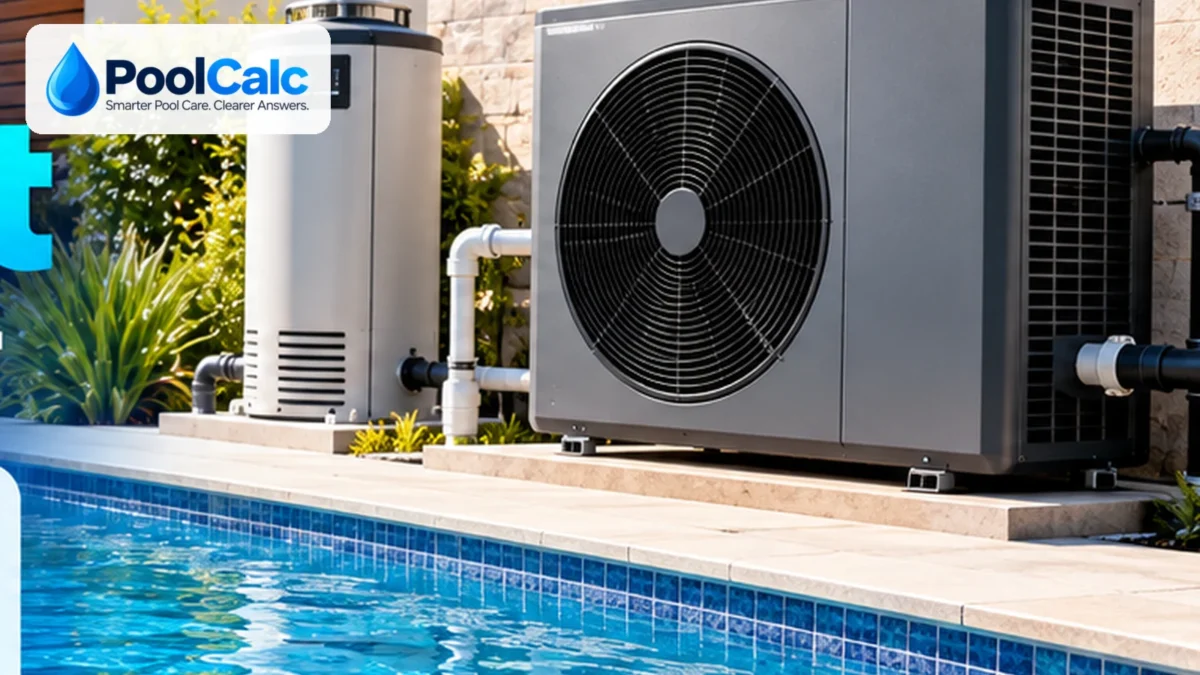
Heating a pool costs between about $100 and $600 a month, and the spread is that wide because almost none of it is down to the heater. Surface area, how many degrees you are asking for, and whether the pool is covered between swims matter far more than which appliance you bought.
Where the heat goes
A pool loses heat almost entirely from its surface, and the largest single route is evaporation — somewhere around 70% of it. Every litre that evaporates carries away the energy it took to warm it.
This is the fact the whole bill turns on. You are not heating a volume of water so much as replacing what the surface gives up, night after night. A deep pool and a shallow pool of the same surface area cost roughly the same to keep warm, even though the deep one costs far more to warm up in the first place.
The three heaters, as running costs
| Type | Typical month | Speed | Suits |
|---|---|---|---|
| Gas | $200–$600 | Fast — hours | Occasional use, cold snaps |
| Heat pump | $100–$250 | Slow — a day or two | Holding a temperature all season |
| Solar | Near zero | Weather-dependent | Extending the season cheaply |
Gas is quick and expensive. It makes sense if you heat the pool for a weekend and then let it go cold, because you only pay while it runs.
A heat pump moves heat from the air rather than making it, so it delivers several units of heat per unit of electricity — typically three to five. That is why it is cheaper to run and why it struggles once the air drops below about 50°F: there is less heat in the air to move.
Solar has almost no running cost at all. It cannot hit a target temperature on demand, but for adding a few degrees across a season it is unbeaten. See the three compared in full for purchase prices and sizing.
What one degree costs
Raising water by one degree Fahrenheit takes 8.34 BTU per gallon. For a 20,000 gallon pool that is 166,800 BTU per degree — before any losses.
At a gas price of $1.40 a therm and 84% efficiency, that one degree costs about $2.80. Ten degrees is $28, and that is only to get there; holding it is a separate daily cost.
The same degree through a heat pump at $0.17 a kilowatt-hour and a COP of 5 comes to roughly $1.65. The gap widens the longer the season runs.
Each degree you add also raises the standing loss, because a warmer pool loses heat faster. Going from 80°F to 86°F does not cost six times one degree — it costs more, and it keeps costing more every night afterwards.
The cover is the whole argument
If evaporation is most of the loss, then stopping evaporation is most of the saving. A solar cover on an uncovered pool typically cuts heating cost by 50 to 70%.
Nothing else available to a pool owner comes close. A $150 cover that halves a $300 monthly bill has paid for itself inside a month, and it goes on saving every night it is used. The catch is entirely practical — it has to actually go on, and a cover left folded by the shed saves nothing.
A reel makes the difference between a cover that gets used and one that does not, which is why it is worth buying at the same time. The types of cover differ in what else they do.
Four more ways to cut it
- Drop the target by two degrees. 80°F instead of 82°F is barely noticeable in the water and takes a real slice off the bill.
- Shelter the pool from wind. Wind drives evaporation hard. A hedge or fence on the prevailing side is a one-off cost against a permanent saving.
- Do not heat an empty week. Letting it drift down while nobody swims costs less than holding it, even allowing for the reheat — as long as the gap is more than two or three days.
- Heat overnight on a time-of-use tariff if you have one. The heat pump does not care when it runs.
Common questions
Is it cheaper to keep a pool warm or heat it when needed?
If you swim most days, holding the temperature is cheaper — reheating from cold repeatedly wastes more than the standing loss. If you swim at weekends only, letting it fall during the week wins. The crossover is around two to three days, and a cover moves it in favour of holding, because a covered pool loses very little overnight.
How much does a heat pump cost per month?
Usually $100 to $250 for a typical residential pool held at 82°F in season, at around $0.17 a kilowatt-hour. Cold nights, wind and no cover push it to the top of that; a covered, sheltered pool in mild weather sits at the bottom. Put your own volume, temperature and electricity rate into the heating cost calculator for a figure that means something.
Does running the pump longer heat the pool?
Only in the sense that a heater cannot work without flow. The pump itself adds a negligible amount of heat and costs money to run, so extending its hours to warm the water is an expensive way to achieve almost nothing. With solar it is different — there, circulation during sunny hours is exactly the point.
Why is my heating bill higher than these figures?
The usual culprits, in order: no cover, an exposed windy site, a target above 84°F, and a heat pump being asked to work in air that is too cold for it. A large surface area does it too — a 40-foot pool loses roughly twice what a 28-foot one does, whatever the heater.