
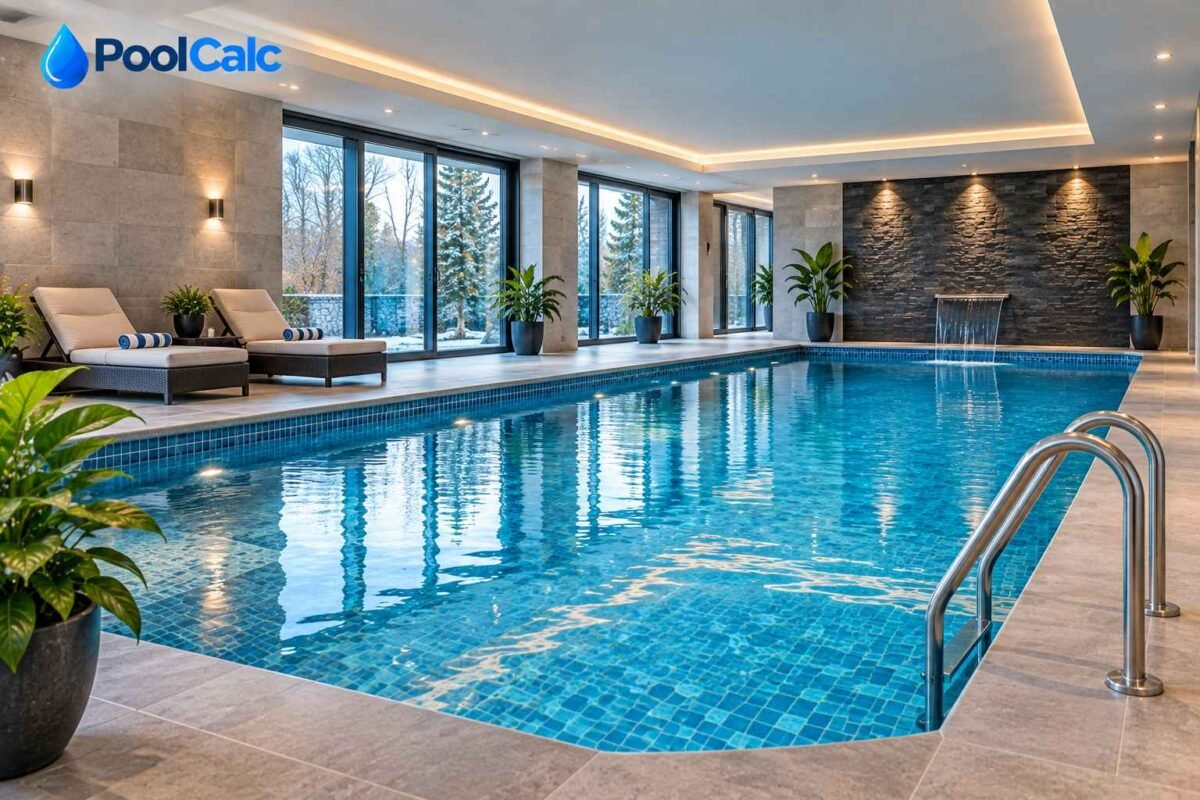
An indoor pool swaps weather for air. There is no sunlight destroying chlorine, no leaves to skim and no seasonal shutdown — but the building itself becomes part of the pool, and managing the air matters as much as managing the water.
The single biggest difference is that indoor pools need no cyanuric acid at all. Stabiliser exists to protect chlorine from sunlight; indoors there is no sunlight, so all it does is slow the chlorine down. Most indoor pools run at zero.
The other difference is chloramines. Outdoors they disperse into the sky; indoors they collect just above the water, which is exactly where swimmers breathe. That sharp “chlorine smell” in a badly ventilated indoor pool is chloramines, and it means too little free chlorine rather than too much.
At a glance
| Characteristic | Typical |
|---|---|
| Cyanuric acid | Not needed — usually kept at zero |
| Chlorine demand | Lower, since sunlight is not destroying it |
| Season | Year-round |
| Critical system | Ventilation and dehumidification |
| Air handling | As important as the water treatment |
Advantages and limitations
What works well
- Swim all year, whatever the weather.
- No leaves, pollen, storms or seasonal opening and closing.
- Chlorine lasts far longer without sunlight destroying it.
- Water temperature is far easier to hold.
- Complete privacy.
What to weigh up
- The building is the expensive part, not the pool.
- Humidity will damage the structure without proper dehumidification.
- Chloramines build up in the air and irritate eyes and airways.
- Ventilation runs constantly and adds to the energy bill.
- No sunlight means algae is less of a problem, but so is natural warming.
Looking after one
- Keep cyanuric acid at zero. It offers nothing indoors and holds chlorine back.
- Watch combined chlorine closely — above 0.5 ppm you will smell it, and it is time to shock.
- Run the ventilation and dehumidification continuously, not only while swimming.
- Test chlorine and pH twice a week; demand is lower but not zero.
- Check the building for condensation, particularly on cold surfaces and in the roof space.
What it costs to own
The enclosure dominates the cost — a proper pool building with dehumidification is a construction project in its own right, usually far larger than the pool inside it.
Running costs shift, rather than fall. You spend less on chlorine and stabiliser, and more on ventilation, dehumidification and heating the space. Getting the air handling right is also what protects the building, so it is not a place to economise.
Prices for pools vary enormously by region, access, ground conditions and specification, so no figure is quoted here. The Ownership Cost Calculator uses your own numbers instead of an average that would be wrong for most people.
Calculators for this pool
Questions people ask
Do indoor pools need cyanuric acid?
No. Stabiliser protects chlorine from sunlight, and there is none indoors. Adding it simply makes the chlorine less effective, so indoor pools are normally run at zero.
Why does my indoor pool smell so strongly?
Chloramines — chlorine that has already reacted and is now spent. It means the free chlorine level is too low, not too high. Ventilate, then shock to breakpoint.
Do indoor pools get algae?
Rarely. Algae needs light, and an indoor pool gives it very little. Bacteria are still a concern, so chlorine still matters.
Is humidity really that serious?
Yes. Unmanaged pool humidity rots timber, corrodes fixings and destroys plaster. The dehumidification system is protecting the building, not the swimmers.