
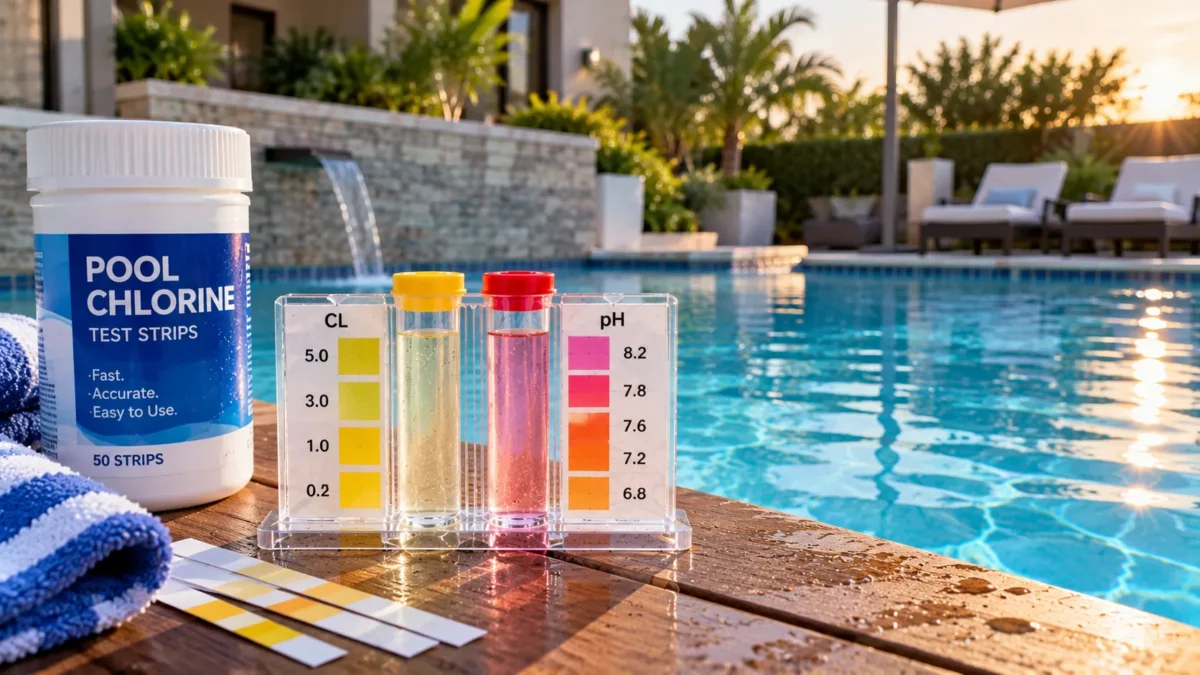
If your pool chlorine is low, do not simply keep adding more chlorine without finding out why the level dropped. Low free chlorine can result from sunlight, low or excessive stabilizer, heavy swimmer use, debris, algae, poor circulation, filtration problems, testing errors, or a chlorine-producing system that is not keeping up with demand.
The basic process is simple:
Test → diagnose → calculate the required dose → add chlorine correctly → circulate → retest.
For a precise chlorine dose based on your pool volume, current free chlorine, target level, CYA, and actual product strength, use the Chlorine Calculator. The calculator is designed around the numbers in your own pool rather than a generic one-size-fits-all dose.
If your chlorine keeps falling after you add it, however, the answer may not be “add more.” You need to identify the source of the chlorine demand.
What should I do if my pool chlorine is low?
First, test the water rather than guessing.
Check:
- Free chlorine
- pH
- Cyanuric acid (CYA) if the pool is outdoors and uses stabilizer
- Total chlorine and combined chlorine if your test kit provides them
- Pool water clarity
- Filter and circulation
- Salt-cell or chlorinator operation if you have a saltwater pool
For a residential pool, CDC recommends maintaining appropriate free chlorine and pH and testing regularly. Its current guidance recommends pH of 7.0–7.8 and at least 1 ppm chlorine in pools without cyanuric acid, or at least 2 ppm when cyanuric acid is being used. Product labels and local requirements can specify different operating ranges, so always follow the product instructions that apply to your pool.
PoolCalc’s Pool Chemistry Calculator uses 2–4 ppm as its normal free-chlorine range and lets you enter free chlorine, pH, alkalinity, calcium hardness, CYA, and salt together.
If the reading is low, the next question is not simply “How much chlorine should I add?” It is:
Why did the chlorine become low?
That distinction is what prevents the same problem from returning tomorrow.
What is free chlorine and why does it matter?
Free chlorine, commonly abbreviated as FC, is the chlorine available in the water to sanitize it.
When chlorine is added to a pool, some of it remains available to react with contaminants and microorganisms. Some chlorine is consumed by things such as swimmer waste, organic debris, algae, and other contaminants.
This is why a pool can have a history of adding chlorine but still show a low free chlorine reading.
CDC describes chlorine and pH as the first line of defense against germs in pool water and recommends routine testing and adjustment.
It is also important to distinguish free chlorine from combined chlorine and total chlorine.
Free chlorine
Free chlorine is the available sanitizer measured by the test.
Combined chlorine
Combined chlorine is chlorine that has reacted with contaminants and formed chloramines or other combined chlorine compounds.
Total chlorine
Total chlorine is the combined amount of free and combined chlorine.
The basic relationship is:
Total Chlorine = Free Chlorine + Combined Chlorine
This distinction matters because a test result showing “chlorine” does not always tell you how much usable free chlorine remains.
What causes low chlorine in a pool?
There are several reasons your free chlorine may be low.
1. Sunlight is destroying chlorine
One of the most common reasons chlorine drops in an outdoor pool is sunlight.
Ultraviolet radiation breaks down chlorine. This is one reason outdoor pools commonly use cyanuric acid (CYA), also called chlorine stabilizer or conditioner.
CYA helps protect chlorine from UV degradation.
CDC specifically notes that sunlight can reduce chlorine concentration and recognizes cyanuric acid as a chlorine stabilizer.
If your chlorine is fine in the morning but almost gone later in the day, sunlight and chlorine demand should be among the first things you investigate.
This is also why adding chlorine later in the day is commonly used as a practical way to reduce immediate UV loss.
2. Your CYA may be too low
Low cyanuric acid can make chlorine disappear quickly in an outdoor pool.
CYA acts as a stabilizer. Without adequate stabilizer, sunlight can consume free chlorine much faster.
However, adding more CYA is not automatically the answer.
Too much CYA can also change the relationship between the chlorine level and its sanitizing effectiveness.
That means you should test CYA instead of repeatedly adding stabilizer without knowing the current reading.
PoolCalc’s chemistry tools account for CYA when calculating chlorine requirements, and its chlorine calculator specifically allows the CYA level to be entered because it changes the chlorine requirement.
3. Your pool has a high chlorine demand
If you add chlorine and the reading drops again unusually quickly, you may have a high chlorine demand problem.
Chlorine can be consumed by:
- Algae
- Organic debris
- Leaves
- Dirt
- Pollen
- Sweat
- Sunscreen
- Body oils
- Heavy swimmer loads
- Contamination
- Combined chlorine
- Other organic material in the water
CDC specifically identifies swimmer waste and dirt as factors that reduce chlorine concentration.
A busy pool party can create a very different chlorine demand from an unused pool.
This is why a dosing chart alone cannot predict exactly how much chlorine your pool will consume after treatment.
4. Algae may be consuming the chlorine
If your pool is starting to turn green, cloudy, or dull, algae may be using chlorine faster than you can replace it.
A common pattern is:
Low chlorine → algae begins growing → algae consumes more chlorine → chlorine falls further → water becomes cloudy or green.
This can create a cycle where adding a small routine dose of chlorine does not solve the underlying problem.
If the pool is already green or showing visible algae, treat it as an algae problem rather than simply a low-chlorine problem.
For related troubleshooting, see Green Pool Water: Causes, Fixes & Prevention.
5. Heavy swimmer use can lower chlorine
Swimmers bring contaminants into the water.
Sweat, body oils, sunscreen, dirt and other organic material all contribute to chlorine demand.
That means chlorine consumption can rise significantly after:
- A pool party
- A busy weekend
- Several swimmers using the pool
- Children spending long periods in the water
- Heavy sunscreen use
- Poor pre-swim hygiene
CDC recommends showering before swimming because dirt, sweat and body products contribute to chlorine-consuming contaminants.
If your pool chlorine drops after a particularly busy swimming day, that does not necessarily mean your chlorinator has failed.
It may simply be dealing with a much larger contaminant load.
6. Leaves, debris and organic material can consume chlorine
Leaves, grass, pollen and other organic debris can increase chlorine demand.
If the pool has recently experienced:
- Wind
- Heavy rain
- Storms
- Falling leaves
- Dust
- Yard debris
check the water and remove visible debris before trying to solve the chlorine problem with chemicals alone.
A clean pool reduces the amount of material chlorine has to react with.
7. Your test result may be wrong
Before adding a large amount of chlorine, make sure the test itself is reliable.
This is one of the most overlooked causes of apparent low chlorine.
Test strips are convenient, but liquid drop-based testing can provide more dependable measurements when accuracy matters.
CDC recommends DPD testing for chlorine and pH and notes that test strips are less accurate. CDC also warns that very high chlorine concentrations can interfere with some tests and produce a falsely low or zero reading.
Check:
- Test kit expiration date
- Reagent condition
- Correct sample volume
- Correct testing procedure
- Proper storage of test chemicals
- Whether the sample was taken from a representative location
If your test says zero chlorine immediately after a large chlorine treatment, do not automatically assume the water contains no chlorine.
Verify the reading.
8. Poor circulation can make chlorine problems worse
Chlorine needs to distribute throughout the pool.
If the pump is not operating properly, circulation is poor, or the filtration system is blocked, chemical distribution and water turnover can suffer.
Check:
- Pump operation
- Return flow
- Skimmer flow
- Filter pressure
- Filter cleanliness
- Air entering the suction system
- Chlorinator operation
- Salt-cell operation
- Pump runtime
Poor circulation can also contribute to cloudy water.
PoolCalc’s Cloudy Pool Water guide notes that low chlorine, dirty or undersized filters and insufficient circulation can all contribute to cloudy water.
9. A dirty filter can contribute to water-quality problems
A dirty filter does not directly “remove chlorine,” but poor filtration can leave contaminants in the water and reduce the system’s ability to keep the pool clean.
Check your filter pressure against its normal clean-filter reading.
If pressure is unusually high, follow the filter manufacturer’s cleaning or backwashing instructions.
Do not assume every low-chlorine problem is a chemistry problem.
Sometimes the chemistry is reacting to an equipment or filtration problem.
10. Your saltwater system may not be producing enough chlorine
A saltwater pool is still a chlorine pool.
The difference is that a salt chlorine generator produces chlorine from salt rather than requiring all chlorine to be manually added.
If free chlorine is low in a saltwater pool, check:
- Salt level
- Salt-cell condition
- Cell cleanliness
- Generator output percentage
- Pump runtime
- Water temperature where relevant to your system
- Flow detection
- System warnings
- Cell age
- CYA
- Overall chlorine demand
Do not assume that “saltwater” means the pool does not need chlorine testing.
PoolCalc’s pool-type information also treats saltwater pools as chlorine pools with a different method of chlorine production.
If your generator is producing less chlorine than the pool is consuming, the free chlorine level can continue to fall.
How do I raise my chlorine level in my pool?
Once you know the current free chlorine level and your desired level, calculate the required dose based on:
- Pool volume
- Current free chlorine
- Target free chlorine
- Chlorine product strength
- Relevant CYA conditions
This is much more accurate than using a generic “one cup per 10,000 gallons” rule.
The PoolCalc Chlorine Calculator uses the actual chlorine product strength you enter. Its methodology is based on the amount of active chlorine required to increase a known volume by a known ppm amount.
How much chlorine should I add to my pool?
There is no single correct dose for every pool.
A 5,000-gallon pool and a 30,000-gallon pool need different amounts.
Likewise, a 10% liquid chlorine product and a 12.5% product do not deliver the same amount of available chlorine per fluid ounce.
PoolCalc’s methodology uses the underlying relationship that raising 10,000 US gallons by 1 ppm requires approximately 37.85 grams, or about 1.34 ounces, of available chlorine. The actual product dose then depends on the concentration or purity of the product being used.
For example, PoolCalc’s chlorine calculator gives a worked example in which a 20,000-gallon pool moving from 1 ppm to 3 ppm requires about 43 fluid ounces of 12.5% liquid chlorine, assuming the product is actually at its labeled strength.
That is an example, not a universal dose.
Your pool volume and product concentration may be different.
How to calculate chlorine dosage
The basic process is:
Step 1: Determine pool volume
You need an accurate estimate of the amount of water in the pool.
If you do not know the volume, start with a pool-volume calculation before calculating chemical dosage.
PoolCalc provides its calculations in US gallons and metric units, with volume based on pool dimensions and average depth.
Step 2: Test free chlorine
Write down the actual FC reading.
For example:
Current FC = 1 ppm
Step 3: Choose your target
Suppose your target is:
Target FC = 3 ppm
The required increase is:
3 − 1 = 2 ppm
Step 4: Check your chlorine product
Look at the label.
Do not assume every liquid chlorine or granular chlorine product has the same strength.
Step 5: Calculate the dose
Use the product concentration and pool volume to determine the amount needed.
Step 6: Add the chemical according to the product label
Do not mix chlorine products together.
Follow the manufacturer’s directions for application.
Step 7: Circulate and retest
Do not assume the first calculation guarantees the final water chemistry.
The water needs to circulate and then be retested.
Should I shock the pool if chlorine is low?
Sometimes, but low chlorine alone does not automatically mean you need to shock the pool.
If your pool simply needs a routine increase from, for example, 2 ppm to your normal target, a calculated chlorine dose may be sufficient.
Shock or superchlorination becomes more relevant when you are dealing with:
- Persistent chlorine demand
- Visible algae
- Significant contamination
- Elevated combined chlorine
- Chlorine that repeatedly disappears
- Water-quality problems that normal dosing does not resolve
PoolCalc’s methodology explains that its shock calculation considers both CYA and combined chlorine, with the higher applicable target determining the shock level.
For a specific shock calculation, use the Pool Calculators page and select the Pool Shock calculator. The site currently provides 23 calculators covering water chemistry, equipment, costs and maintenance.
The important point is:
Do not shock blindly just because one chlorine test is low. Diagnose the reason first.
Why is my chlorine still low after shocking?
If chlorine is still low after shocking, investigate chlorine demand rather than automatically repeating the same treatment.
Possible causes include:
Algae
The chlorine may be getting consumed while fighting an algae problem.
Organic contamination
Leaves, dirt, swimmer waste and other contaminants can consume chlorine.
Low CYA
Outdoor chlorine may be lost quickly to sunlight.
High CYA
A high stabilizer level changes the amount of free chlorine required to maintain effective sanitation.
Poor circulation
The treatment may not be distributing properly.
Filtration problems
Contaminants can remain in the water if filtration is inadequate.
Testing error
The result may not accurately represent the water.
Salt-cell or chlorinator problem
The system may not be producing enough sanitizer to match demand.
If the same pattern keeps happening, stop treating the symptom and diagnose the system.
Why does my pool chlorine keep dropping?
If your chlorine keeps dropping, work through this checklist:
| Possible cause | What to check |
|---|---|
| Sunlight | Outdoor exposure and CYA |
| Low CYA | Test stabilizer |
| High CYA | Check stabilizer level before adding more |
| Heavy swimmer load | Recent pool use |
| Organic debris | Leaves, pollen, dirt |
| Algae | Green, dull or cloudy water |
| Poor circulation | Pump and return flow |
| Dirty filter | Filter pressure and condition |
| Salt-cell problem | Generator output and cell condition |
| Testing problem | Kit, reagents and testing method |
| High chlorine demand | Chlorine disappears quickly after dosing |
This is why the question “Why can’t I keep my chlorine level up in my pool?” has more than one answer.
The right solution depends on what is consuming or preventing the chlorine from remaining available.
Does sunlight lower pool chlorine?
Yes.
Sunlight, particularly UV exposure, can reduce chlorine concentration in outdoor pools.
That is one reason cyanuric acid is used as a chlorine stabilizer.
If your pool loses chlorine primarily during sunny periods, check the CYA level and the relationship between CYA and free chlorine before simply increasing the chlorine dose.
CDC specifically identifies sunlight as one factor that reduces chlorine concentration.
Does low CYA cause low chlorine?
It can contribute to rapid chlorine loss in an outdoor pool.
CYA protects chlorine from sunlight, so inadequate stabilizer can allow chlorine to disappear faster.
But CYA should be tested rather than guessed.
There is also an important second side to the equation: adding excessive stabilizer does not simply make chlorine work better.
That is why your chlorine reading should always be interpreted together with your CYA reading.
PoolCalc’s chlorine calculator includes CYA because it changes the chlorine requirement and displays a CYA-related minimum alongside the dose.
How do I test low chlorine levels?
For a routine check:
- Use a pool test kit according to its instructions.
- Take the sample from representative pool water.
- Test free chlorine.
- Test pH.
- Test CYA when relevant.
- If available, test total chlorine so you can calculate combined chlorine.
- Record the readings.
- Retest after making an adjustment.
For greater accuracy, CDC recommends DPD testing for chlorine and pH and notes that test strips are less accurate.
If you are repeatedly seeing unusual results, take a sample to a qualified pool professional or use a more reliable testing method.
What should free chlorine be in a pool?
There is no single number that applies to every pool under every condition.
CDC currently recommends at least:
- 1 ppm free chlorine in pools without cyanuric acid
- 2 ppm free chlorine when cyanuric acid or stabilized chlorine products are being used
- pH 7.0–7.8
PoolCalc’s calculator uses 2–4 ppm as its normal free-chlorine range.
Your product label, pool type, sanitizer system, CYA level, local regulations and testing results all matter.
Do not treat a single “pool chlorine chart” as a substitute for testing your actual water.
Pool chlorine levels chart
A simple way to understand your reading is:
| Free chlorine reading | What it generally means |
|---|---|
| 0 ppm | No measurable free chlorine; investigate and correct before swimming |
| Below your normal target | Chlorine needs attention |
| Around your target | Continue normal testing and maintenance |
| Above your normal target | Follow your product guidance and retest before swimming |
| Very high | Allow the level to return to the appropriate range and follow product instructions |
The exact target should be interpreted alongside CYA, pH, the sanitizer system and the product being used.
If the reading is unexpectedly high or low, verify the test before making a large chemical adjustment.
Is it safe to swim in a pool with low chlorine?
A low chlorine reading should not be treated as automatically safe simply because the water looks clear.
Clear water does not prove that the water is properly sanitized.
CDC explains that chlorine and pH are important defenses against germs in recreational water and recommends maintaining appropriate disinfectant levels.
If chlorine is below the applicable minimum, the water is cloudy, the bottom cannot be clearly seen, or there has been contamination, keep swimmers out until the water has been properly treated and verified.
PoolCalc’s own safety guidance similarly states that no calculator can determine whether water is safe to swim in and recommends testing and following product labels.
For additional information about swimming-related water quality, see What Chlorine Kills, and What It Does Not.
You can also review the CDC’s home pool water treatment guidance for current recommendations on chlorine, pH and testing.
Can low chlorine cause algae or cloudy water?
Yes, low chlorine can be associated with both.
When sanitizer levels remain inadequate, algae can gain a foothold and organic contamination can accumulate.
Cloudy water can also have several other causes, including:
- High pH
- High calcium hardness
- Dirty filtration
- Insufficient circulation
- Dead algae after treatment
- Fine debris
- Very high CYA
PoolCalc’s Cloudy Pool Water guide explains that low chlorine is only one possible cause and that the correct treatment depends on the underlying problem.
This is another reason not to automatically shock every cloudy pool.
What if my pool has low chlorine and cloudy water?
Start with testing.
Check:
- Free chlorine
- pH
- CYA
- Calcium hardness
- Total alkalinity
- Filter pressure
Then identify whether the primary issue is chemistry, filtration or contamination.
If chlorine is low, correct the sanitizer level.
If filter pressure is high, clean or backwash the filter according to the manufacturer’s instructions.
If pH is outside the appropriate range, correct it carefully.
If algae is present, treat the algae problem rather than expecting filtration alone to solve it.
If you cannot clearly see the bottom of the pool, keep swimmers out because cloudy water can create a separate visibility and safety hazard.
What causes low chlorine in a saltwater pool?
Saltwater pools can also have low free chlorine.
The most common things to investigate are:
Salt level
If the salt concentration is outside the generator’s operating range, chlorine production may be affected.
Salt cell
A dirty, scaled, aging or malfunctioning cell may produce less chlorine.
Generator output
Check the output percentage and system settings.
Pump runtime
The generator normally needs adequate water flow and operating time.
High chlorine demand
The pool may be consuming chlorine faster than the generator can produce it.
CYA
Outdoor saltwater pools still need appropriate stabilizer management.
Water temperature
Some salt systems reduce production or behave differently at lower temperatures.
If your saltwater pool chlorine is low, test the water before increasing generator output blindly.
Why does chlorine disappear after I add it?
If chlorine disappears after you add it, there is probably something consuming it or a problem with how the water is being managed.
Common reasons include:
- Strong sunlight
- Low CYA
- Algae
- Heavy organic contamination
- Heavy swimmer load
- Debris
- High chlorine demand
- Poor circulation
- Incorrect testing
- Product degradation
PoolCalc notes that chlorine demand from algae, organic debris or heavy bather loads is not included in a simple chemical dose calculation because these factors can consume part of the added chlorine immediately.
This is a key distinction:
A calculator can tell you how much chlorine is required to change the measured level under its assumptions. It cannot predict exactly how much additional chlorine an active algae bloom or heavy contamination will consume.
How long does it take to raise chlorine levels?
The answer depends on:
- Chlorine product
- Product strength
- Pool volume
- Starting chlorine level
- Target chlorine level
- Water circulation
- Sunlight
- CYA
- Chlorine demand
Liquid chlorine can begin raising the free chlorine level relatively quickly once it is distributed through circulating water, but the correct time to retest depends on the product, dose, pool conditions and label directions.
Do not decide that the treatment failed simply because the reading has not changed immediately.
Give the chemical time to circulate, then retest.
Should I add chlorine during the day or at night?
For outdoor pools, adding chlorine later in the day can reduce immediate sunlight-related chlorine loss.
This is particularly useful when the goal is to raise the free chlorine level without having a large portion of the added chlorine exposed to strong UV immediately afterward.
However, timing does not solve an underlying chlorine-demand problem.
If algae is consuming chlorine, adding it at dusk will not eliminate the algae.
If CYA is inadequate, timing alone will not correct the stabilizer problem.
If your salt system is not producing enough chlorine, nighttime dosing does not repair the generator.
Liquid chlorine vs. tablets vs. granular chlorine
Different chlorine products affect pool chemistry differently.
Liquid chlorine
Often based on sodium hypochlorite.
It raises free chlorine without adding CYA.
Trichlor tablets
They provide chlorine but also add cyanuric acid.
That can be useful in some situations but can become a problem if CYA continually rises.
Dichlor
It adds chlorine and cyanuric acid.
Calcium hypochlorite
It adds chlorine and contributes calcium.
The important lesson is:
Do not compare chlorine products only by the size of the container. Compare the active ingredient and concentration.
PoolCalc’s methodology specifically accounts for product strength because the same volume of two different chlorine products does not necessarily provide the same amount of active chlorine.
How do I keep my pool chlorine from dropping?
The goal is not to stop chlorine consumption completely. Chlorine is supposed to be consumed as it sanitizes the water.
The goal is to keep chlorine demand predictable.
Use this routine:
Test regularly
Monitor free chlorine and pH consistently.
Keep CYA appropriate
Especially for outdoor pools.
Remove debris
Skim leaves and organic material rather than allowing them to remain in the water.
Control swimmer load
Encourage swimmers to shower before entering.
Maintain circulation
Keep the pump, filter and returns operating correctly.
Maintain filtration
Clean the filter when pressure indicates it needs attention.
Check salt systems
Verify salt level, cell condition and generator output.
Watch for algae
Do not allow a small algae problem to become a large chlorine-demand problem.
Calculate doses
Use actual pool volume and product strength rather than guessing.
For a broader maintenance plan, the Pool Calculators section includes tools for chlorine, chemistry, CYA, salt, shock, pH, water health and other pool calculations.
Low chlorine pool symptoms
Low chlorine does not always produce an obvious visual symptom.
Possible signs include:
- Chlorine test reading below the normal target
- Free chlorine reading close to zero
- Cloudy water
- Beginning algae growth
- Green water
- Persistent water-quality problems
- Chlorine disappearing unusually quickly
- Strong chloramine smell in some circumstances
A strong chlorine smell does not necessarily mean the pool contains too much chlorine.
Chloramines can form when chlorine reacts with contaminants, and CDC explains that chloramines can irritate the eyes, skin and respiratory tract.
Always test rather than diagnosing chlorine levels by smell.
What if my chlorine is low but the water looks perfectly clear?
Do not assume clear water means the sanitizer level is adequate.
Water clarity is not the same thing as disinfection.
A pool can look clean while its free chlorine is too low.
CDC emphasizes maintaining disinfectant and pH levels rather than relying on appearance alone.
This is why testing is more useful than simply looking at the water.
Can you increase free chlorine naturally?
There is no reliable “natural” substitute for maintaining an appropriate sanitizer level.
You can reduce unnecessary chlorine demand by:
- Removing debris
- Showering before swimming
- Keeping the pool covered when appropriate
- Managing sunlight exposure
- Maintaining appropriate CYA
- Keeping filtration working
- Correcting algae
- Reducing contamination
But these actions do not replace the need to maintain an appropriate chlorine residual.
The sanitizer still has a job to do.
A simple low-chlorine troubleshooting checklist
If your pool chlorine is low, work through this list in order:
1. Test
Record:
FC + pH + CYA
Add total chlorine and combined chlorine if available.
2. Verify the test
If the result seems impossible, repeat the test.
3. Check the water
Look for:
- Green tint
- Cloudiness
- Algae
- Leaves
- Dirt
- Heavy debris
4. Check equipment
Inspect:
- Pump
- Filter
- Returns
- Chlorinator
- Salt cell
5. Check CYA
Especially if this is an outdoor pool.
6. Calculate the dose
Use your:
- Pool volume
- Current FC
- Target FC
- Product strength
7. Add chlorine according to the product label
Never mix incompatible chemicals.
8. Circulate
Allow the pool to circulate according to your equipment and product instructions.
9. Retest
Do not assume the first dose solved the entire problem.
10. If chlorine keeps disappearing
Investigate chlorine demand, algae, CYA, circulation, filtration, testing and salt-system performance.
When should you stop and get professional help?
Get professional assistance when:
- You cannot get consistent test results
- Chlorine repeatedly disappears despite proper treatment
- The water has severe algae
- The water has been contaminated
- Equipment appears damaged
- A salt system is reporting a persistent fault
- You suspect a chemical overdose
- Someone becomes ill after swimming
- You are unsure how to handle a pool chemical safely
PoolCalc states that its calculations are estimates rather than instructions for a specific pool and recommends following the product label and seeking professional help when appropriate.
Pool chlorine safety: never mix chemicals
Pool chemicals require care.
Never mix chlorine with acids or other incompatible pool chemicals.
Store chemicals according to the manufacturer’s instructions and keep them away from children and pets.
PoolCalc’s Disclaimer and Safety Guidance specifically warns that mixing chlorine products with acid can release chlorine gas and emphasizes following product labels.
The US EPA also treats swimming-pool chlorine products as chemicals requiring appropriate handling and safety precautions. See EPA swimming pool chemical safety guidance.
Most importantly:
Your product label wins.
If a calculator estimate conflicts with the instructions on your actual product, follow the product label.
A practical example: chlorine is low in a 20,000-gallon pool
Suppose your pool has:
- Volume: 20,000 gallons
- Current free chlorine: 1 ppm
- Target free chlorine: 3 ppm
- Product: 12.5% liquid chlorine
The required increase is:
3 − 1 = 2 ppm
PoolCalc’s chlorine calculator gives approximately 43 fluid ounces of 12.5% liquid chlorine for that example.
But this assumes the pool volume is accurate, the product is actually at the stated strength, the water is circulating and there is no unusually high chlorine demand.
If algae is actively consuming chlorine, you may find that the measured level falls again.
That is not a calculator failure.
It is a sign that the pool has a demand that needs to be diagnosed.
Why accurate pool volume matters
Chemical calculations are only as accurate as the pool volume used.
If you think your pool contains 20,000 gallons but the actual volume is substantially different, the chlorine calculation will also be wrong.
PoolCalc’s methodology uses pool shape and average depth to estimate volume. It notes that one cubic foot of water equals 7.48052 US gallons and uses surface area multiplied by average depth as the basic volume relationship.
For irregular pools, steps, benches and ledges can also affect the actual water volume.
That is why a volume estimate should be treated as an estimate rather than laboratory precision.
Low chlorine after rain
Rain can change pool chemistry and introduce contaminants.
After significant rainfall, check:
- Free chlorine
- pH
- CYA where relevant
- Water level
- Water clarity
- Debris
- Filter pressure
Heavy rain can also increase the amount of organic material entering the pool.
Do not automatically dump a large chlorine dose into the pool without testing first.
Low chlorine after a pool party
If chlorine is low after heavy swimming, the explanation may be straightforward.
More swimmers mean more:
- Sweat
- Body oils
- Sunscreen
- Dirt
- Organic contaminants
That increases chlorine demand.
Test the water after heavy use and adjust based on the actual readings.
CDC recommends more frequent testing when a pool is being used by a large number of people.
Low chlorine in an indoor pool
Indoor pools behave differently because sunlight is not constantly destroying chlorine.
For example, PoolCalc’s Indoor Pool guide notes that indoor pools generally do not need CYA for sunlight protection and have different chloramine and ventilation concerns.
If an indoor pool has low chlorine, investigate:
- Water chemistry
- Chlorine demand
- Bather load
- Combined chlorine
- Circulation
- Filtration
- Chemical feed system
Do not automatically add stabilizer simply because chlorine is low.
Low chlorine vs. high chlorine: why both can be a problem
The goal is not to have “as much chlorine as possible.”
Too little chlorine can leave the pool inadequately sanitized.
Too much chlorine can create its own problems and may make the pool uncomfortable or require waiting before swimming.
The correct target depends on the pool, sanitizer system, CYA, product and applicable guidance.
Follow the product label and verify the water with a reliable test.
The easiest way to solve a low-chlorine problem
If you want the shortest practical process, use this:
1. Test free chlorine.
2. Test pH.
3. Test CYA if applicable.
4. Check whether the water is clear and free from algae.
5. Check circulation and filtration.
6. Calculate the chlorine dose from your actual pool volume and product strength.
7. Add chlorine according to the product label.
8. Circulate the water.
9. Retest.
10. If chlorine drops again, investigate chlorine demand instead of repeatedly adding more.
For the actual calculation, use the PoolCalc Chlorine Calculator.
For multiple chemistry readings, use the Pool Chemistry Calculator.
And if the problem keeps returning, do not keep increasing the dose indefinitely. Check the underlying cause: sunlight, CYA, algae, contamination, circulation, filtration, testing or chlorine-production equipment.
Work out the numbers
These calculators give the figures for your pool rather than a rule of thumb.
Water Health Check
Enter your test results and see what is in range, what is not, and what to do first.
CalculateFrequently Asked Questions
What to do if chlorine is low in a pool?
Test free chlorine, pH and CYA where applicable, check for algae and contamination, verify circulation and calculate the required chlorine dose based on pool volume and product strength. Retest after treatment.
How do I raise my chlorine level in my pool?
Add an appropriate chlorine product based on your pool volume, current free chlorine, target level and product concentration. Do not guess the dose.
Why can’t I keep my chlorine level up in my pool?
Common reasons include sunlight, unsuitable CYA, algae, heavy swimmer load, organic debris, poor circulation, filtration problems, testing errors and insufficient chlorine production from a salt system.
Why does my pool chlorine keep dropping?
Chlorine is continuously consumed by sunlight and contaminants. If it drops unusually quickly, investigate chlorine demand, CYA, algae, debris, circulation and equipment.
What causes low free chlorine in a pool?
Sunlight, low stabilizer, algae, swimmer waste, debris, poor circulation, testing problems and inadequate chlorine production can all contribute.
How do I increase free chlorine in a pool?
Calculate the required dose using pool volume, current FC, target FC and chlorine-product strength, then add the product according to its label and retest.
Does sunlight lower pool chlorine?
Yes. UV radiation can reduce chlorine concentration, which is why outdoor pools commonly use cyanuric acid as a stabilizer.
Does low CYA cause low chlorine?
Low CYA can allow chlorine to be consumed more quickly by sunlight in an outdoor pool. Test CYA before adding more stabilizer.
Can swimmers and debris cause chlorine levels to drop?
Yes. Sweat, body waste, dirt, sunscreen and organic debris can increase chlorine demand.
Should I shock a pool when chlorine is low?
Not automatically. A simple low reading may only require a calculated chlorine adjustment. Shock treatment is more appropriate when persistent chlorine demand, algae, contamination or elevated combined chlorine indicates a need for it.
Is it safe to swim in a pool with low chlorine?
Do not rely on clear-looking water as proof of safety. If chlorine is below the applicable minimum, the water is cloudy, or there is contamination or another water-quality concern, keep swimmers out until the water is properly treated and verified.
How long does it take to raise chlorine levels?
It depends on the product, dose, pool volume, circulation, sunlight and chlorine demand. Retest after the treatment has circulated according to the product instructions rather than assuming an immediate result.
Why does chlorine disappear after I add it?
It may be consumed by sunlight, algae, organic contaminants or heavy swimmer use. Incorrect testing, poor circulation and product degradation can also contribute.
Why is my chlorine still low after shocking?
Persistent low chlorine after shocking suggests that something is consuming chlorine or preventing effective treatment. Check algae, CYA, contamination, circulation, filtration, equipment and the accuracy of the test.
Why is my saltwater pool not producing enough chlorine?
Check the salt level, salt cell, generator output, pump operation, flow, water chemistry and chlorine demand. A saltwater pool still relies on chlorine as its sanitizer.
Can a dirty filter or poor circulation cause low chlorine?
They can contribute to persistent water-quality problems by limiting circulation and filtration. Check pump flow, filter pressure and equipment operation.
What is the difference between free chlorine and combined chlorine?
Free chlorine is the available sanitizer. Combined chlorine is chlorine that has reacted with contaminants. Total chlorine is the combination of free and combined chlorine.
Can low chlorine cause algae or cloudy water?
Yes. Low chlorine can allow algae and microorganisms to become established, which can contribute to cloudy or green water. However, cloudy water can also result from filtration, pH, calcium hardness, debris and other problems.
How do I keep my pool chlorine from dropping?
Maintain appropriate free chlorine and pH, manage CYA, remove debris, maintain circulation and filtration, monitor swimmer load, watch for algae and keep chlorine-producing equipment operating correctly.
How much chlorine should I add to my pool?
The correct amount depends on your pool volume, current chlorine, target chlorine and product strength. Use a pool-specific calculation rather than a generic dose.