
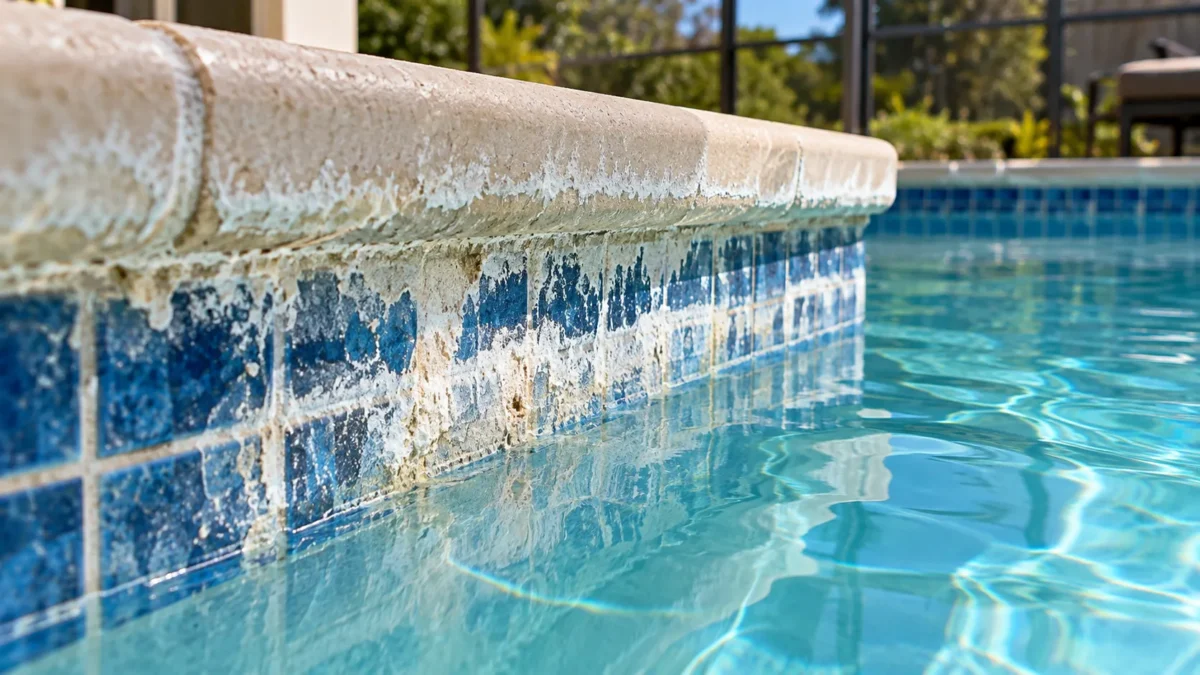
Calcium scale is the chalky white or grey crust that forms at the water line, on tiles and inside heaters. It happens when calcium comes out of solution — and the trigger is almost always pH, not calcium.
Two kinds turn up. Calcium carbonate is the common one: white, flaky, and it fizzes if you put a drop of acid on it. Calcium silicate is harder, grey-white, does not fizz, and takes professional treatment.
Scale inside a heater is the expensive version. It insulates the heat exchanger, so the heater works harder, runs hotter and eventually fails.
What causes it
- High pH, the usual trigger. Calcium stays dissolved at 7.4 and comes out at 8.0.
- High calcium hardness, often from hard fill water or years of cal-hypo.
- High total alkalinity, which keeps pushing pH up.
- Evaporation, which concentrates everything left behind — worst in hot, dry climates.
- Salt chlorine generators, where scale forms on the cell plates and cuts chlorine output.
- Warm water, which holds less calcium in solution than cool water.
What to test first
Before adding anything, take a reading. Guessing at this stage is how a small problem becomes an expensive one.
| Test this | Why it matters |
|---|---|
| pH | The trigger. Above 7.8, calcium starts coming out of solution. |
| Calcium hardness | Above 400 ppm there is more calcium available than the water can hold. |
| Total alkalinity | High TA keeps pH high, which keeps scale forming. |
| The scale itself | A drop of acid on it: fizzing means calcium carbonate, no reaction means silicate. |
How to fix it
- Fix the chemistry first, or any scale you remove will simply return. Bring pH to 7.4 to 7.6 and alkalinity to 80 to 100 ppm.
- If calcium hardness is above 400 ppm, replace part of the water. Nothing removes calcium chemically.
- For light scale at the water line, a pumice stone works on tile and concrete — never on vinyl or fibreglass.
- For heavier scale, a scale remover designed for pools, following its instructions exactly.
- For a salt cell, soak it in a diluted acid solution per the manufacturer’s instructions. Never use full-strength acid on a cell.
- For scale inside a heater, call a professional. Acid flushing a heat exchanger badly can destroy it.
Scale removers are acidic. Wear eye protection and gloves, never mix them with chlorine products, and follow the label exactly — especially around a salt cell, where too strong a solution destroys the plates. Never mix pool chemicals, and never add two products one after the other without circulating in between. Chlorine and acid together release chlorine gas. Always add chemical to water, never water to chemical.
Work out the numbers
These calculators give the figures for your pool rather than a rule of thumb.
Stopping it coming back
- Hold pH at 7.4 to 7.6. This single habit prevents most scale.
- Keep calcium hardness between 200 and 400 ppm.
- Top up with softened water in a hard-water area if you can.
- Inspect a salt cell every three months and clean it before output drops.
Questions people ask
What is the white stuff on my pool tiles?
Almost certainly calcium carbonate scale. A drop of acid on it will fizz. It comes from high pH letting calcium fall out of solution at the water line, where evaporation concentrates it.
Can I prevent scale without lowering calcium?
Largely, yes. Scale is triggered by pH far more than by calcium level. A pool at 350 ppm calcium and pH 7.5 will usually stay clear, while the same pool at pH 8.2 will scale.
Does a sequestrant help?
It holds calcium and metals in solution and is genuinely useful in hard-water areas. It needs re-dosing monthly, as it breaks down in chlorinated water.
Why has my salt cell stopped making chlorine?
Scale on the plates is the most common reason. Inspect it, and clean it if you can see white deposits between the plates. Cells also simply wear out after three to seven years.