
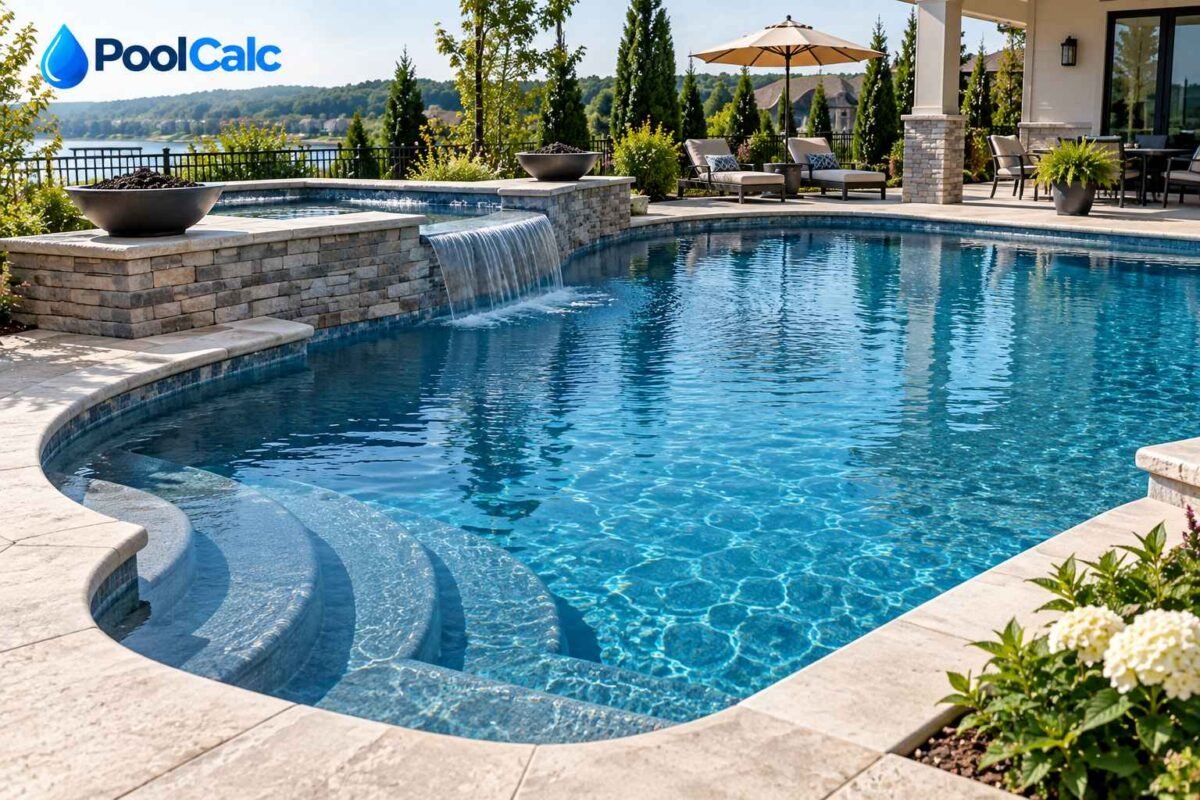
A concrete pool is built on site: a steel frame, sprayed concrete, then a plaster, pebble or tile finish. It can be any shape, any depth, with any feature you can draw — and it will outlast everything else in the garden.
It is also the most demanding to look after. The plaster finish is porous and slightly alkaline, which means it interacts with the water in a way fibreglass and vinyl do not. Get calcium hardness or pH wrong and the surface pays for it.
Concrete is what public pools, competition pools and most high-end residential pools are built from, for good reason: nothing else offers the same freedom of shape or the same lifespan.
At a glance
| Characteristic | Typical |
|---|---|
| Construction | Steel reinforcement, sprayed gunite or shotcrete |
| Finish | Plaster, pebble, quartz or fully tiled |
| Installation | Typically months, with curing time built in |
| Shapes | Unlimited — any shape, depth or feature |
| Resurfacing | Plaster is renewed on a cycle of roughly a decade or more |
Advantages and limitations
What works well
- Any shape, depth or feature — vanishing edges, beach entries, integrated spas, diving wells.
- The longest structural life of any pool type.
- Can be renovated, resurfaced, enlarged or reshaped later.
- Premium finishes such as pebble and tile are only available on concrete.
What to weigh up
- The highest up-front cost and the longest build.
- The porous surface uses more chlorine than fibreglass.
- Algae gets a foothold in the surface texture more easily.
- Plaster needs resurfacing periodically — a significant expense when it comes.
- Rough or etched plaster is uncomfortable underfoot and harbours algae.
Looking after one
- Keep calcium hardness at 200 to 400 ppm. Soft water dissolves calcium straight out of the plaster.
- Hold pH at 7.4 to 7.6 — high pH scales the tile line, low pH etches the plaster.
- Brush weekly, and thoroughly. The surface texture is exactly where algae starts.
- Expect higher chlorine demand than a fibreglass pool of the same size.
- Watch the tile line for scale and deal with it before it hardens.
What it costs to own
Concrete is the most expensive pool to build, and the cost scales with size, depth, finish and features far more than with the other constructions. A plain rectangular gunite pool and a freeform pool with a vanishing edge are very different projects.
Ongoing, budget for slightly higher chemical use and for the resurfacing cycle. Plaster does not last forever, and a resurface is a planned expense rather than a repair — worth setting money aside for from the beginning.
Prices for pools vary enormously by region, access, ground conditions and specification, so no figure is quoted here. The Ownership Cost Calculator uses your own numbers instead of an average that would be wrong for most people.
Calculators for this pool
Questions people ask
How long does pool plaster last?
Roughly a decade or more with well-balanced water, considerably less if calcium hardness or pH are allowed to run out of range. Water chemistry is the single biggest factor in how long a surface survives.
Why is my plaster rough?
Etching — water low in calcium or pH dissolving calcium out of the surface. It does not reverse. Getting the chemistry right stops it getting worse; only resurfacing makes it smooth again.
Do concrete pools use more chlorine?
Yes, noticeably more than fibreglass. The surface is porous and textured, which gives algae somewhere to live and increases chlorine demand.
Gunite or shotcrete — is there a difference?
Both are sprayed concrete. Gunite mixes dry material with water at the nozzle; shotcrete arrives pre-mixed. Done properly, both give an equally sound pool.