
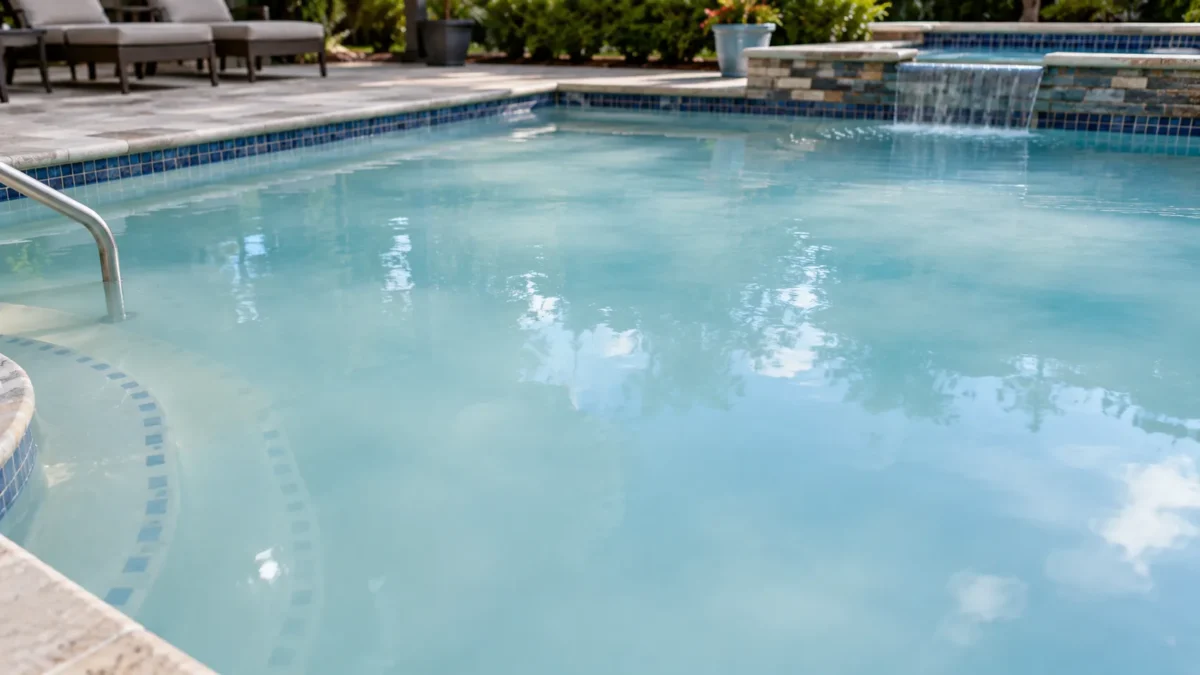
Cloudy water is very fine particles suspended in the pool — too small for the filter to catch on the first pass. The trick is working out where they came from, because the fix is completely different depending on the answer.
There are three broad causes: a chemistry problem putting particles into the water, a filtration problem failing to take them out, or the aftermath of something else — dead algae, a heavy storm, a busy weekend. Testing tells you which.
One quick check narrows it down. If chlorine is low, it is a chemistry problem. If chlorine is fine and the filter pressure is high, it is a filtration problem. If both are fine, it is usually fine debris that simply needs time and circulation.
What causes it
- Low free chlorine. Bacteria and early algae cloud the water before it goes green.
- High pH or high calcium hardness. Calcium comes out of solution as a fine haze, often with scale at the water line.
- A dirty or undersized filter. The most common cause in a pool with good chemistry.
- Not enough run time. Water that is not circulating is not being filtered.
- Dead algae after a shock treatment. Normal, and clears with filtration.
- Fine debris after rain or wind. Pollen, dust and ash are too small to skim.
- Very high cyanuric acid. Chlorine is present but too slow to keep up.
What to test first
Before adding anything, take a reading. Guessing at this stage is how a small problem becomes an expensive one.
| Test this | Why it matters |
|---|---|
| Free chlorine | If it is low, that is the cause. Fix it before anything else. |
| pH | Above 7.8, calcium starts to cloud the water and chlorine slows down. |
| Calcium hardness | Above 400 ppm, high pH will precipitate it as a haze. |
| Total alkalinity | High alkalinity drives pH up, which brings the calcium problem with it. |
| Filter pressure | More than 8 to 10 psi above its clean reading means the filter needs cleaning. |
How to fix it
- Test first. Cloudy water with low chlorine and cloudy water with a dirty filter need opposite actions.
- If chlorine is low, bring it back into range — and if it will not hold, shock the pool.
- If pH is above 7.6, bring it down with acid. This alone clears many cloudy pools.
- Clean or backwash the filter, then check the pressure has dropped back to its clean baseline.
- Run the pump continuously for 24 to 48 hours. Most cloudy water is a filtration problem and filtration takes time.
- Brush and vacuum to lift settled particles into the water where the filter can reach them.
- If it is still cloudy after two days of good chemistry and clean filtration, a clarifier will clump the fine particles so the filter can catch them. Use it as a last step, not a first one.
If you cannot clearly see the bottom of the deep end, keep people out of the pool. Cloudy water hides a swimmer in difficulty and is a genuine drowning hazard, whatever the chemistry says. Never mix pool chemicals, and never add two products to the water one after the other without circulating in between. Chlorine and acid together release chlorine gas. Always add chemical to water, never water to chemical.
Work out the numbers
These calculators give the figures for your pool rather than a rule of thumb.
Stopping it coming back
- Clean the filter on pressure, not on a schedule.
- Keep pH in the 7.4 to 7.6 band so calcium stays in solution.
- Run at least one full turnover a day.
- Test after storms and after heavy use.
Questions people ask
How long does cloudy water take to clear?
With good chemistry and a clean filter, usually 24 to 48 hours of continuous filtration. After a shock treatment for algae, allow three to five days.
Will shocking clear cloudy water?
Only if the cause is low chlorine or organic matter. Shocking a pool that is cloudy because of a dirty filter or high pH achieves nothing and wastes chemicals.
Should I use a clarifier or a flocculant?
A clarifier clumps particles so the filter catches them, and is the easier option. A flocculant sinks everything to the floor to be vacuumed to waste — faster, but it bypasses the filter and drops the water level.
My filter pressure is high. Is that the problem?
Very likely. More than 8 to 10 psi above the clean reading means flow has dropped far enough to affect filtration. Clean it and see what the water does over the next day.
Is my filter too small?
If the chemistry is in range, the filter is clean, and the water still will not clear, an undersized filter is a strong candidate — particularly a sand filter on a busy pool. Check the size against your flow rate.