
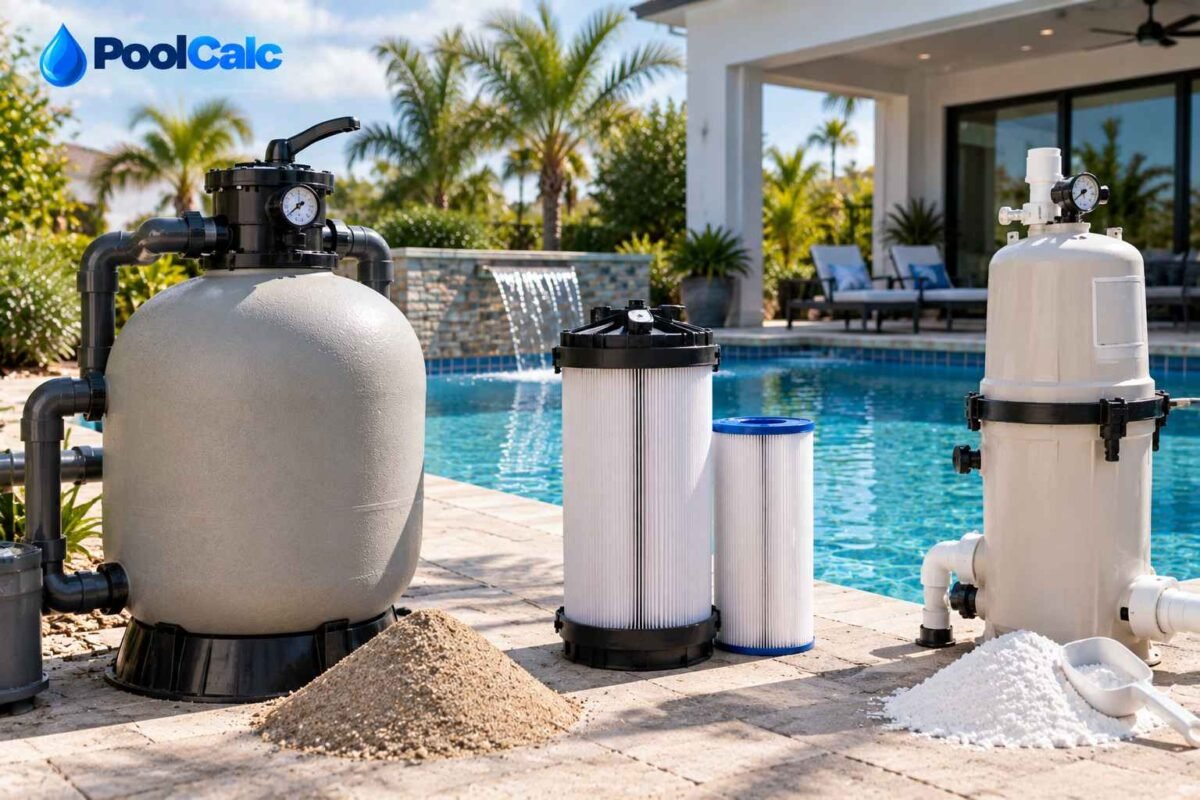
There are three kinds of pool filter in common use. They differ in how fine they filter, how you clean them, and how much water that costs — and those three things point at different pools.
The three types, compared
| Type | Filters down to | Cleaning | Water used |
|---|---|---|---|
| Sand | about 20–40 microns | Backwash | High — hundreds of gallons each time |
| Cartridge | about 10–20 microns | Remove and hose | Almost none |
| DE | about 3–5 microns | Backwash, then recharge with powder | High, plus new powder |
Sand
The cheapest to buy, the simplest to live with, and the coarsest. Cleaning means turning a valve for a couple of minutes. The sand itself lasts years before it needs replacing.
The counter-intuitive part is that a sand filter cleans best when it is slightly dirty — the trapped debris itself narrows the gaps between grains. Backwashing on a schedule rather than on pressure actually gives you worse filtration, as well as wasting water.
Cartridge
Finer than sand, and it uses essentially no water to clean, which matters where water is expensive or restricted. The trade is labour: you shut the system down, open the housing, pull the element and hose it. Cartridges need replacing every few years.
DE
Diatomaceous earth gives the finest filtration available domestically — fine enough to clear water the other two leave slightly hazy. It is also the most work: backwash, then recharge with fresh powder every time. The dry powder should not be breathed in, so it is handled with a mask.
Backwash by pressure, not by calendar
Whatever the type, the gauge decides. Note the pressure when the filter is freshly cleaned — that is the baseline. Clean it when the reading is about 8 to 10 PSI above that. Without the baseline written down the gauge tells you nothing at all, which is why so many filters get cleaned at the wrong time.
A rising pressure reading means the filter is doing its job. A falling one usually means something is restricting flow before the filter — a blocked skimmer basket, a clogged impeller, or a leak drawing air.
Calculators
Sizing
A filter is rated for a maximum flow rate. Push more through it than that and you get worse filtration, not better, because the water spends too little time in the medium. The filter must be able to take everything the pump can deliver — which is one more reason an oversized pump causes problems rather than solving them.
Which filter is best?
For most home pools, cartridge if water is expensive or you want fine filtration with no backwashing, sand if you want the least effort. DE is worth it when you want the clearest possible water and do not mind the work.
How long should I backwash for?
Until the sight glass runs clear, usually two to three minutes, then rinse for around thirty seconds before returning to filter.
Can I use a cartridge filter with a variable-speed pump?
Yes, and they suit each other well: a cartridge filter has low resistance, so the pump can run slowly and still move plenty of water.
Why is my water still cloudy with a clean filter?
Cloudiness that survives good filtration is usually chemistry rather than filtration — most often high pH, or particles too fine for the filter to catch. Check the balance before assuming the filter is at fault.