
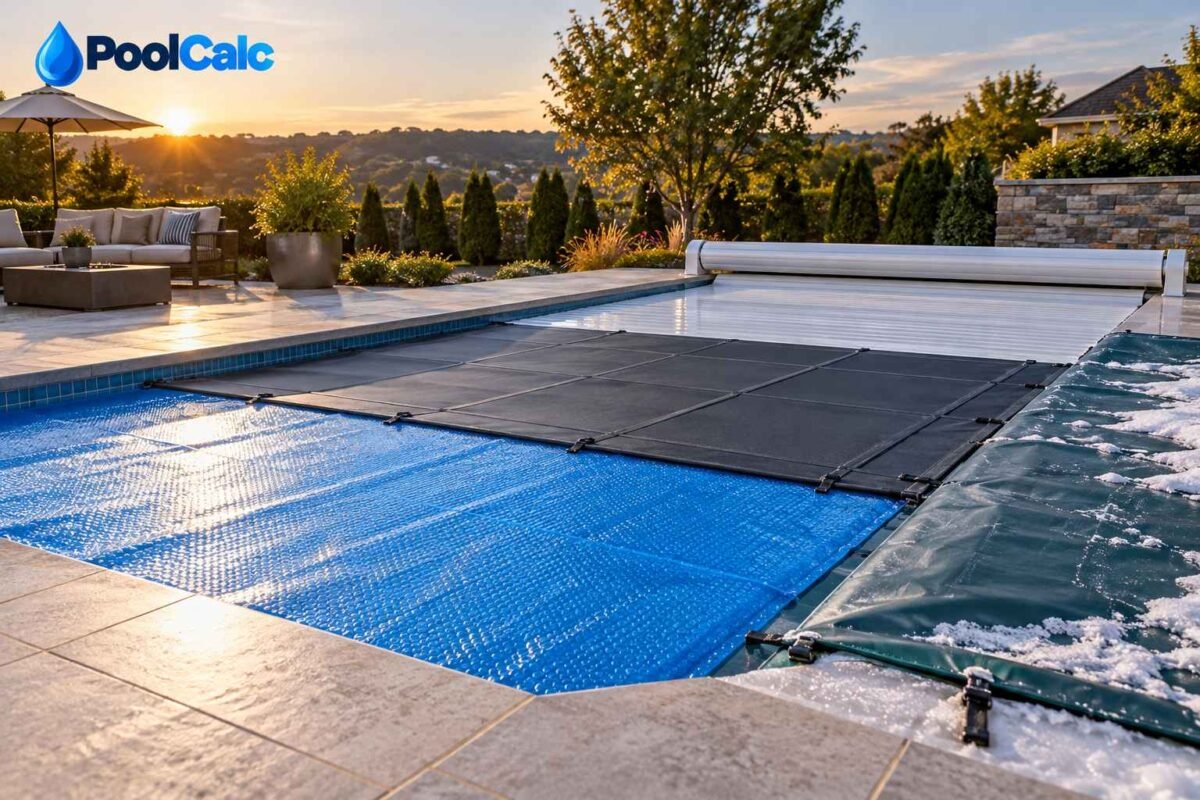
Four quite different products are sold as “pool covers”, they solve four different problems, and buying the wrong one is how people end up disappointed with something that was never designed to do what they wanted. One of them is a safety device. The others are emphatically not.
The four types, and what each is actually for
A solar cover is a floating sheet of bubble material that sits directly on the water. Its job is to stop evaporation and let sunlight through. It is the cheapest cover, the easiest to use, and the one that saves the most money on a heated pool.
A winter cover is an opaque tarpaulin secured over the pool for the closed season. Its job is to keep debris and sunlight out while the pool is not in use. It is not rated to hold weight and it is not a barrier.
A safety cover is an engineered barrier, anchored into the deck, designed and tested to support a specified load. Its job is to prevent a person or animal falling into the pool. It is the only one of the four that is a safety device.
An automatic cover is a motorised rigid or semi-rigid cover that rolls across the pool on tracks. Depending on its specification it can combine the heat retention of a solar cover with genuine safety performance, and it is used daily rather than seasonally — which is precisely why it gets used at all.
Why a cover is the best money a heated pool can spend
A pool loses heat continuously through its surface, and the dominant mechanism is evaporation rather than radiation or conduction. Evaporating water carries away a very large amount of energy — this is the same physics that makes sweating effective.
A cover addresses that loss directly and completely, which is why nothing else comes close for the money. No heater upgrade, no efficiency rating and no thermostat adjustment tackles the dominant loss the way a sheet of floating plastic does.
The saving is not only fuel. Evaporation is also how a pool loses water, so a covered pool needs topping up far less often. Less top-up means less fresh water, which means less dilution of your chemistry and less calcium and alkalinity arriving from the supply. On hard fill water that is a real ongoing benefit rather than a rounding error.
And chlorine lasts longer under a cover, because ultraviolet light is what destroys it. A pool covered between swims holds its sanitiser noticeably better than the same pool left open to the sun.
Our guide to choosing a pool heater makes the same point from the other direction: sizing a heater without also covering the pool is spending money to replace heat you could simply have kept.
Solar covers in detail
These are sold by thickness, usually 8, 12 or 16 mil. Thicker lasts longer and retains slightly more heat; thinner is cheaper and much easier to handle. For most owners, 12 mil is the sensible middle.
They go bubble side down, which surprises people. The bubbles trap air against the water surface and that trapped air is the insulation. Laid the other way up the cover still reduces evaporation but retains noticeably less heat.
The practical problem with solar covers is handling. A full-size sheet is awkward, heavy when wet, and unpleasant to wrestle on and off twice a day. A reel makes the difference between a cover that gets used and one that spends the summer rolled up behind the shed — and an unused cover saves nothing at all.
Liquid solar covers are an alternative worth knowing about. They form a microscopically thin layer on the surface that slows evaporation. They are much less effective than a physical cover, they are disrupted by swimming and wind, and they need re-dosing. But they require no handling whatsoever, which for some owners makes them the cover that actually gets used.
A solar cover is not a safety device. It looks like a solid surface, it is not, and a child or animal that gets onto or under one can be trapped beneath it. Never leave a solar cover on a pool that is accessible to children, and remove it fully before anyone swims.
Safety covers in detail
This is the category where the standards matter. A safety cover is anchored into the surrounding deck and is designed to support a specified load without allowing a person through — the relevant US standard covers static load, perimeter gaps and labelling.
They come in two constructions. Mesh covers let rain and melt water through, so nothing pools on top, and they are lighter to handle. They do let some light through, which means a little algae growth over a long closed season. Solid covers block light entirely and keep the water cleaner, but they hold rainwater, so they need a cover pump to remove it — and a solid cover with several inches of water standing on it is both a hazard and a strain on the anchors.
Installation is not a DIY job in most cases, because the anchors have to be set into the deck accurately and the tension has to be right. A badly fitted safety cover is not a safety cover.
For households with young children, the CPSC’s Pool Safely campaign is the reference worth reading, and its guidance on layers of protection for parents makes the important point that a cover is one layer among several rather than a complete answer. Our pool safety guide covers the full picture.
Winter covers in detail
A winter cover is the cheapest way to close a pool, and it is exactly what it looks like: a tarpaulin held down by water bags, or by the coping in the case of an above-ground pool.
It keeps leaves and sunlight out, which is most of what a closed pool needs. What it does not do is support weight — and this is the source of the most common serious accident around closed pools, because a winter cover with leaves and snow on it can look deceptively solid.
Water bags are used rather than bricks or blocks for a specific reason: if someone does fall onto the cover, a water bag gives way, while a concrete block becomes a projectile and a hazard. Never use solid weights.
Winter covers also need a cover pump, because rain and melt water collect on top. Left to accumulate, the weight will drag the cover into the pool, taking all the collected debris with it, which turns a straightforward spring opening into a difficult one.
Automatic covers in detail
These are the most expensive option by a considerable margin, and the one owners are most consistently pleased with — for a simple reason. A cover that closes at the press of a button gets used every time. A cover that takes ten minutes to drag on gets used when somebody feels like it.
Because they are used daily, automatic covers capture the full heat, water and chemical savings that a solar cover only captures in theory. Over a season that adds up considerably, and on a heated pool it offsets a meaningful share of the purchase price.
Many are rated as safety covers as well, which makes them the only product that does both jobs. Check the specification rather than assuming: not every automatic cover carries a safety rating.
The drawbacks are cost, the fact that the track system constrains pool shape — they suit rectangles far better than freeform designs — and mechanical complexity. Motors, tracks and fabric all eventually need servicing, and replacement fabric is not cheap.
Choosing between them
| If you want to… | Buy |
|---|---|
| Cut heating costs on a pool in use | Solar cover, with a reel |
| Keep children and pets out of the water | Safety cover, or a rated automatic cover |
| Close the pool cheaply for winter | Winter cover, with a cover pump |
| Have a cover that actually gets used daily | Automatic cover |
| Reduce water loss on an exposed, windy site | Any physical cover |
| Keep leaves out during autumn | Leaf net over whatever you already have |
A leaf net deserves a mention of its own. It is a fine mesh laid over the cover during leaf fall, and it turns the miserable job of cleaning a debris-laden cover into lifting one light sheet. For a pool under trees it is among the best value items available.
Looking after a cover
Covers are consumables, and how long they last depends almost entirely on how they are treated.
- Never leave a solar cover folded in the sun. Concentrated heat in the folds will destroy the bubbles in a single afternoon. Store it rolled, shaded or covered.
- Remove it before shocking. High chlorine degrades cover material quickly, and a cover left on during a shock treatment can be visibly damaged within a day.
- Rinse it before storage. Chemical residue left to dry shortens the material’s life.
- Keep water off the top. On solid and winter covers, run the cover pump. Standing water is weight, and weight is what tears covers and pulls out anchors.
- Check anchors annually on a safety cover. A cover is only as good as what holds it down.
A solar cover treated well lasts three to five seasons. The same cover left folded on a hot deck may last one.
What a cover will not fix
Covers do not sanitise. A covered pool still needs chlorine, still needs circulation, and still needs testing. A pool covered and ignored for a fortnight in summer will still develop problems, and a solid cover in particular can create a warm dark environment that suits some organisms very well.
Nor do they eliminate the need to run the pump. Water that does not circulate is not filtered or sanitised regardless of what is on top of it — see how long to run a pool pump.
And a cover does not replace a barrier. In a household with small children, a fence with a self-closing, self-latching gate is the primary protection, and the cover is a supplementary layer. That distinction has been the subject of a great deal of research and it is not a technicality.
Sizing, fitting and the reel
A solar cover is cut to the pool, and it should be cut slightly oversize then trimmed to fit once it is floating. Trim it to the waterline, not to the coping — a cover that rides up the walls traps debris underneath and is harder to roll.
The reel is what determines whether the cover gets used, and it is worth more attention than the cover itself. A cover that takes two people ten minutes to remove will be left off during the week; one that a single person can roll back in a minute gets used twice a day.
For pools wider than about eighteen feet, look for a reel with a solid tube rather than a telescoping one, because long telescoping tubes flex and bind under load. On a wide pool, two narrower covers on one reel are often easier to handle than one wide sheet.
Safety covers are measured and fabricated to the specific pool, including any steps, and the anchors are drilled into the deck. This is not a job to attempt with a generic cover and improvised anchoring: the load rating depends on the geometry being right.
What a cover saves, in rough terms
Precise savings depend on climate, wind exposure, how warm you keep the water and how often the cover is actually on. The pattern, though, is consistent enough to plan around.
On heat, a cover addresses the dominant loss directly, and on a heated pool it is routinely the difference between a heating bill that is tolerable and one that is not. This is the saving that pays for the cover.
On water, evaporation is how an uncovered pool loses most of its volume. A covered pool needs topping up far less often, which matters financially where water is metered and matters chemically everywhere, because every top-up dilutes your balance and brings in whatever your supply carries.
On chemicals, ultraviolet light is what destroys free chlorine. A pool covered between swims holds its sanitiser noticeably longer, which reduces both chlorine consumption and the stabiliser needed to protect it.
On cleaning, a covered pool collects a fraction of the debris, which means less vacuuming, less filter loading and less time with a net. Put the filling cost calculator and the heating cost calculator against your own figures to see what the four add up to for your pool.
Calculators
Work out what a cover would save you
Which side of a solar cover goes down?
Bubbles down, against the water. The trapped air is the insulation. Laid the other way it still reduces evaporation but retains considerably less heat.
Is a solar cover a safety cover?
No, and this is an important distinction. A solar cover looks like a solid surface and is not one. A child or animal that gets onto or under it can be trapped. Only a rated safety cover is a safety device.
Do I need to remove the cover to run the pump?
No. Circulation works normally with a cover on. You do need to remove a solar cover before swimming, and before shocking.
Mesh or solid safety cover?
Mesh lets water through so nothing accumulates on top and it is lighter to handle, at the cost of letting some light through. Solid keeps the water cleaner but needs a cover pump to remove rainwater. In snowy regions mesh is usually easier to live with.
How long does a solar cover last?
Three to five seasons if it is stored out of direct sun and removed before shocking. One season if it is left folded on a hot deck, which destroys the bubbles.
Are automatic covers worth the money?
On a heated pool used regularly, often yes — mainly because they get used every single time, so they capture the full saving rather than the theoretical one. On a pool used occasionally the payback is much longer.
Can I use a winter cover as a safety cover?
No. A winter cover is a tarpaulin. It is not anchored, not rated, and will not support weight. It is one of the more dangerous misunderstandings in pool ownership.
Will a cover make my pool water cloudy or smelly?
It can if the pool is covered and then neglected. A cover does not sanitise; a covered pool still needs chlorine, circulation and testing. Cover a well-maintained pool and it stays cleaner; cover a neglected one and it gets worse faster.