
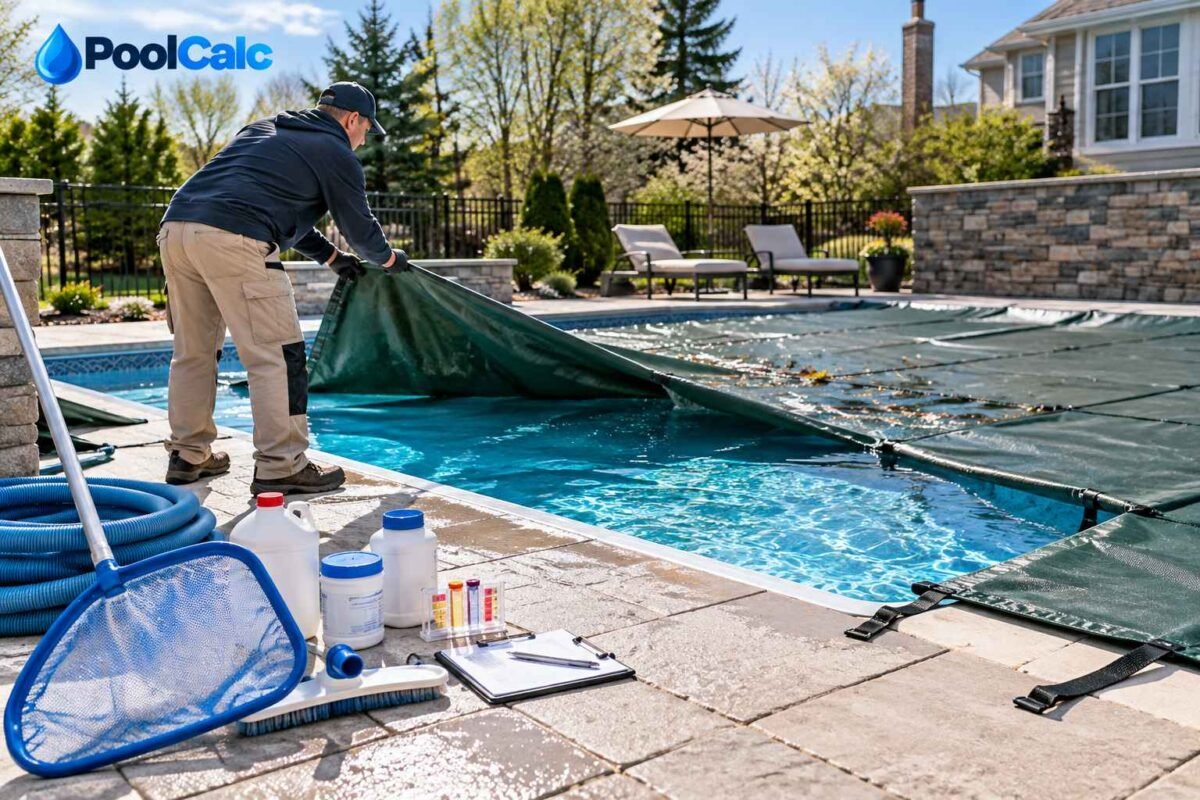
Opening a pool badly costs a fortnight and a great deal of chemical. Opening it well takes an afternoon and a few days of patience. The difference is almost entirely in the order you do things, and in resisting the urge to add chemicals before you know what you are dealing with.
Open earlier than you think
The most common and most expensive mistake is waiting for warm weather. Owners wait until it feels like swimming season, pull off the cover, and find a green pool that takes two weeks and several hundred dollars to recover.
Algae growth accelerates sharply once water rises above about 60 °F. Open while the water is still cold and there is essentially nothing living in it; open in late spring and you are not opening a pool, you are treating one.
The practical rule is to open when daytime air temperatures are consistently in the 60s, regardless of whether anybody intends to swim for another month. The cost of running the pump for those extra weeks is far less than the cost of clearing an algae bloom, and the pool is ready when you want it rather than two weeks after.
Before you touch the cover
Clear the cover first. Remove standing water with a cover pump, then sweep or blow off leaves and debris while the cover is still in place. Everything you remove now is something that does not end up in the water.
This step is worth doing thoroughly. Tipping a winter’s worth of leaves and black water into an otherwise clean pool converts a two-hour job into a multi-day one, and it is entirely avoidable.
Then pull the cover back slowly from one end, with a second person if the pool is large, keeping the edge lifted so debris slides toward you rather than in. Lay it out on the lawn, hose it down, let it dry completely, and fold it. A cover put away damp comes out mildewed.
Reassemble before you add anything
Put the equipment back together and get water moving before you think about chemistry. There is no point dosing water that is not circulating.
- Remove winter plugs from the returns, skimmers and the pump, and reinstall the normal fittings, eyeballs and drain plugs.
- Reinstall anything removed for winter: ladders, rails, the diving board, baskets, the cleaner.
- Raise the water level to mid-skimmer. It will have dropped over winter.
- Reinstall filter and pump drain plugs before filling anything. Forgetting one is the classic way to spend the afternoon mopping.
- Prime the pump, start it, and check for leaks at every union and fitting while you can still see them.
- Check the filter pressure once it is running, and write the number down. That is your clean baseline for the whole season.
That last step takes ten seconds and is skipped almost universally. Without a clean baseline, the filter pressure gauge tells you nothing at all for the rest of the year, and you end up backwashing on a calendar instead of on a reading.
Now test — and test the right things
Run the pump for at least a full turnover before testing anything. Water that has sat still all winter is stratified, and a sample from the top is not representative.
Then take a complete set of readings: free chlorine, combined chlorine, pH, total alkalinity, cyanuric acid and calcium hardness. Salt too, if you have a salt system. This is one of only two times a year a full panel is genuinely worth doing.
Expect surprises. Cyanuric acid often reads lower than it did in autumn, because winter rain dilutes it. Calcium may read higher if the pool lost water to evaporation and was topped up. Alkalinity will usually have drifted. None of this is a problem; it is simply why you test before dosing rather than after.
Our guide to testing pool water properly covers sampling technique, and the health check will take a full set of readings and tell you which to fix first.
Balance before you chlorinate
This is the order that saves the fortnight.
Correct total alkalinity first, because it controls whether pH will stay where you put it. Then pH, to between 7.2 and 7.6 — and aim toward the lower end, because you are about to add a lot of chlorine and pH above 7.8 makes much of it ineffective. Then calcium hardness if it is out of range, though it rarely needs urgent attention at opening.
Only now does chlorine become worth adding. Adding chlorine to water at pH 8.2 is pouring money into a pool where three-quarters of it will do nothing useful. The reasoning is covered in alkalinity and pH.
If cyanuric acid reads under 20, add stabiliser now as well — otherwise the chlorine you are about to add will burn off in the spring sun faster than you can replace it.
Shock, and be prepared for it to take more than once
Once balance is right, shock the pool to the level your cyanuric acid reading demands — roughly 40% of the CYA figure. Add it in the evening, run the pump continuously, and test in the morning.
On a pool that closed well, one shock and a day of filtering is usually enough. On a pool that closed badly, expect to hold shock level for several days, re-dosing each evening until the overnight chlorine loss falls below 1 ppm. That overnight test is the thing that tells you whether you are finished.
If chlorine vanishes completely and repeatedly no matter how much you add, the pool may have developed ammonia over winter — a known consequence of closing a pool with low chlorine. The demand is enormous but finite. Keep dosing and it will break through, usually after a great deal more chlorine than seems reasonable.
Our guide to shocking properly covers the dose, and why a pool will not hold chlorine covers the diagnosis if it refuses to clear.
Brush, filter, and wait
Brush the entire pool, including the places nobody brushes: behind the ladder, under the steps, the tight corners, the waterline. Whatever survived the winter is there, and chlorine cannot reach what is under a protective layer.
Then run the pump continuously. Not eight hours a day — continuously, until the water is clear. Filtration is the slowest part of an opening and the part people short-change. Clear water is a filtration outcome, not a chemical one.
Watch the filter pressure. A pressure rise of 8 to 10 PSI above the baseline you wrote down means it is time to clean or backwash, and during an opening that can happen more than once in a day. A filter that is not cleaned when it needs it simply stops working.
Expect three to five days from shock to genuinely clear water on a typical opening. A pool that was closed badly can take a week or more, and no amount of additional chemistry accelerates the filtering stage.
What to check while everything is exposed
Opening is the best opportunity of the year to inspect things you will not see again until autumn.
- The surface. Look for new cracks, chips, or plaster that feels rough where it was smooth. Rough plaster usually means the water was aggressive — see calcium hardness.
- Tile and grout. Missing grout and loose tiles are far cheaper to fix early.
- The liner, on a vinyl pool. Check seams, wrinkles and any fading around fittings.
- Equipment. Look for corrosion, drips, cracked unions and perished O-rings. A union that weeps now will fail in July.
- Electrical. Bonding, the GFCI on the pump circuit, and the light housing. If anything looks doubtful, this is a job for an electrician rather than an experiment.
- The barrier. Fence, gate, latch, self-closing hinge. The Pool Safely campaign is clear that the barrier is the primary layer of protection, and spring is when to check it works.
A realistic timeline
| When | What |
|---|---|
| Day 1, morning | Clear and remove the cover; reassemble equipment; fill to mid-skimmer; start the pump; note baseline pressure |
| Day 1, afternoon | Run a full turnover, then test everything |
| Day 1, evening | Correct alkalinity and pH; add stabiliser if low; shock after dark |
| Day 2 | Brush thoroughly; run continuously; test morning and evening; re-shock if chlorine fell |
| Days 3–5 | Keep filtering; clean the filter when pressure rises 8–10 PSI; re-test |
| Day 5–7 | Water clear; chlorine holding overnight; return to a normal schedule |
Do not swim yet
Water that looks clear is not automatically water that is safe. Before anyone gets in, free chlorine should be back below about 4 ppm, pH in range, and combined chlorine under 0.5 ppm.
The reason to be particular about this is that the germs responsible for recreational water illness are killed by free chlorine at proper levels, and a pool still working through its opening demand is not yet at proper levels reliably. The CDC’s healthy swimming guidance is the reference, and the short version is that clarity and safety are different things.
If you have opened to a green pool
It happens, most often after a mild winter or a cover that failed. The pool is opaque green and it is tempting to drain it. Usually you should not.
Draining an in-ground pool carries real risk: a shell can float out of the ground if groundwater is high, and plaster left dry can crack. It also wastes a great deal of water and the refill brings its own chemistry. Treat first, and drain only if cyanuric acid or calcium is too high to correct any other way.
- Remove the debris physically. Net out leaves and sludge before adding anything. Chemicals spent oxidising leaf litter are chemicals wasted.
- Test, and get pH into range first. At pH 8.2 most of the chlorine you are about to add will do nothing.
- Test cyanuric acid before dosing. It sets the shock target, and after a winter of rain it is often lower than you expect — which is good news, because the shock is cheaper.
- Shock to target and hold it. Re-dose every evening until overnight loss is under 1 ppm. This commonly takes three to five days on a green pool.
- Brush daily, everywhere, including behind the ladder and under the steps.
- Run the pump continuously and clean the filter whenever pressure rises 8 to 10 PSI. On a bad opening this can be twice a day.
- Expect the colour to change before it clears. Green turns cloudy grey or white as the algae dies. That is progress, not a new problem, and the remaining job is filtration.
The grey stage is where people give up, because the pool looks worse than when they started. It is the point at which the chemistry has worked and only filtering remains, and it clears with time and a clean filter.
A short shopping list
Having these on hand before you start turns a two-day job into an afternoon, because nothing stops for a trip to the shop.
- A full test kit with in-date reagents — last season’s will read low
- Liquid chlorine, more than you think, for shocking
- Alkalinity increaser and pH decreaser
- Stabiliser, if the winter rain has diluted it
- A replacement set of filter O-rings and lubricant
- Winter plugs removed and the normal fittings located before you start
- A cover cleaner, or simply a hose and a soft brush
Calculators
Work out your opening doses
Water Health Check
Enter your test results and see what is in range, what is not, and what to do first.
CalculateWhen should I open my pool?
When daytime temperatures are consistently in the 60s, regardless of when you intend to swim. Algae takes off above about 60 °F water temperature, and opening before that point is far cheaper than treating a bloom afterwards.
Should I drain and refill instead of treating a green pool?
Usually not. Draining risks a plaster shell floating or cracking if groundwater is high, it wastes a great deal of water, and refilling brings its own chemistry. Treat first; drain only if cyanuric acid or calcium is too high to correct any other way.
How long does opening take?
An afternoon of work and three to five days of filtering on a pool that closed well. A week or more if it closed badly. The filtering stage is the slow part and cannot be rushed with chemicals.
Do I need to shock at opening even if the water looks clear?
Yes. Clear water can still carry a substantial chlorine demand, and the overnight loss test after a shock is what confirms the pool is genuinely clean rather than merely transparent.
My chlorine disappears as fast as I add it. What now?
Keep going. A pool that overwintered with little chlorine can develop an ammonia demand that consumes extraordinary amounts before anything registers. It is finite, and holding shock level will eventually break through.
Should I replace the water every few years?
Not on a schedule, but partial drains become necessary when cyanuric acid or calcium hardness climb past what you can correct. Testing at opening is what tells you whether this is that year.
Can I add all my chemicals at once to save time?
No. Add one at a time with a full turnover between, and never combine chlorine with acid in any form. Beyond the safety issue, dosing everything at once makes it impossible to tell what worked.
Is it worth paying for a professional opening?
It can be for the first one, particularly if you inherited the pool and do not know how the equipment goes together. After watching it done once, most owners find the job straightforward.