
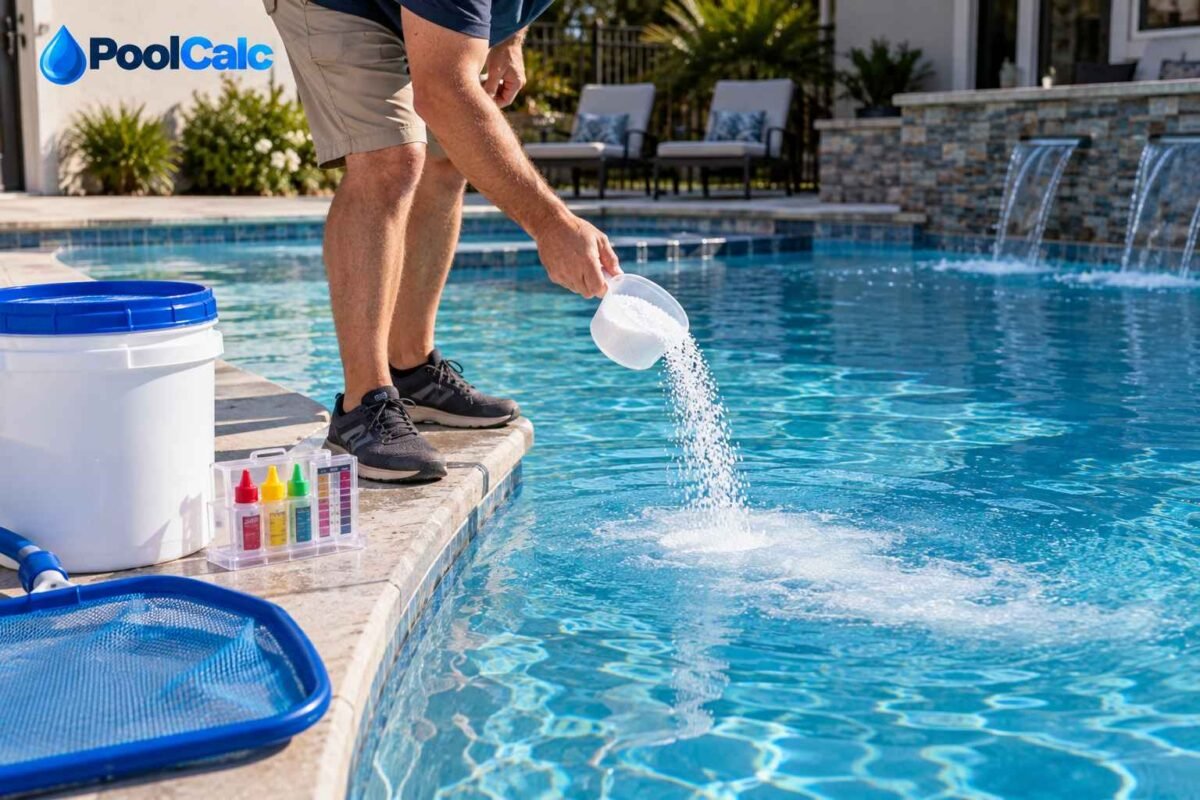
Shocking a pool is the most misunderstood job in pool care. Most people do it on a schedule, at a dose printed on a bag, and then wonder why the water has not cleared by morning. The dose that actually works is not a fixed amount — it depends on a reading most owners have never taken.
What shocking actually is
Shocking means raising free chlorine high enough, and holding it there long enough, to destroy what normal sanitiser levels cannot. That is a different job from sanitising, even though it uses the same chemical.
Day to day, chlorine kills what arrives in the water — bacteria off skin, spores blown in on the wind, whatever a swimmer brings with them. It handles a steady trickle. Shocking clears a backlog: the chloramines that have built up, the algae that has taken hold, the sweat and sunscreen and pollen and leaf tannin that ordinary chlorine levels cannot work through fast enough.
The word itself causes half the confusion, because “shock” is both a product on a shelf and a process in the water. You are not adding a magic ingredient. You are raising free chlorine to a target and keeping it there until the water passes a test. Any product that gets you to that target will do the job; the differences between them are in what else they leave behind.
Understanding that one distinction changes how you approach every part of this. You stop asking “how many bags?” and start asking “what is my target, where am I now, and what gets me there without wrecking something else?”
The reading that decides your dose
Cyanuric acid — stabiliser, or conditioner — binds loosely to chlorine and shields it from ultraviolet light. Without it, an outdoor pool can lose most of its free chlorine in a single sunny afternoon. With it, that chlorine survives the day.
The trade-off is that bound chlorine is not working chlorine. Stabiliser protects your chlorine by holding it in reserve, which means the more stabiliser you have in the water, the more total chlorine you need in order to get the same sanitising strength. A free chlorine reading of 3 ppm means something quite different at 30 ppm CYA than it does at 90.
This is why a standard bag dose does nothing in some pools and works fine in others. The widely used working figure is that an effective shock level is about 40% of your cyanuric acid reading. In a pool sitting at 30 ppm CYA, shock is roughly 12 ppm free chlorine. At 80 ppm CYA, it is 32 ppm — nearly three times the chlorine for exactly the same job, in exactly the same pool.
| Cyanuric acid | Shock target | Normal minimum | Roughly how much liquid chlorine, 20,000 gal |
|---|---|---|---|
| 30 ppm | 12 ppm | 2.3 ppm | about 2.4 gal from zero |
| 40 ppm | 16 ppm | 3.0 ppm | about 3.2 gal |
| 50 ppm | 20 ppm | 3.8 ppm | about 4.0 gal |
| 60 ppm | 24 ppm | 4.5 ppm | about 4.8 gal |
| 80 ppm | 32 ppm | 6.0 ppm | about 6.4 gal |
| 100 ppm | 40 ppm | 7.5 ppm | about 8.0 gal |
Those last figures assume 12.5% liquid chlorine and a starting point of zero free chlorine, which is unusual — in practice you are topping up from wherever you are. They are there to show the shape of the problem: the chemical bill for a shock roughly triples between a well-managed pool and a neglected one, and the difference is entirely down to a reading that costs nothing to take.
If you have never tested cyanuric acid, test it before you shock anything. It is the most common single reason a shock treatment fails, and it is covered in full in our guide to what cyanuric acid does to your chlorine.
At 100 ppm CYA and above, shocking stops being practical. You would need 40 ppm of free chlorine, which is a great deal of chemical, a long wait before anyone can swim, and a real risk of bleaching a vinyl liner. At that point the answer is dilution: drain part of the pool and refill. No chemical removes cyanuric acid.
When you actually need to shock
Not weekly, and not because it is Saturday. Shocking on a fixed schedule wastes chemical on the weeks you did not need it and leaves you short on the weeks you did. Shock when there is a reason, and the reasons are mostly measurable.
- Combined chlorine above 0.5 ppm. This is the one you can measure. Combined chlorine is total chlorine minus free chlorine, and it is the chloramines responsible for the smell people mistake for “too much chlorine”.
- Algae, or water that has gone cloudy and will not clear. Diagnose first — see green water and cloudy water, because the two have different causes and only one of them is fixed by chlorine.
- After heavy use. A pool party puts more organic load into the water in one afternoon than a fortnight of ordinary swimming.
- After a storm. Runoff brings organics, phosphates, dust and dilution all at once, and the dilution lowers your chlorine at precisely the moment the load goes up.
- On opening and on closing. Both are covered in the seasonal sections of the maintenance routine.
- After a fecal or vomit incident. This is not an ordinary shock and it has its own procedure.
That last case deserves particular attention because the response depends on what happened. A formed stool and diarrhoea call for very different chlorine levels and contact times, and the difference matters: some parasites survive routine chlorination for days. The CDC publishes the specific procedures in its healthy swimming prevention guidance, and it is worth reading before you need it rather than while standing at the poolside with a net.
Free, combined and total chlorine
Three numbers, and the relationship between them tells you most of what you need to know.
| Reading | What it is | What it means |
|---|---|---|
| Free chlorine (FC) | Chlorine still available to sanitise | The working number. Hold it at 7.5% of CYA or above. |
| Combined chlorine (CC) | Chlorine already bound to contaminants | Should be under 0.5 ppm. Above that, shock. |
| Total chlorine (TC) | Free plus combined | On its own it tells you very little. |
Test strips that report only “total chlorine” are the reason so many owners are flying blind. A reading of 3 ppm total could be 3 ppm free and no combined, which is healthy, or 1 ppm free and 2 ppm combined, which is a pool in trouble. If your kit cannot separate the two, that is the first thing worth upgrading.
The mechanism behind shocking is called breakpoint chlorination. Chloramines are destroyed only once free chlorine rises to roughly ten times the combined chlorine reading. Below that point you partially oxidise them, which can make the smell worse rather than better — which is exactly what people report when they add “a bit of shock” and find the pool smells stronger afterwards.
Which shock product to use
Four products are commonly sold as shock. They are not interchangeable. Each raises chlorine; each does something different to the rest of your water, and those side effects accumulate over a season.
| Product | Strength | Side effect | Best for |
|---|---|---|---|
| Liquid chlorine (sodium hypochlorite) | 10–12.5% | Adds a little salt. Effectively pH-neutral once it has reacted. | Almost every situation |
| Cal-hypo (calcium hypochlorite) | 47–73% | Adds calcium hardness — roughly 0.8 ppm per 1 ppm chlorine at 73% | Pools genuinely low in calcium |
| Dichlor | 56–62% | Adds cyanuric acid — roughly 0.9 ppm per 1 ppm chlorine | Rarely the right choice for shocking |
| Non-chlorine shock (MPS) | n/a | Oxidises but does not sanitise | Clearing chloramines when you cannot raise chlorine |
For most pools most of the time, liquid chlorine is the right answer. It adds nothing that builds up, it dissolves instantly rather than sitting on the floor, and per pound of available chlorine it is usually the cheapest. Its drawbacks are that it is bulky, it loses strength on the shelf — a jug stored warm for a month is noticeably weaker than the label claims — and it is corrosive to handle.
Cal-hypo makes sense when calcium is genuinely low, because you get two jobs from one product. But every shock adds hardness you cannot remove, and calcium is effectively a one-way reading. A season of cal-hypo shocking in a pool that started at 300 ppm can finish it well past 500, at which point you are looking at scale on the tile and inside the heater. It also needs pre-dissolving in a bucket, and it must never be stored near trichlor.
Dichlor is the trap, because it is convenient and it dissolves beautifully. Shocking with it can add 20 or 30 ppm of cyanuric acid in a single treatment. Do that three or four times across a summer and you have permanently changed how much chlorine your pool needs for the rest of its life, with no way back except draining. It has a legitimate use — starting a fresh fill that needs stabiliser anyway — but shocking an established pool is not it.
Non-chlorine shock is an oxidiser, not a sanitiser. It will clear chloramines and let people swim sooner, but it kills nothing at all. It also interferes with DPD chlorine tests for a day or so afterwards, which can make your readings look inexplicable. Useful in its place; not a substitute for chlorine.
How to shock properly
- Test first. Free chlorine, combined chlorine, pH and cyanuric acid. Without the CYA reading you are guessing at the target, and without pH you may be about to waste most of the dose.
- Get pH into range. Between 7.2 and 7.6. Above 7.8, much of the chlorine you add sits in its inactive form and the shock underperforms badly. This is covered in alkalinity and pH.
- Brush the pool if you are dealing with algae. Chlorine cannot reach what is under a protective layer, and brushing is what exposes it.
- Work out the dose from your actual volume, your current free chlorine and your shock target — not from the bag.
- Add at dusk or after dark. Sunlight destroys unstabilised chlorine fast, and a shock dose is far above what your stabiliser can protect.
- Pre-dissolve anything granular in a bucket of water. Chemical into water, never water into chemical.
- Run the pump. Not for an hour — for a full turnover at minimum, and overnight is better.
- Re-test in the morning. If free chlorine has held near target and combined chlorine is below 0.5 ppm, it worked.
- Wait to swim until free chlorine is back under about 4 ppm.
The overnight test in step eight is the important one, and it is the step most people skip. A pool with live algae will consume the entire dose by morning. A clean pool will hold most of it. That difference is the clearest diagnostic you have, and it costs nothing but patience.
Why a shock fails
If the water has not cleared by the next morning, one of these is almost always the reason.
| What you see | Likely cause | What to do |
|---|---|---|
| Chlorine gone by morning | Live algae still consuming it, or the dose never reached shock level | Re-dose to target and hold it each evening until overnight loss is under 1 ppm |
| Chlorine held but water still cloudy | Filtration, not chemistry | Check filter pressure, run longer, see cloudy water |
| Smell got worse | Partial oxidation — you stopped short of breakpoint | Raise chlorine further, not less |
| Nothing changed at all | High CYA, so the dose was never a shock dose for this pool | Test CYA, then dilute if it is very high |
| Water turned cloudy after shocking | Calcium or metals knocked out of solution | Check calcium and pH; if there are metals, see pool stains |
| Water turned green or brown after shocking | Metals in the water oxidising | Stop. Chlorine will set the stain permanently. Use a sequestrant first. |
That last row is worth dwelling on, because it is the one that does lasting damage. If a pool turns brown, green or purple after chlorine goes in rather than before, the cause is usually dissolved metal — iron, copper or manganese from fill water, a corroding heater, or an algaecide containing copper. Shocking a pool with metals in it drives them out of solution and onto the surface, and a metal stain set by chlorine is extremely difficult to remove.
The counter-intuitive rule: a pool that smells strongly of chlorine almost always has too little free chlorine, not too much. The smell is chloramines, and chloramines exist precisely because there was never enough chlorine to finish the reaction. See why your pool smells of chlorine.
Shocking different kinds of pool
Saltwater pools. A salt pool is a chlorine pool, so it needs shocking for the same reasons. The cell produces chlorine steadily but cannot reach shock levels quickly — most have a boost or superchlorinate mode, and even that takes many hours. Adding liquid chlorine directly is faster and does not overwork the cell. See saltwater versus chlorine.
Vinyl liner pools. Undissolved granular shock sitting on a liner will bleach it, permanently, in the shape of the pile. Always pre-dissolve, and never broadcast granules across a vinyl pool. Very high chlorine held for days can also fade patterns, which is another argument for fixing high CYA rather than shocking around it.
Above-ground pools. Usually smaller, so doses are smaller and easy to overshoot — work from your real volume, which is often less than the box claimed. Many have limited filtration, so allow longer for the water to clear after the chemistry is right.
Indoor pools. No sunlight means no stabiliser is needed, which means shock levels are low and easy to reach. But chloramines have nowhere to go, so ventilation matters as much as chemistry; the sharp smell in an indoor pool is almost always a ventilation and chloramine problem rather than an excess of chlorine.
A worked example
A 20,000 gallon plaster pool. Free chlorine reads 1.5 ppm, combined chlorine 1.2 ppm, pH 7.8, cyanuric acid 50 ppm. The water is faintly cloudy and smells of chlorine.
- Combined chlorine is 1.2 ppm, well over the 0.5 ppm threshold. That is the reason to shock, and the smell confirms it.
- CYA is 50 ppm, so the shock target is 40% of that: 20 ppm free chlorine.
- pH at 7.8 is too high — bring it to about 7.4 first, or a large part of the dose will be wasted.
- Current free chlorine is 1.5 ppm, so the rise needed is 18.5 ppm.
- At 12.5% strength that is roughly 3.7 gallons of liquid chlorine for 20,000 gallons.
- Add after dark, run the pump overnight, test in the morning.
By morning, free chlorine at 17 or 18 ppm with combined chlorine under 0.5 means it worked and the pool simply needs to come back down. Free chlorine at 4 ppm means something consumed 14 ppm overnight, and the answer is to dose again rather than to conclude that shocking does not work.
Shocking on a schedule versus shocking on a reading
Most pool retailers recommend shocking weekly. It is simple advice, it sells chlorine, and for a pool nobody tests it is better than nothing.
For a pool that is tested, it is wasteful in both directions. On the weeks when combined chlorine is 0.1 ppm, the shock achieves nothing and costs money. On the weeks when it is 1.5 ppm, a standard dose falls short of breakpoint and makes the smell worse.
Shocking on a reading — combined chlorine above 0.5 ppm, or a visible problem — costs less over a season and works better when it is done. The only thing it requires is a test kit that separates free from combined chlorine, which most strips do not.
There is one schedule worth keeping: shock at opening and at closing, regardless of readings. Both are transition points where the pool has been sitting without normal circulation, and both benefit from starting clean.
Calculators
Work out your own numbers
How often should I shock my pool?
When there is a reason, not on a schedule. The measurable trigger is combined chlorine above 0.5 ppm. A pool that is tested regularly and holds its chlorine may go weeks without needing it; a neglected one may need it twice in a week. Shocking a pool that does not need it wastes chemical and, if you are using cal-hypo or dichlor, quietly pushes calcium or stabiliser up.
Can I over-shock a pool?
You can waste chemical and you will wait longer before anyone can swim, but shock levels themselves do not harm a well-balanced pool. What does cause harm is undissolved granules on a vinyl liner, repeated cal-hypo in a pool that already has high calcium, or shocking water that contains dissolved metals.
How long after shocking can we swim?
Until free chlorine is back below about 4 ppm, which is usually the following day with the pump running. Test rather than time it, because the answer depends on your dose, your stabiliser level and how much sun the pool gets.
Do I need to shock a saltwater pool?
Yes. The cell makes chlorine continuously but cannot reach shock levels quickly. Most systems have a boost mode; adding liquid chlorine directly is faster and saves wear on the cell.
Should I shock before or after adding algaecide?
Shock first, and leave time between them. Many algaecides are deactivated by high chlorine, so adding both together wastes the algaecide. Chlorine is what actually kills algae; algaecide mostly prevents it returning.
Why does my chlorine disappear overnight after shocking?
Something is consuming it, and live algae is the usual answer even when the water looks clear. Hold shock level and re-dose each evening until overnight loss is under 1 ppm. That test is the standard way to confirm algae is genuinely dead.
Can I shock and add other chemicals on the same day?
Add one thing at a time and allow a full turnover between them. Never combine chlorine with acid in any form — not in a bucket, not in the skimmer, not one straight after the other into the same spot of water. See our guide to handling pool chemicals safely.
Is liquid chlorine the same as household bleach?
Chemically the active ingredient is the same, but pool chlorine is stronger (10 to 12.5% against roughly 6%) and household bleach often contains fragrances and thickeners you do not want in a pool. Check the label; if it lists anything beyond sodium hypochlorite, do not use it.