
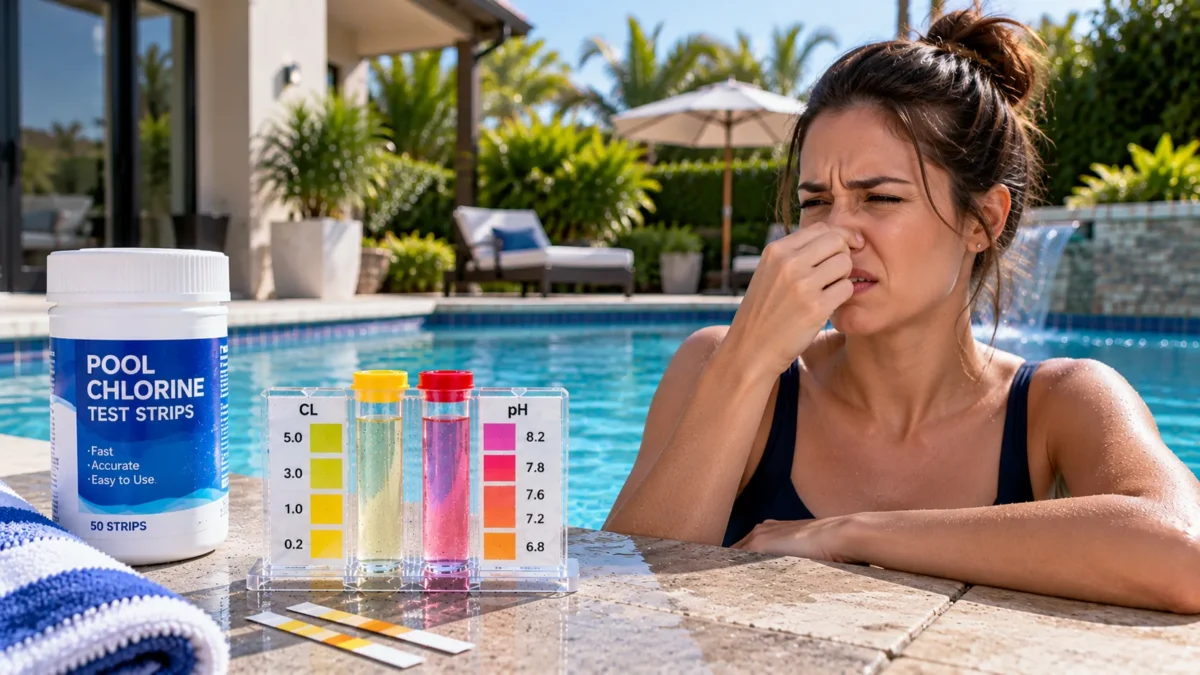
The sharp smell people call “too much chlorine” is the opposite. It is chloramines — chlorine that has already reacted with sweat, sunscreen and urine and is now spent. A properly chlorinated pool barely smells at all.
Free chlorine is the useful kind: available, active, and almost odourless. Combined chlorine — chloramines — is what is left after it has done its work. Chloramines smell strongly, irritate eyes and skin, and no longer sanitise anything.
This is why an indoor pool that reeks of chlorine is usually under-treated and under-ventilated, not over-chlorinated. The fix is more chlorine, not less.
What causes it
- Combined chlorine above about 0.5 ppm. The direct cause of the smell.
- Heavy bather load without a matching increase in chlorine.
- Free chlorine too low to break the chloramines down.
- Poor ventilation in an indoor pool, which lets chloramines build up over the water.
- No recent shock treatment. Breakpoint chlorination is what clears chloramines, and it needs doing periodically.
What to test first
Before adding anything, take a reading. Guessing at this stage is how a small problem becomes an expensive one.
| Test this | Why it matters |
|---|---|
| Free chlorine | The active sanitiser. Often low in a pool that smells. |
| Total chlorine | Free plus combined. |
| Combined chlorine | Total minus free. Above 0.5 ppm is what you can smell. |
| pH | Above 7.8 chlorine works poorly, so chloramines accumulate faster. |
How to fix it
- Work out your combined chlorine. Total chlorine minus free chlorine. Anything above 0.5 ppm needs dealing with.
- Shock to breakpoint. That is roughly ten times the combined chlorine reading — so 1 ppm of combined chlorine needs the free chlorine taken to about 10 ppm. The shock calculator works out the dose.
- Do it at dusk and run the pump overnight.
- Ventilate an indoor pool while you do it. Chloramines concentrate in the air just above the water.
- Re-test in the morning. Combined chlorine should be back near zero and the smell gone.
- If it comes back within days, your normal free chlorine level is too low for the bather load. Raise the target.
Chloramines irritate eyes and airways, and concentrate over the water surface in enclosed pools. If swimmers are getting red eyes and a sharp smell indoors, ventilate first, then shock. Never mix pool chemicals, and never add two products to the water one after the other without circulating in between. Chlorine and acid together release chlorine gas. Always add chemical to water, never water to chemical.
Work out the numbers
These calculators give the figures for your pool rather than a rule of thumb.
Water Health Check
Enter your test results and see what is in range, what is not, and what to do first.
CalculateStopping it coming back
- Hold free chlorine at the top of its range during busy periods.
- Ask swimmers to shower before getting in — it removes much of what forms chloramines.
- Never let anyone urinate in the pool; it is a major chloramine source.
- Shock periodically rather than waiting for the smell.
- Ventilate indoor pools properly.
Questions people ask
Does a strong chlorine smell mean too much chlorine?
No — nearly always the opposite. The smell is chloramines, which form when there is not enough free chlorine to break them down. The answer is to shock the pool, not to add less chlorine.
Why do my eyes sting in the pool?
Usually chloramines, or pH outside the 7.4 to 7.6 band. Properly balanced water with low combined chlorine does not sting.
How do I get rid of the smell?
Breakpoint chlorination: take free chlorine to about ten times the combined chlorine reading and hold it overnight.
Why do indoor pools smell worse?
Chloramines are heavier than air and settle just above the water. Outdoors they disperse; indoors, without good ventilation, they build up exactly where swimmers breathe.