
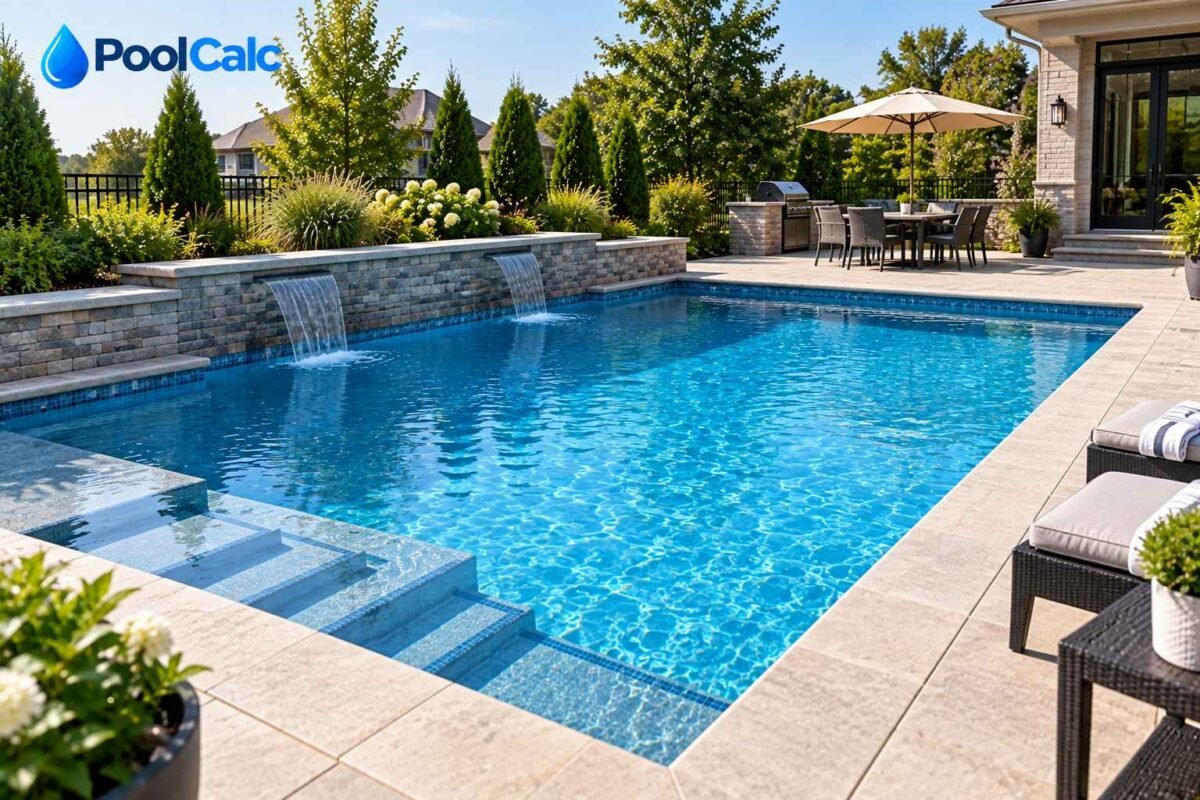
A fibreglass pool is a single moulded shell, made in a factory and lowered into an excavated hole. Nothing is built on site, which is why it can be swimming within weeks rather than months.
The surface is a gelcoat finish — smooth, non-porous, and the reason fibreglass pools are the lowest-maintenance of the three in-ground constructions. Algae has far less to grip, and there is no plaster for soft water to attack.
The trade-off is choice. You are buying a shape that already exists in a mould, in whatever sizes that manufacturer makes, and it has to physically fit down your side access.
At a glance
| Characteristic | Typical |
|---|---|
| Construction | One-piece moulded fibreglass shell |
| Surface | Smooth gelcoat, non-porous |
| Installation | Often a few weeks from excavation to swimming |
| Shapes | Limited to the manufacturer’s moulds |
| Size limit | Constrained by what can be transported by road |
Advantages and limitations
What works well
- The fastest in-ground installation by a wide margin.
- Smooth surface that resists algae and is comfortable underfoot.
- Non-porous, so it uses noticeably less chlorine than plaster.
- No liner to replace and no resurfacing cycle.
- Very low ongoing maintenance compared with concrete.
What to weigh up
- You choose from existing moulds — no custom shapes.
- Maximum size is limited by road transport.
- Needs clear access for a crane or large truck to deliver the shell.
- Gelcoat can fade, stain or develop crazing over many years.
- Repairs to the shell are specialist work.
Looking after one
- Chlorine demand is lower than plaster, but still test twice a week in season.
- Calcium hardness is less critical than on plaster — 150 to 250 ppm is usually plenty.
- Avoid abrasive brushes and pumice stones; they damage gelcoat permanently.
- Watch pH carefully, since low pH can dull the gelcoat over time.
- Never drain a fibreglass pool without professional advice — an empty shell can float or deform.
What it costs to own
Installation typically lands between vinyl liner and concrete: more than a liner pool, less than gunite, with the shell itself a fixed cost and the site work the variable.
Ongoing costs are where fibreglass earns its reputation. A non-porous surface uses less chlorine, there is no liner to replace, and there is no resurfacing cycle. Over ten or fifteen years that difference is substantial.
Prices for pools vary enormously by region, access, ground conditions and specification, so no figure is quoted here. The Ownership Cost Calculator uses your own numbers instead of an average that would be wrong for most people.
Calculators for this pool
Questions people ask
Do fibreglass pools need less chemicals?
Usually yes. The non-porous gelcoat gives algae almost nothing to hold on to and does not absorb chlorine the way plaster does, so demand is lower.
Can a fibreglass pool crack?
The shell flexes rather than cracking, which is one of its advantages in ground that moves. What can happen is surface crazing in the gelcoat over many years — cosmetic rather than structural.
Can I drain it to clean it?
Not without advice. Groundwater pressure can lift or distort an empty shell. This is genuinely the most expensive mistake an owner can make with a fibreglass pool.
What calcium hardness does it need?
Lower than plaster — 150 to 250 ppm is generally enough. There is no plaster for soft water to dissolve; calcium is mainly there to protect metal equipment.