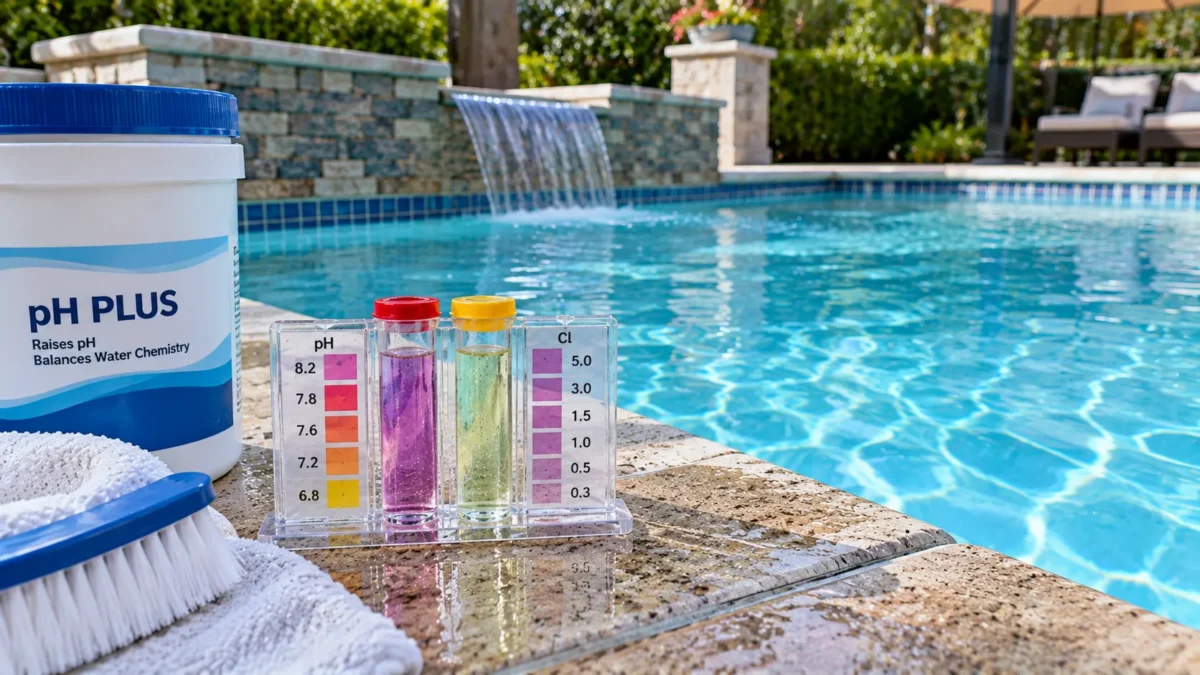
Pool pH is one of the most important parts of swimming pool water chemistry. If the pH is too high, chlorine becomes less effective and the water may become cloudy or form scale. If the pH is too low, the water becomes more acidic and can contribute to corrosion of pool equipment and surfaces.
So, what should pool pH be?
The CDC recommends maintaining residential pool pH between 7.0 and 7.8. Many pool-care programs use approximately 7.4–7.6 as a practical target within that broader range. The right target can vary with the pool, sanitation system, local requirements and overall water chemistry.
The important thing is not simply getting one perfect number. Pool pH changes over time, so regular testing and controlled adjustments are part of normal pool maintenance.
Use a reliable pool pH calculator when you need help estimating an adjustment, but always compare any calculated result with your actual test readings and the chemical manufacturer’s instructions.
Quick Answer: What Is the Ideal pH for Swimming Pools?
A practical target for many residential pools is 7.4–7.6, while the CDC recommends maintaining residential pool pH within 7.0–7.8. This range helps balance chlorine effectiveness, swimmer comfort and protection of pool plumbing.
Pool pH Range at a Glance
| Pool pH | General condition |
|---|---|
| Below 7.0 | Too acidic |
| 7.0–7.2 | Low side |
| 7.2–7.4 | Acceptable |
| 7.4–7.6 | Common practical target |
| 7.6–7.8 | High side of acceptable |
| Above 7.8 | High pH |
| Above 8.0 | Significant concern for chlorine effectiveness |
The exact target can depend on the pool, sanitation system, local requirements and water chemistry, so don’t treat one number as a universal rule.
What Is Pool pH?
pH describes how acidic or alkaline water is.
The pH scale runs from 0 to 14:
- Below 7 = acidic
- 7 = neutral
- Above 7 = alkaline
Swimming pool water is normally maintained slightly on the alkaline side of neutral.
When someone searches for “what is the pH of a pool?”, “what is pH in a pool?”, “pH for pool”, “pH of pool”, or simply “pool pH,” they are generally asking the same basic question: what does the number mean and where should it be?
The answer becomes more important when pH starts moving outside the desired range.
What Does the Pool pH Scale Mean?
The pH number tells you where the water sits on the acidic-to-alkaline scale.
- A lower number means more acidic water.
- A number around 7 is neutral.
- A higher number means more alkaline water.
Pool owners generally want the water in the recommended operating range rather than trying to make it exactly neutral.
What Does Pool pH Affect?
Pool pH affects several parts of water management, including:
- Chlorine effectiveness
- Swimmer comfort
- Water clarity
- Scale formation
- Corrosion risk
- Pool surfaces
- Plumbing and equipment
- Overall water balance
The CDC notes that as pH increases, chlorine’s ability to kill germs decreases, especially when pH is above 8.0. At very low pH, particularly below 7.0, pool plumbing is more likely to corrode or break down.
Why Is pH Important for Swimming Pools?
pH isn’t just another number on a test strip.
It influences how the rest of your pool chemistry behaves.
pH Affects Chlorine Performance
Chlorine is one of the primary defenses against germs in pool water, and its effectiveness is affected by pH. The CDC recommends routinely testing and adjusting both chlorine concentration and pH.
When pool pH becomes too high, maintaining effective sanitation can become more difficult.
That is why pool pH and chlorine should be considered together rather than treating pH as an isolated measurement.
pH Affects Swimmer Comfort
Unbalanced water can contribute to uncomfortable swimming conditions.
Pool owners may notice:
- Irritated eyes
- Dry or uncomfortable skin
- An unpleasant water feel
However, these symptoms alone cannot tell you whether your pH is high or low. Test the water instead of guessing.
pH Affects Pool Equipment and Surfaces
Very low pH creates more acidic water and can increase corrosion risk.
Very high pH can increase the tendency for calcium carbonate to precipitate and form scale, particularly when calcium hardness and other water-balance factors are also elevated.
That can affect:
- Heaters
- Metal fittings
- Pool surfaces
- Filters
- Plumbing
- Tile
What Should Pool pH Be?
One of the most common searches is “what should pool pH be?”
The CDC recommends a residential pool pH range of 7.0–7.8. Many pool-care programs use 7.4–7.6 as a practical target within that range.
The important point is that pool pH does not need to remain at exactly 7.5 every minute of every day.
How to Maintain the Right Pool pH
- Test the water.
- Compare the reading with your target.
- Check total alkalinity and other relevant chemistry.
- Make a measured adjustment if necessary.
- Allow the water to circulate.
- Retest.
This approach is much better than repeatedly adding chemicals based on guesswork.
Pool pH Levels: What Each Reading Means
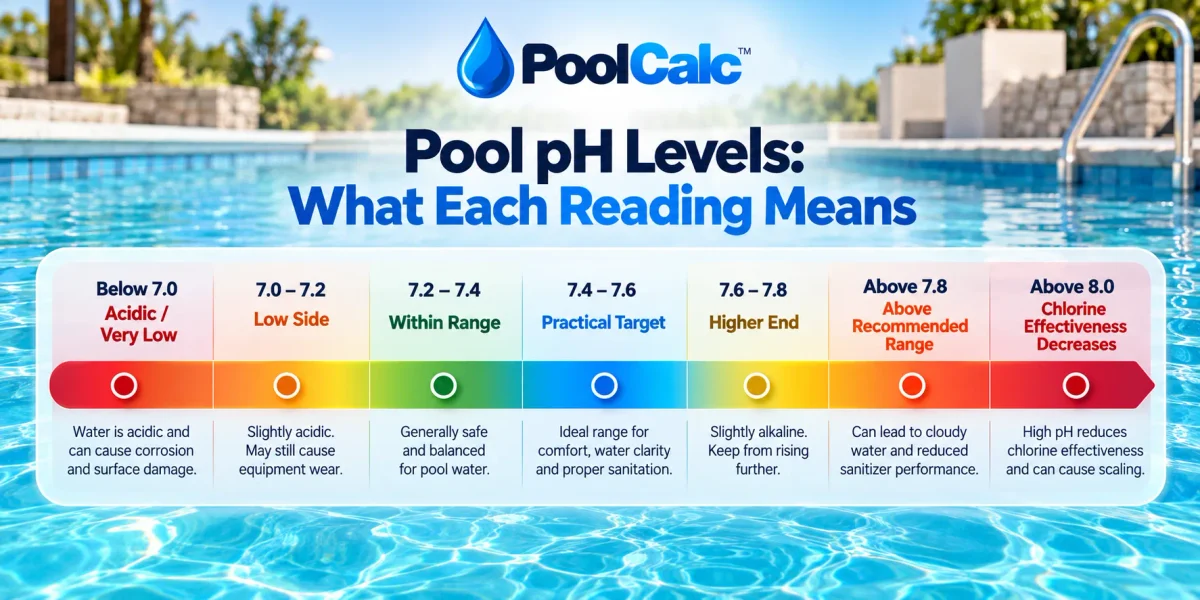
Understanding pool pH levels makes water testing much easier.
Below 7.0
The water is acidic.
Very low pH can increase corrosion risk and may be uncomfortable for swimmers. The CDC specifically notes increased corrosion risk when pH drops below 7.0.
7.0–7.2
The water is toward the lower side of the recommended residential range.
If your test consistently shows this level, investigate the cause rather than ignoring it.
7.2–7.4
This is within commonly used pool operating ranges.
7.4–7.6
This is a commonly used practical target for residential pool maintenance.
7.6–7.8
This remains within the CDC’s residential range but is toward the higher end.
Above 7.8
This is above the CDC’s recommended residential range and should prompt you to test and determine why the level has risen.
Above 8.0
The CDC notes that chlorine’s ability to kill germs decreases especially as pH rises above 8.0.
Why Is My Swimming Pool pH Level High?
If pH is high, don’t immediately add acid without testing the water.
First ask:
Why does my pool pH keep rising?
Several factors can contribute.
Aeration
Water movement can drive dissolved carbon dioxide out of the water. Features such as:
- Waterfalls
- Fountains
- Spa jets
- Return jets
- Spillovers
- Vigorous water movement
can contribute to upward pH movement.
This is one reason some pools seem to develop high pool pH repeatedly even after being corrected.
High Total Alkalinity
Total alkalinity acts as a buffer for pH.
When alkalinity is too high, pH may become more difficult to control and can tend to rise repeatedly.
That means a pool with high pH and high alkalinity should not necessarily be treated by repeatedly lowering pH alone.
You need to understand both numbers.
Fresh Plaster or New Pool Surfaces
New plaster and some cement-based pool surfaces can affect water chemistry while they cure.
If you have a recently constructed or resurfaced pool and the pH keeps increasing, that can be an important part of the troubleshooting process.
Pool Chemicals
Some products can temporarily or directly affect pH.
For example, soda ash is used to raise pH. Certain chlorine products can also affect pH depending on their chemistry and how they are used.
What Does High pH Mean?
If you search “what does high pH mean?”, the simple answer is:
High pH means the pool water is more alkaline than your desired range.
High pH does not automatically mean the pool is unsafe or that you should pour a large amount of acid into it.
First:
- Test the water
- Confirm the result
- Check total alkalinity
- Check sanitizer levels
- Consider recent chemical additions
- Look for repeated causes of upward pH movement
The actual response should be based on the measured chemistry.
What Happens If Pool pH Is Too High?
When pool pH is too high, several problems can develop.
Chlorine Becomes Less Effective
As pH increases, chlorine’s germ-killing effectiveness decreases. This relationship is one of the reasons maintaining pH within the recommended range matters.
Pool Water Can Become Cloudy
High pH can contribute to cloudy water, especially when calcium hardness and other saturation factors are also elevated.
Scale Can Form
High pH can increase the tendency for calcium carbonate to come out of solution and form deposits.
You may notice:
- White deposits
- Rough tile
- Scale around fittings
- Buildup on equipment
Swimmers May Experience Discomfort
High or low pH can contribute to skin and eye irritation. The CDC recommends maintaining pH within 7.0–7.8 to help balance disinfection and swimmer comfort.
But remember: irritation isn’t a reliable pH test.
Test first.
How to Test the pH in Your Pool
Regular testing is the foundation of pool water chemistry.
The CDC recommends testing chlorine concentration and pH at least twice per day, and more often when a pool is heavily used.
Your local requirements, pool type and usage may call for a different schedule.
Test Strips
Pool test strips are convenient and fast.
Depending on the product, they can provide readings for:
- pH
- Free chlorine
- Total alkalinity
- Calcium hardness
- Stabilizer
Follow the manufacturer’s instructions carefully.
The CDC notes that test strips can be used but are less accurate than DPD test kits.
Liquid Test Kit
A liquid kit can provide more detailed testing.
Common kits use reagents and color comparison to determine pH.
DPD-Based Testing
The CDC identifies DPD testing as an accurate method for measuring chlorine and pH in home pools and hot tubs. Test strips can also be used, but the CDC notes that they are less accurate than DPD testing.
How to Read a Pool pH Test
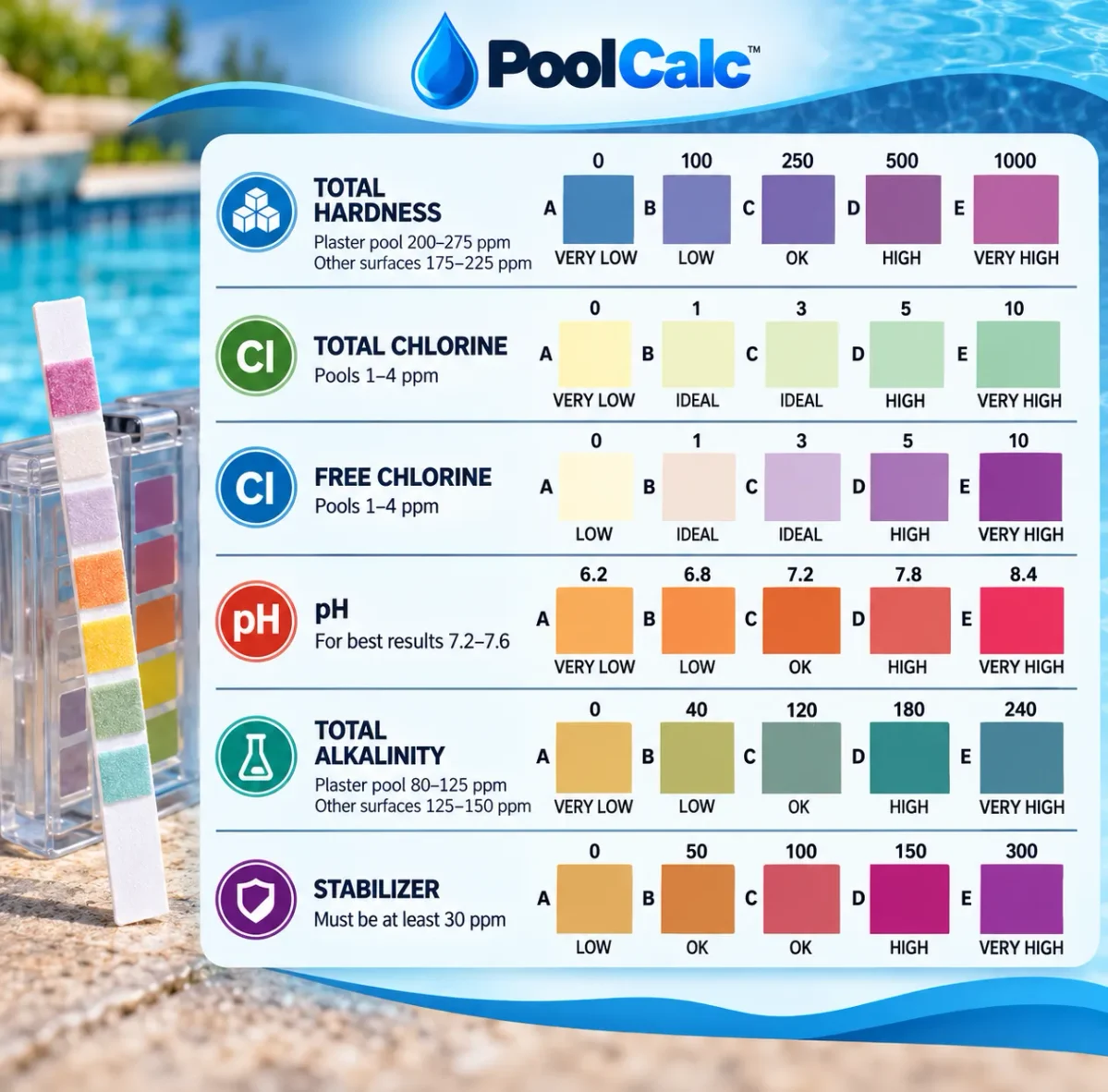
A typical test produces a color that you compare with the manufacturer’s reference chart.
The basic process is:
- Collect a representative water sample according to the kit instructions.
- Add the required reagent or dip the test strip as directed.
- Wait the specified amount of time.
- Compare the color with the chart.
- Record the result.
- Test other important parameters.
Don’t try to estimate a pH number from memory.
If the color falls between two values, follow the test manufacturer’s instructions rather than assuming an exact reading.
How to Use a Pool Test Kit
Before using any pool test kit:
- Check its expiration date
- Follow the manufacturer’s instructions
- Use clean testing equipment
- Collect the sample as instructed
- Avoid contaminating the sample
- Read the result within the specified time
For chemical adjustments, accurate testing matters because an incorrect reading can lead to overcorrection.
How to Balance Pool pH
Balancing pool pH is a process, not a single chemical addition.
Step 1: Test pH
Find your current pH.
Step 2: Test Total Alkalinity
Alkalinity helps buffer pH, so it can explain why your pH keeps moving.
Step 3: Check Sanitizer
Test free chlorine or the sanitizer appropriate for your pool.
Step 4: Identify the Direction
Is the pH:
- Too low?
- Too high?
- Within range?
Step 5: Make a Controlled Adjustment
Use the appropriate product for the chemistry you are trying to correct.
Step 6: Circulate the Pool
Allow the pool to circulate according to the product directions.
Step 7: Retest
Never assume that adding more chemical is automatically better.
Small corrections followed by testing are easier to control than a large correction followed by another correction.
How to Raise pH in a Pool
If your pool pH is too low, you need to increase it.
The appropriate method depends partly on your total alkalinity.
Soda Ash
Sodium carbonate, commonly called soda ash, is a common pH increaser.
It can raise pH relatively strongly and also affect alkalinity.
It may be appropriate when pH is low and you need a chemical pH increase.
Baking Soda
Sodium bicarbonate, commonly called baking soda, is primarily used to increase total alkalinity.
It can also raise pH, but generally much less dramatically than soda ash.
This distinction is important.
If your search is “how to raise pH in pools using baking soda,” don’t assume baking soda is always the best choice.
If alkalinity is already appropriate and you mainly need to raise pH, a different approach may make more sense.
Aeration
Aeration can raise pH without directly adding an alkaline chemical because it encourages carbon dioxide to leave the water.
Water features, fountains and upward-facing returns can increase aeration.
This can be useful when you need to influence pH while minimizing an increase in total alkalinity.
How to Raise Pool pH Safely
If your pH is below your desired range:
- Test pH.
- Test alkalinity.
- Confirm pool volume.
- Select the appropriate chemical or non-chemical method.
- Follow the product label.
- Add gradually.
- Circulate.
- Retest.
- Make another adjustment only if needed.
Avoid blindly adding baking soda simply because you searched “what raises pool pH.”
Baking soda is primarily an alkalinity adjustment, while soda ash is a stronger pH-increasing chemical.
The correct choice depends on your water chemistry.
How to Lower pH in a Pool
If your pool pH is too high, common chemical approaches include:
- Muriatic acid
- Sodium bisulfate, also called dry acid or pH Down
Both lower pH, but they have different handling and water-chemistry considerations.
Muriatic Acid
Muriatic acid is hydrochloric acid and is commonly used to reduce pool pH.
It is effective but hazardous if handled incorrectly.
Always:
- Follow the product label
- Wear the recommended protective equipment
- Provide adequate ventilation
- Keep the chemical away from children
- Never mix pool chemicals
- Follow the manufacturer’s instructions for adding the product
The CDC emphasizes following product labels and using appropriate protective equipment when handling pool chemicals.
Sodium Bisulfate
Sodium bisulfate is commonly sold as dry acid or pH Down.
It also lowers pH and can be easier to handle than liquid acid, but it still requires careful handling and label compliance.
How to Lower Pool pH Safely
If the question is “how to reduce pH in pool?”, use this process:
- Test the pool.
- Confirm that pH is actually high.
- Test total alkalinity.
- Determine the manufacturer’s recommended dose.
- Add the appropriate pH reducer according to the product instructions.
- Keep swimmers out while chemical treatment instructions require it.
- Allow adequate circulation.
- Retest.
- Repeat only if the test still indicates that adjustment is necessary.
Do not try to correct a high reading by adding a large amount of acid all at once.
Why Does Pool pH Keep Rising?
A pool that repeatedly develops high pH needs troubleshooting rather than endless acid additions.
High Alkalinity
High total alkalinity can make upward pH movement more persistent.
Aeration
Waterfalls, fountains, spa jets and other features can increase CO₂ loss.
New Plaster
Fresh cement-based surfaces can contribute to elevated pH during curing.
Chemical Additions
Some products can increase pH.
If you repeatedly have to lower your pool pH, record:
- pH before adjustment
- Alkalinity
- Chemicals added
- Amount added
- Time between tests
- Pool usage
- Water features
This can reveal a pattern.
Why Does Pool pH Keep Dropping?
Low pH can also have several causes.
Potential factors include:
- Acidic chemical additions
- Source water
- Low total alkalinity
- Heavy dilution or water replacement
- Chemical treatment
- Testing errors
If your pH level is low in the pool repeatedly, don’t simply keep adding pH increaser.
Check total alkalinity and investigate why the pH isn’t staying stable.
What Causes Low pH in Pool Water?
Low pH means the water is more acidic than your target.
Possible signs can include:
- Uncomfortable water
- Corrosion risk
- Damage to metal components
- Surface deterioration
- Unstable chemistry
However, symptoms aren’t enough to diagnose low pH.
The correct approach is:
test → identify → adjust → circulate → retest.
High Alkalinity in a Pool: What Does It Mean?
Total alkalinity is related to pH but is not the same thing as pH.
pH tells you about the current acidity or alkalinity of the water.
Total alkalinity describes the water’s capacity to neutralize acids and resist changes in pH.
That buffering function is why alkalinity is important when you are trying to keep pool pH balanced.
Pool pH vs. Alkalinity
Think of the two measurements this way:
| Measurement | What it tells you |
|---|---|
| pH | Current acidity/alkalinity |
| Total alkalinity | Resistance to pH change |
| Chlorine | Sanitizing capability |
| Calcium hardness | Calcium concentration and scaling/corrosion balance |
| Cyanuric acid | Stabilization of chlorine from sunlight |
They work together.
That’s why high alkalinity and pH in a pool can be more complicated than simply lowering pH.
What Causes High Alkalinity in a Pool?
High total alkalinity can result from:
- Source water with high alkalinity
- Repeated use of alkaline products
- Chemical additions
- Insufficient water replacement
- Inaccurate testing
If your pool water has high alkalinity, first verify the measurement.
Then determine whether pH is also high.
A pool with:
- High pH + high alkalinity
- Normal pH + high alkalinity
- Low pH + high alkalinity
can require different approaches.
Is High Alkalinity in a Pool Dangerous?
High alkalinity is not simply another name for high pH.
Its importance comes largely from how it affects water balance and the ability to control pH.
If total alkalinity is high, you may find that pH repeatedly drifts upward or becomes difficult to adjust.
So if your pool alkalinity is too high, don’t ignore it.
But don’t automatically add acid without measuring both pH and alkalinity.
What If Pool pH and Alkalinity Are Both High?
If you have high pH and high alkalinity in a pool, you have two related but different measurements to manage.
The correct treatment depends on:
- Current pH
- Total alkalinity
- Pool volume
- Calcium hardness
- Sanitizer
- Water source
- Pool surface
- Chemical history
This is one of the situations where a calculator can help organize the numbers, but the chemical manufacturer’s directions still matter.
What If Pool pH Is High but Alkalinity Is Low?
This is different from high pH and high alkalinity.
If you have:
high pH + low alkalinity
don’t assume that the same treatment used for high alkalinity is appropriate.
Test carefully, verify the readings and consider the complete water chemistry before making a correction.
What If Alkalinity Is High but pH Is Low?
This combination can also occur.
Searches such as “high alkalinity low pH in pool” and “pool pH high alkalinity low” describe a chemistry combination that requires looking at both measurements rather than treating pH alone.
When measurements appear unusual or contradictory, repeat the test using a reliable method before adding chemicals.
Does Chlorine Increase pH?
The answer depends on the chlorine product.
Not every chlorine product affects pool pH in exactly the same way.
This is why the question “does chlorine increase pH?” cannot be answered accurately with a blanket yes or no for every chlorine product.
Different chlorine formulations have different chemical characteristics and can affect water balance differently.
If you are asking “does chlorine raise or lower pH?”, check the active ingredient and product instructions rather than assuming every chlorine product behaves identically.
How Often Should You Test Pool pH?
The correct frequency depends on pool usage and local guidance.
The CDC currently recommends testing residential pool pH and disinfectant levels at least twice per day, with more frequent testing when the pool is heavily used.
You may also want to test after:
- Heavy rain
- Heavy swimming
- Adding chemicals
- Opening the pool
- Significant water replacement
- Unusual water appearance
- Equipment changes
Regular testing is especially useful when your pH has a history of rising or falling unexpectedly.
Pool pH Color Chart: How to Use One

Check Your Pool pH Level
Move the slider or tap a pH value below to instantly see what your pool pH reading means.
Your pool pH is in the preferred range
A reading between 7.2 and 7.6 is the preferred range shown on this reference chart.
Pool Chemical Levels: What Else Should You Check?
pH is only one part of pool water chemistry.
A basic pool chemistry check may include:
- pH
- Free chlorine
- Total alkalinity
- Calcium hardness
- Cyanuric acid
- Water temperature
The exact testing requirements depend on the pool and sanitation system.
For residential pools, the CDC emphasizes routinely testing and adjusting pH and chlorine.
A complete pool chemical levels guide should therefore never treat pH as the only number that matters.
How to Keep Pool pH Balanced
The easiest way to maintain balanced pool water is to prevent large swings.
Test Consistently
Don't wait until the water looks bad.
Record Your Results
Keep a simple log of pH, alkalinity and sanitizer.
Make Small Corrections
Large chemical additions can cause overcorrection.
Check Alkalinity
If pH constantly moves in one direction, alkalinity may be part of the explanation.
Watch Water Features
Aeration can affect pH.
Test After Major Events
Rain, heavy swimming and chemical treatment can change water chemistry.
Never Mix Pool Chemicals
Follow product labels and chemical-handling instructions. The CDC warns that pool chemicals can cause injury when mixed or handled improperly.
How to Calculate Pool Chemical Levels
Calculating chemical adjustments isn't as simple as:
“Add X ounces for every 10,000 gallons.”
The required amount can depend on:
- Pool volume
- Current pH
- Target pH
- Total alkalinity
- Chemical concentration
- Water chemistry
- Product formulation
That is why a pool chemical calculator or pool pH calculator can be useful.
For the most reliable result, first calculate your actual pool volume and enter accurate test readings.
Why Pool Volume Matters
A chemical dose suitable for a 10,000-gallon pool is not automatically suitable for a 20,000- or 30,000-gallon pool.
Accurate pool volume is therefore an important starting point for chemical calculations.
Using a Pool pH Calculator
A calculator can help estimate chemical requirements based on the values you enter.
You can use the Swimming Pool Calculator to work with pool-related calculations.
Always treat calculated chemical quantities as estimates and compare them with the instructions for the specific product you are using.
Common Pool pH Mistakes
Mistake 1: Treating Symptoms Instead of Testing
Cloudy water does not automatically mean high pH.
Test first.
Mistake 2: Confusing pH With Alkalinity
They are related but different measurements.
Mistake 3: Adding Too Much Chemical
Overcorrection can create a second problem.
Mistake 4: Ignoring Pool Volume
A treatment appropriate for 10,000 gallons isn't automatically appropriate for 30,000 gallons.
Mistake 5: Using Baking Soda for Every Low-pH Situation
Baking soda primarily affects alkalinity.
Mistake 6: Ignoring Repeated pH Drift
If your pH keeps rising or dropping, investigate the underlying cause.
Mistake 7: Trusting an Expired Test Kit
Replace expired or damaged testing supplies.
Pool pH Troubleshooting Chart
| Problem | What to check first |
|---|---|
| pH is high | pH confirmation + alkalinity |
| pH is low | pH confirmation + alkalinity |
| pH keeps rising | Alkalinity, aeration, new surfaces, chemical additions |
| pH keeps falling | Alkalinity, source water and chemical additions |
| High pH + high alkalinity | Test both accurately before treatment |
| High pH + low alkalinity | Verify readings and assess complete chemistry |
| High alkalinity + low pH | Confirm both readings before correction |
| Cloudy water | pH, chlorine, calcium hardness and filtration |
| Scale | pH, calcium hardness and overall water balance |
| Eye irritation | Test pH and sanitizer rather than guessing |
Frequently Asked Questions About Pool pH
What Is a Good Pool pH Level?
A commonly used residential target is around 7.4–7.6, within the broader CDC-recommended residential range of 7.0–7.8.
What Is the Ideal pH for a Pool?
For many residential pool-care programs, 7.4–7.6 is used as a practical target within the broader recommended range.
What Should the pH of a Pool Be?
The CDC recommends 7.0–7.8 for residential pools. Many pool-care programs use 7.4–7.6 as a practical target within that range.
What Happens If Pool pH Is Too High?
High pH can reduce chlorine effectiveness and contribute to cloudy water and scale formation. The CDC specifically notes that chlorine's ability to kill germs decreases as pH rises, particularly above 8.0.
What Happens If Pool pH Is Too Low?
Low pH means more acidic water and can increase corrosion risk and discomfort.
What Causes High pH in Pool Water?
Common contributors include aeration, high alkalinity, new cement-based pool surfaces and certain chemical additions.
What Causes Low pH in Pool Water?
Possible causes include low alkalinity, acidic chemical additions and changes in source or replacement water.
How Do I Increase pH in a Pool?
Depending on alkalinity, common approaches include soda ash or aeration. Baking soda primarily raises alkalinity and may raise pH more gradually.
What Raises the pH in a Swimming Pool?
Sodium carbonate, commonly called soda ash, is a common chemical pH increaser. Aeration can also raise pH by allowing carbon dioxide to escape.
What Raises Pool pH Without Chemicals?
Aeration can raise pH without directly adding a pH-increasing chemical.
How Do You Increase pH in a Pool?
First test pH and total alkalinity. Then select the appropriate adjustment based on the readings and follow the chemical manufacturer's dosing instructions.
How Do You Lower pH in a Pool?
Common pH reducers include muriatic acid and sodium bisulfate. Always follow product instructions and chemical-safety precautions.
Is Lowering pH in Pools a Good Thing and Why?
Lowering pH is appropriate when the measured pH is above your desired range. The goal isn't to make pH as low as possible; it is to restore appropriate water balance.
Does Chlorine Increase pH?
It depends on the chlorine product. Different chlorine formulations can affect pH differently.
Does Chlorine Raise or Lower pH?
Check the specific chlorine formulation and its label rather than assuming all chlorine products have the same effect.
Why Does Pool pH Keep Rising?
Aeration, alkalinity, fresh plaster and certain chemical additions can contribute to upward pH movement.
Why Does Pool pH Keep Dropping?
Low alkalinity, acidic chemical additions and changes in source water can contribute to declining pH.
How Often Should I Test Pool pH?
The CDC currently recommends testing residential pool pH and disinfectant levels at least twice daily, with more frequent testing when the pool is heavily used.
What Is the Relationship Between Pool pH and Alkalinity?
pH measures the current acid/base condition, while total alkalinity represents the water's buffering capacity against changes in pH.
Is High Alkalinity in a Pool Dangerous?
High alkalinity is primarily a water-balance issue. It can make pH difficult to control and contribute to persistent pH drift.
Can Baking Soda Raise Pool pH?
Baking soda mainly raises total alkalinity and usually produces a smaller pH increase than soda ash.
What Is Pool Water Chemistry?
Pool water chemistry is the management of pH, sanitizer, alkalinity, calcium hardness, stabilizer and other factors needed to maintain balanced water.
What Is an Acidic Pool?
An acidic pool has a pH below 7. Very low pool pH can increase corrosion risk and cause swimmer discomfort.
What Does High pH Mean?
It means the water is more alkaline than the desired range.
How Do I Balance Pool Water?
Test the major chemistry parameters, identify the imbalance, make controlled corrections, circulate and retest.