
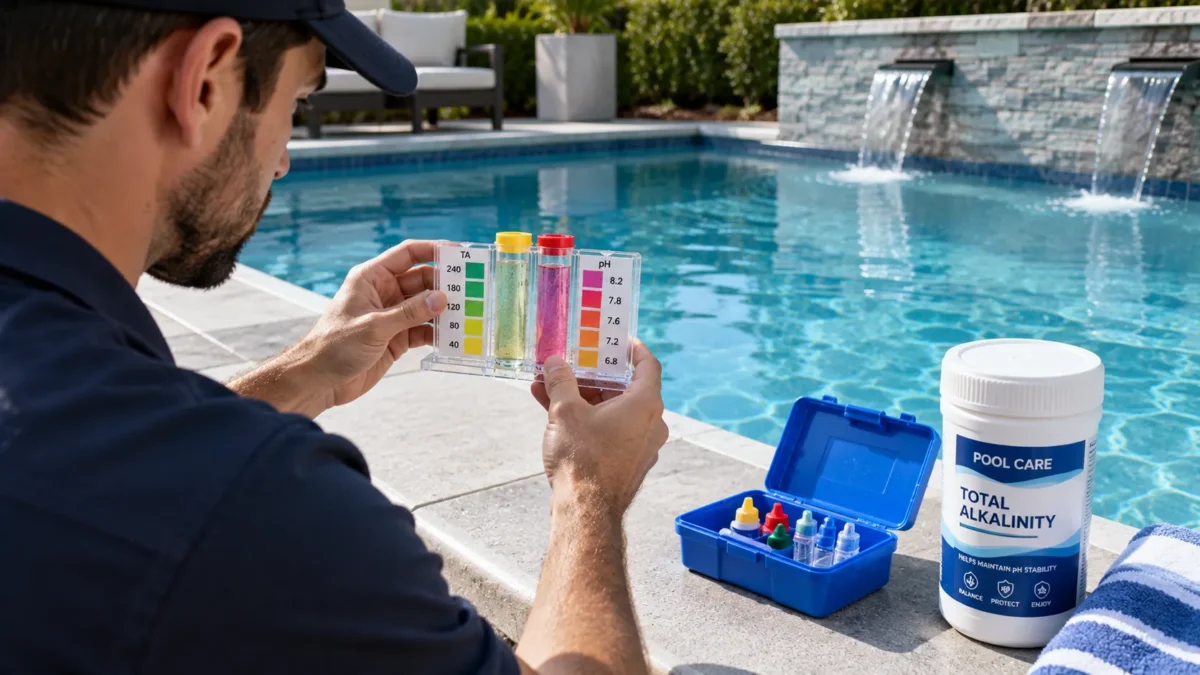
Total alkalinity above 120 ppm locks pH high. You can add acid every week and watch pH climb back within days, because the alkalinity keeps pulling it up. Lowering alkalinity is the only lasting fix.
There is no product that lowers alkalinity without also lowering pH. The method is a cycle: acid brings both down, then aeration brings pH back up without restoring the alkalinity. Repeat until alkalinity is in range.
It takes days rather than hours, and that is normal. Anyone selling a one-dose alkalinity reducer is selling acid.
What causes it
- Hard fill water. In many areas tap water arrives at 150 ppm or higher.
- Too much baking soda added when correcting low alkalinity.
- Cal-hypo or soda ash used regularly.
- Topping up frequently in a hot, dry climate, since each refill brings more alkalinity with it.
What to test first
Before adding anything, take a reading. Guessing at this stage is how a small problem becomes an expensive one.
| Test this | Why it matters |
|---|---|
| Total alkalinity | Above 120 ppm is the problem. Above 180 ppm expect several rounds. |
| pH | Almost certainly high, and it will not stay down. |
| Calcium hardness | High alkalinity, high calcium and high pH together produce scale. |
How to fix it
- Add acid to bring pH down to about 7.0. The pH calculator gives the dose. Do not go below 7.0.
- Aerate the water. Turn on a fountain or waterfall, aim the return jets upward to break the surface, or switch on the spa jets. Aeration raises pH without raising alkalinity.
- Wait for pH to come back to about 7.4 — usually overnight with good aeration.
- Re-test alkalinity. It will have dropped 10 to 20 ppm.
- Repeat until alkalinity is between 80 and 100 ppm.
- Stop at 80 ppm. Below that, pH starts swinging in the other direction.
Muriatic acid is corrosive. Wear eye protection and gloves, add it slowly over a return jet with the pump running, and never pour it near a skimmer or into still water. Never mix pool chemicals, and never add two products one after the other without circulating in between. Chlorine and acid together release chlorine gas. Always add chemical to water, never water to chemical.
Work out the numbers
These calculators give the figures for your pool rather than a rule of thumb.
Stopping it coming back
- Aim for 80 to 100 ppm rather than the middle of the range if your fill water is hard.
- Measure baking soda with the calculator rather than adding a bagful.
- Test your fill water once so you know what every top-up is adding.
Questions people ask
How do I lower alkalinity without lowering pH?
You cannot do it in one step. Acid lowers both; aeration then raises pH back up while leaving alkalinity where it fell. That cycle is the method.
How long does it take?
Two to five days for most pools, depending on how far out it is and how well you can aerate. Rushing it by adding more acid just pushes pH dangerously low.
Is high alkalinity harmful?
Not to swimmers. It causes cloudy water, scale on tiles and equipment, and pH that will not stay put — which in turn makes chlorine less effective.
What is the best way to aerate?
Anything that breaks the surface. Spa jets are fastest, then a fountain or waterfall, then simply angling the return fittings upward so they agitate the surface. An air compressor on the return line is what pool professionals use.