
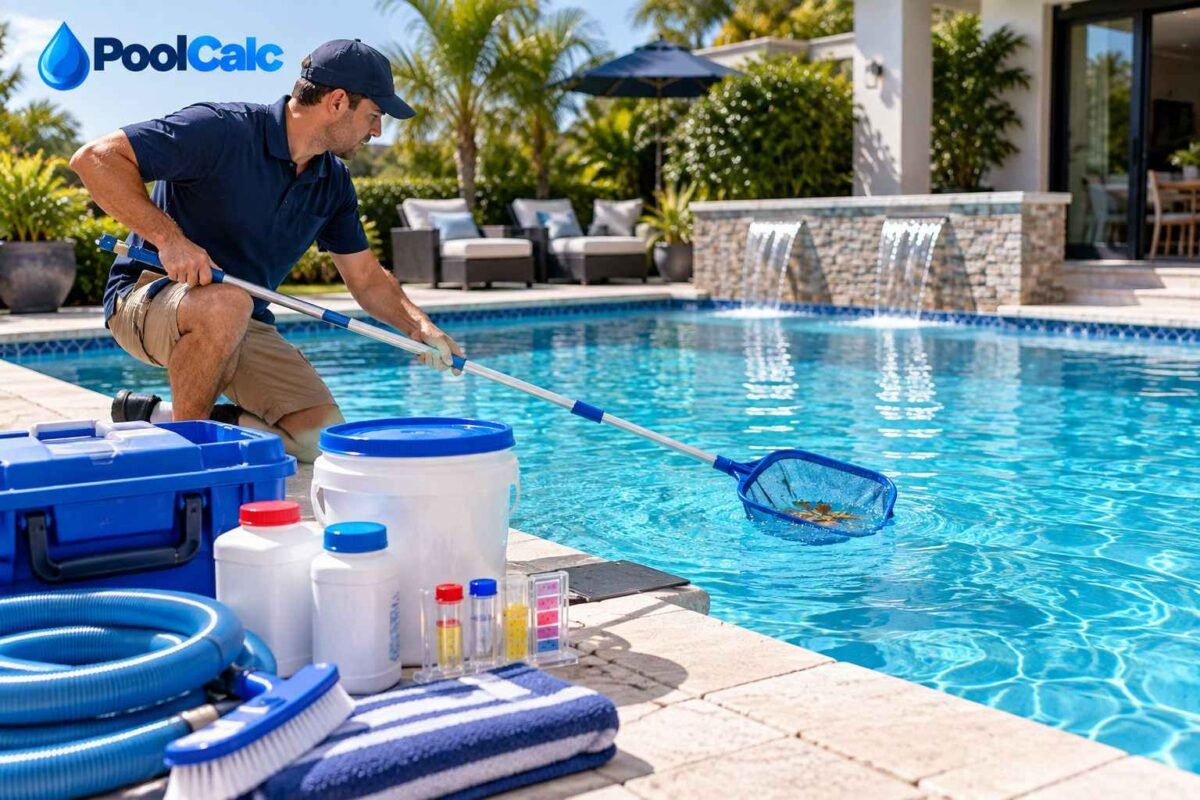
Looking after a pool is not complicated, but it is relentless. Two or three hours a week, spread across short checks and one longer session, keeps a pool clear. Skip a fortnight in July and you will spend a week and a lot of chemicals getting it back.
The one thing that matters most
If you take nothing else from this: keep free chlorine in range every single week. Almost every pool problem — green water, cloudy water, the sharp chlorine smell, algae in the corners — begins with chlorine running out at some point. Everything else in pool care exists to make chlorine work properly.
Daily, five minutes
- Skim the surface. Debris still floating is easy; debris that has sunk is not.
- Check the water level. It should sit around the middle of the skimmer opening. Below that and the pump can draw air.
- Empty the skimmer and pump baskets. A full basket starves the pump and cuts filtration.
Twice a week
Test free chlorine and pH. These are the two readings that move fastest and matter most. A drop-based test kit is markedly more reliable than strips for anything you intend to act on.
Adjust with the calculators rather than a capful — a dose that is roughly right is how pools end up cloudy or over-chlorinated.
Weekly, about an hour
- Brush the walls, steps and corners. Algae starts where water moves least, long before you can see it.
- Vacuum the floor — what the skimmer missed and the filter cannot reach.
- Check the filter pressure. Eight to ten psi above its clean reading means it needs cleaning.
- Top up chlorine to the level your cyanuric acid calls for.
Monthly
- Test total alkalinity and calcium hardness. They move slowly, but out of range they damage surfaces and destabilise pH.
- Test cyanuric acid on an outdoor pool. It creeps up with every tablet used and nothing removes it but fresh water.
- Inspect the equipment pad — leaks, drips, unusual noises.
- On a salt pool, check the cell for scale.
The order to fix things in
When several readings are out at once, there is a running order, and following it saves doing the same job twice:
- Total alkalinity — it holds pH steady, so nothing stays put until this is right.
- pH — often lands in range by itself once alkalinity is fixed.
- Calcium hardness — protects plaster and grout.
- Cyanuric acid — sets how much chlorine the pool has to hold.
- Chlorine — last, because everything above changes how well it works.
How long the pump should run
At least one full turnover a day in warm weather — six to eight hours for most pools, less in winter. Water that is not circulating is not being filtered or sanitised, and a still pool goes green remarkably quickly in the heat.
If you have a variable-speed pump, running it slower for longer moves the same water for a fraction of the electricity, because power draw falls roughly with the cube of speed.
Calculators
Build a schedule for your pool
Chemical safety, every time. Add one product at a time, run the pump for at least four hours before adding anything else, and never mix chemicals. Chlorine and acid together release chlorine gas. Always add chemical to water, never water to chemical.
Common questions
How often should I test my pool?
Chlorine and pH twice a week in season, weekly out of season. Alkalinity and calcium hardness monthly. Always test after heavy rain, a busy weekend, or a large top-up of fresh water.
Can I skip a week?
Once, usually without drama. Several times in warm weather and chlorine runs out, algae takes hold, and clearing it costs far more time and money than the maintenance would have.
Do I need to shock the pool every week?
No. Shock when combined chlorine rises above 0.5 ppm, after heavy use, after a storm, or when algae appears. Shocking on a schedule wastes chemicals.
What is the most common mistake?
Guessing the pool volume. Every chemical dose is calculated per gallon, so a volume that is out by a quarter puts every dose out by a quarter — forever.