
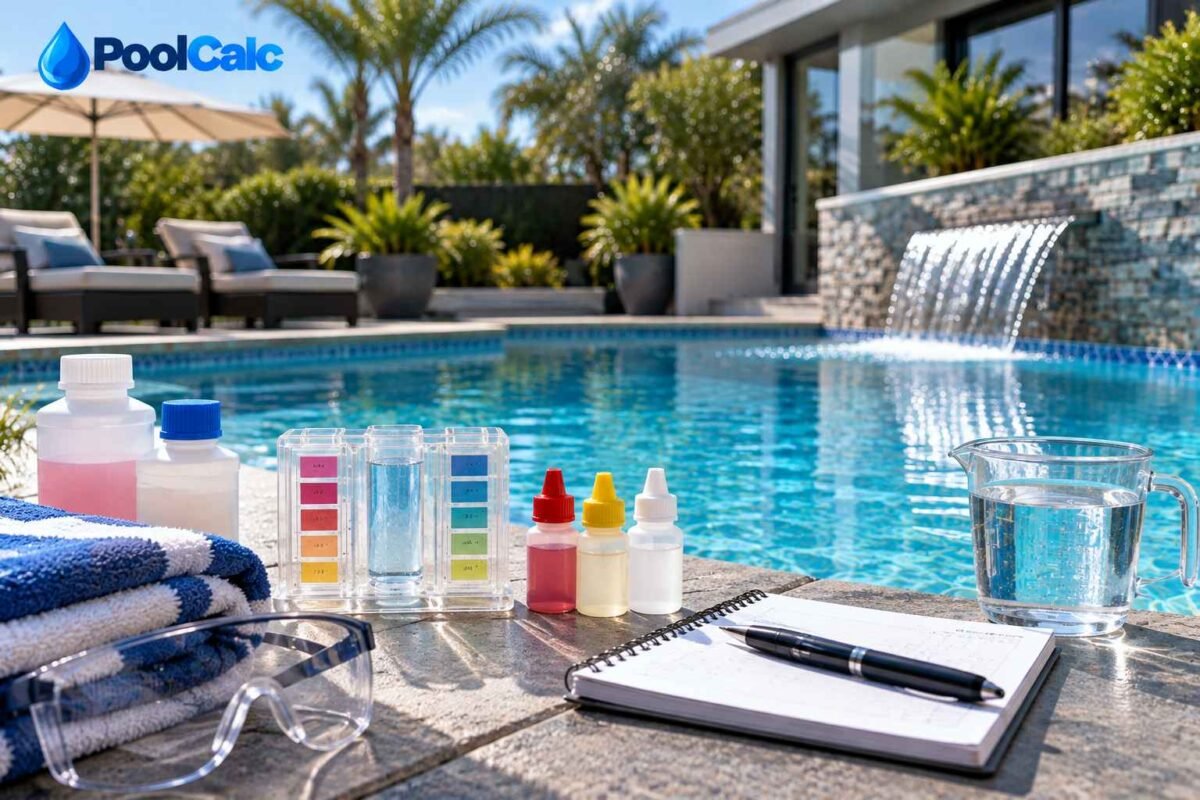
A test kit gives you five or six numbers. They are not independent — each one changes how the others behave, which is why fixing them in the wrong order means doing the job twice.
Free chlorine: the only one that sanitises
Free chlorine is the sanitiser. Everything else on the list exists to make it work properly. The target is 2 to 4 ppm for most pools — but that floor rises with cyanuric acid, to roughly 7.5% of the CYA reading. At 60 ppm CYA, holding 2 ppm of chlorine is not enough.
Chlorine that disappears between tests is not a dosing problem. Something is consuming it, or sunlight is destroying it before it can work.
pH: how well that chlorine works
At pH 7.5, roughly half the free chlorine in the water is in its most active form. By pH 8.0, that has fallen to about a quarter. The chlorine reading has not changed — its effectiveness has. This is how a pool with “plenty of chlorine” still goes green.
Below 7.2, the water turns corrosive: metal fittings, heater cores, pump seals and plaster all suffer, and the damage does not reverse.
Total alkalinity: what holds pH still
Alkalinity is pH’s shock absorber. With it in range at 80 to 120 ppm, pH drifts slowly and predictably. Too low and pH swings on anything — a rain shower, a single dose, a busy weekend. Too high and pH climbs relentlessly and will not stay down however much acid you add.
This is why alkalinity is corrected first. Fix it and pH very often lands in range without a separate adjustment.
Cyanuric acid: protection with a price
Without stabiliser, an outdoor pool can lose most of its free chlorine in a single sunny afternoon. With it, chlorine survives the day. But cyanuric acid also binds chlorine and slows it down, so more of it means you need a higher chlorine level for the same sanitising effect.
Thirty to sixty ppm is the band where chlorine is protected but still effective. Nothing removes cyanuric acid except replacing water, so it is easy to overshoot and hard to undo — and tablets add it with every dose.
Calcium hardness: protecting the pool itself
Water short of calcium takes it from wherever it can find it — plaster, tile grout, concrete — leaving an etched, rough surface. Too much calcium and it comes out as scale on tiles and inside the heater. Two hundred to four hundred ppm on a plaster pool; less matters on vinyl and fibreglass.
How they pull on each other
| If this is wrong | This is what happens |
|---|---|
| Alkalinity too high | pH climbs and will not stay down; scale forms |
| Alkalinity too low | pH swings wildly on anything |
| pH too high | Chlorine works poorly; calcium scales; water clouds |
| pH too low | Metal corrodes; plaster etches; liners harden |
| CYA too low | Sunlight destroys chlorine within hours |
| CYA too high | Chlorine reads fine but acts slowly; algae takes hold |
| Calcium too low | Water dissolves calcium out of plaster and grout |
| Calcium too high | Scale on tiles and inside the heater |
The order to correct them
- Total alkalinity
- pH
- Calcium hardness
- Cyanuric acid
- Free chlorine
It is not arbitrary. Each one changes the behaviour of the ones below it, so working down the list means each adjustment holds.
Calculators
Work out your own numbers
Water Health Check
Enter your test results and see what is in range, what is not, and what to do first.
CalculateOne chemical at a time. Run the pump for at least four hours and re-test before adding the next. Never mix pool chemicals — chlorine and acid together release chlorine gas. If your product label disagrees with anything here, follow the label.
Common questions
Which reading should I fix first?
Total alkalinity, almost always. It is what holds pH steady, and correcting it frequently brings pH into range on its own.
Why does my chlorine not work?
Usually pH above 7.8, or cyanuric acid out of range in either direction. Both leave the chlorine reading looking fine while the chlorine does very little.
Are test strips good enough?
For a rough weekly check, yes. For anything you plan to act on — and certainly for diagnosing a problem — a drop-based kit is far more reliable, and strips drift badly with age and heat.
How accurate do I need to be?
Chlorine and pH matter to within a few tenths. Alkalinity and calcium are fine within ten or twenty ppm. Pool volume matters most of all, because every dose is calculated from it.