
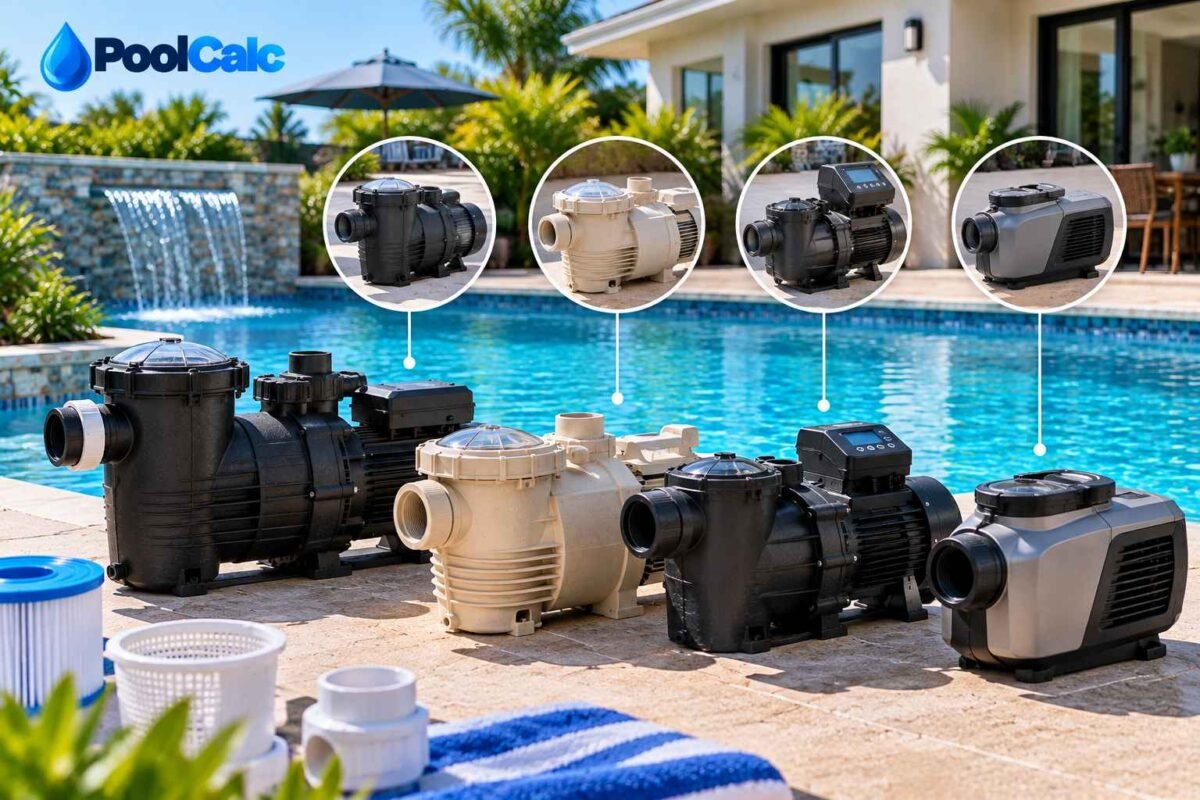
Almost every pool pump is bought on horsepower, and horsepower is close to the wrong number. What matters is flow — how many gallons per minute the pump actually moves through your plumbing — and bigger is not better.
Start with what the pool needs
The pool sets the demand: required flow = pool volume ÷ (turnover hours × 60). A 20,000 gallon pool on an eight-hour turnover needs about 42 GPM. That is the number to shop on.
Then check what the plumbing allows
Water moving faster than about 6 feet per second through suction pipe gets noisy, wastes energy and strains fittings. At that limit, 1½ inch pipe carries roughly 37 GPM and 2 inch about 62 GPM.
This is a hard ceiling. A pump that can push more than the pipe can carry does not clean the pool better — it just makes the plumbing work harder and the pump cavitate. If the pool needs more flow than the pipe allows, the answer is a longer turnover at a lower flow, not a bigger pump.
Why bigger is worse
- Water forced through the filter too fast is filtered less well — dirt is pushed straight through.
- An oversized pump costs more to run every hour of its life.
- High velocity in undersized plumbing causes cavitation, which damages the impeller.
- It can exceed the filter’s design flow rate, shortening its life.
Single-speed or variable-speed
This is where the real money is. Pump power follows roughly the cube of speed, while flow follows speed directly. Halve the speed and you get half the flow for about an eighth of the power. Run for twice as long to move the same water, and you have used roughly a quarter of the electricity.
On most pools a variable-speed pump pays for itself within a few seasons, which is why many utilities offer rebates toward them and why several regions now require them on new installations.
What about horsepower?
Horsepower is a motor rating, not a promise of output. Two pumps of the same HP deliver very different flow depending on the resistance in the system. Use HP as a rough guide to the size of pump you are looking at, and flow as the figure you actually match to the pool.
Calculators
Work out the numbers for your pool
Pipe Size
Check whether your plumbing can carry the flow, and see the velocity in each size.
CalculateCommon questions
What size pump do I need for a 20,000 gallon pool?
About 42 GPM for an eight-hour turnover. In horsepower terms that is usually 1 to 1.5 HP, but check what your plumbing can carry before buying — 1½ inch pipe cannot deliver 42 GPM comfortably.
Are variable-speed pumps worth the money?
On most pools, yes — power falls roughly with the cube of speed, so the saving is large. Compare your current running cost against half-speed operation in the Pump Running Cost calculator.
How do I find my pump’s real flow rate?
From its pump curve rather than a single label figure, since flow falls as resistance rises. A flow meter on the equipment pad gives the actual number, which is always more useful than a rating.
Can I run the pump fewer hours to save money?
Only down to one full turnover. Below that the water is not properly filtered, and what you save in electricity you tend to spend on chemicals and algae treatment.