
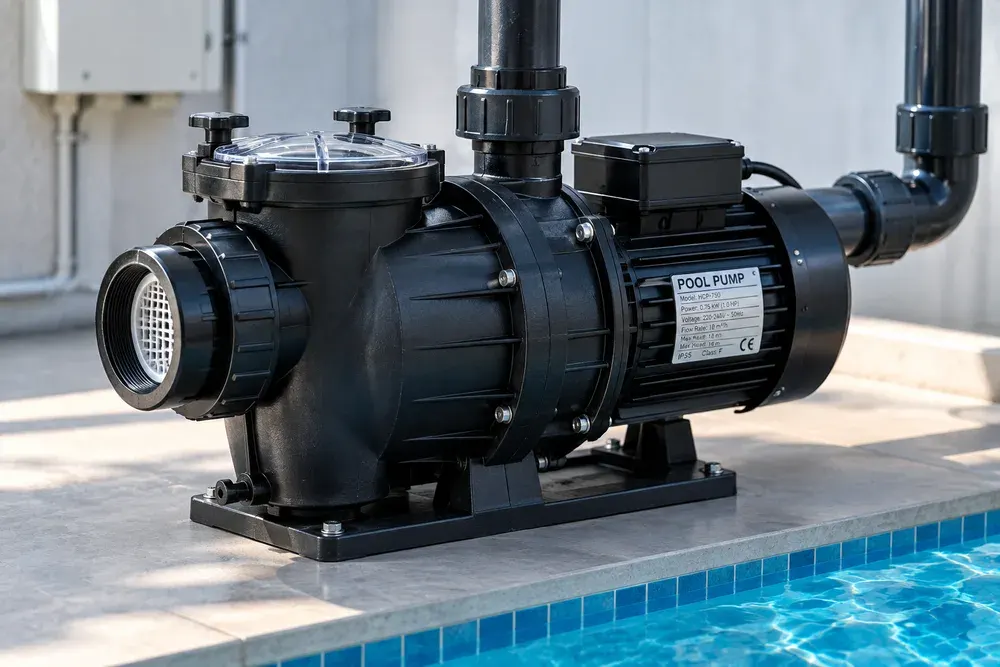
A variable-speed pump costs two to three times what a single-speed pump costs. Every salesperson will tell you it pays for itself. Most of them are right, but for a reason they usually explain badly — and the payback period varies enormously depending on facts about your own pool.
The physics, in one paragraph
Flow rises roughly in proportion to pump speed. Power rises roughly with the cube of pump speed. Those two sentences contain the entire argument.
Halve the speed and you get about half the flow — but you use about one eighth of the power. To move the same volume of water you now have to run twice as long, which brings you to a quarter of the original electricity for an identical turnover. Run at a third speed for three times as long and the saving is larger still.
This is not a marketing claim or an efficiency rating. It is the affinity law that governs centrifugal pumps, and it applies whether the badge on the motor is expensive or not. The reason single-speed pumps waste money is that they can only run at one speed, and that speed is chosen to satisfy the most demanding job the system ever has to do.
Why single-speed pumps are sized for the wrong job
A pool pump has several jobs, and they need very different flow rates. Filtering needs the least. Running a pressure-side cleaner needs considerably more. Backwashing a sand filter needs more again. A spa jet or a waterfall needs the most of all.
A single-speed pump has to be sized for the largest of those, which means that for the twenty-odd hours a week it spends doing nothing but filtering, it is running far faster than filtration requires. You are paying waterfall prices for filter work.
A variable-speed pump simply runs each job at the speed that job needs. Filtration at low speed for most of the day; a short burst at high speed when the cleaner runs; full speed for the two minutes of a backwash. Nothing is oversized because nothing has to compromise.
A worked example
Take a 20,000 gallon pool with a 1.5 HP single-speed pump drawing about 1.75 kW, running eight hours a day for a 180-day season, at 16 cents a kilowatt hour.
1.75 kW × 8 hours = 14 kWh a day. Across 180 days that is 2,520 kWh, or about $403 for the season.
Now the same pool with a variable-speed pump running at roughly half speed. Power falls to something near 0.25 kW — the cube relationship, plus the fact that these motors are more efficient to begin with. To deliver the same turnover it runs sixteen hours instead of eight.
0.25 kW × 16 hours = 4 kWh a day. Across 180 days that is 720 kWh, or about $115. The saving is roughly $288 for the season, and a variable-speed pump that costs $700 more than a single-speed equivalent has repaid the difference in about two and a half seasons.
Those figures use one electricity rate, one pool size and one run time. Change any of them and the answer changes. The pump running cost calculator takes your own rate, your own hours and your own motor, which is the only version of this arithmetic worth acting on.
What makes the payback faster
The saving scales with how much you were spending in the first place, so the pumps pay back fastest exactly where bills are highest.
- A high electricity rate. This is the biggest single factor. At 30 cents a kilowatt hour the same pool saves nearly twice as much as at 16, and pays back in little over a year.
- Long run times. Every hour the old pump ran is an hour of saving. A pool running twelve hours a day saves half again as much as one running eight.
- A long season. Year-round operation in the south saves far more than a four-month season in the north.
- A large pool. More volume means more turnover means more hours.
- A utility rebate. Many US utilities offer a rebate toward qualifying variable-speed pumps, and it can be several hundred dollars. Check before buying, because rebates usually require the purchase to come after the application.
- An oversized existing pump. If your current pump is larger than the pool needs, the waste it is producing is larger too.
What makes it slower — or not worth it
There are genuine cases where the maths does not work, and it is worth being honest about them rather than pretending the answer is always yes.
A small above-ground pool with a modest pump, running four hours a day for a short northern season, may be spending sixty dollars a year on pumping. A pump that saves 70% of sixty dollars will take a very long time to repay several hundred.
A very cheap electricity supply has the same effect from the other direction. The pump saves the same kilowatt hours; they are simply worth less.
A pump that will be replaced anyway changes the comparison entirely, and in favour of variable speed. The relevant number then is not the full price but the difference between the variable-speed unit and the single-speed one you would otherwise have bought — usually far smaller, and paid back much faster.
And a system with very high resistance — long runs of undersized pipe, many bends, an undersized filter — limits how far you can slow the pump before flow becomes inadequate. The saving is still real but smaller. If your plumbing is the bottleneck, see pipe sizing, because fixing that may be the better first purchase.
The part nobody mentions: noise
This is not on any spec sheet and it is the thing owners most often say they would not give up.
A single-speed pump is loud because it only has one speed and that speed is fast. A variable-speed pump at half speed is dramatically quieter — often the difference between a machine you can hear from the patio and one you have to walk over to in order to confirm it is running.
For a pool close to the house, close to a bedroom window, or close to a neighbour, this is worth real money regardless of the electricity. Several owners describe it as the reason they would buy another one even if it saved nothing.
Do you also need a bigger filter?
Often, yes, and this is the hidden cost that catches people out.
Running slowly for longer means water spends more time in the filter, which is good for filtration quality. But a variable-speed pump only saves what it saves if it can actually run slowly, and a filter that is undersized for the pool forces higher speeds to maintain adequate flow.
More importantly, a larger filter has lower resistance, which lets the pump run slower for the same flow — and because of the cube relationship, a small reduction in required speed is a large reduction in power. Upsizing the filter at the same time as the pump often improves the payback rather than harming it. Our guide to choosing a pool filter covers the types; filter sizing covers the numbers.
Setting one up properly
A variable-speed pump installed and left on a factory schedule will save something, but nothing like what it can. The savings come from the programming, and most installers set it once and move on.
- Find the lowest speed that still achieves turnover. This is the setting that does almost all of the saving. Start low and raise it only if water quality suffers.
- Give the cleaner its own block. Suction and pressure-side cleaners need higher flow; run them in a defined window rather than raising the baseline all day.
- Give the heater its own block if you have one. Most heaters require a minimum flow to fire, and running below it simply means the heater refuses.
- Match the salt cell. A salt generator makes chlorine only while water flows through it. Longer, slower run times usually mean you can lower the output percentage.
- Set a high-speed prime. Most units do this automatically; check that yours does, because a pump that fails to prime on low speed runs dry.
- Revisit each season. The right schedule in July is not the right schedule in October.
Regulation, and why the market has moved
This is no longer purely a consumer choice in much of the United States. Federal efficiency standards for dedicated-purpose pool pumps have effectively ended the sale of the least efficient single-speed units, and several states have their own requirements on top.
The practical consequence is that if your current pump fails, the range available to replace it is narrower than it was, and a variable-speed unit may be the straightforward option rather than the premium one. The ENERGY STAR pool pump programme lists qualifying models, and its product criteria explain what the efficiency figures mean — useful, because manufacturer marketing tends to compare against whichever baseline flatters it.
Making the decision
Three questions settle it for most people.
Is your current pump near the end of its life? If so, the comparison is only the price difference between the two types, and variable speed almost always wins.
What do you pay for electricity, and how many hours do you run? Multiply them out. If you are spending more than about $250 a season on pumping, the payback is likely to be under three years.
Is there a rebate available? Check your utility before you buy anything. A few hundred dollars off the purchase price changes a marginal case into a clear one, and the application usually has to precede the purchase.
If your current pump is healthy, your rate is low, your season is short and there is no rebate, the honest answer is that it will take a long time to pay back — and there is nothing wrong with keeping what you have until it fails.
A realistic schedule to start from
Most variable-speed pumps arrive with a manufacturer default that is set conservatively — fast enough that nobody complains, which means fast enough to waste most of the saving. This is a reasonable starting point for a typical residential pool, to be adjusted from there.
- A short prime at high speed, usually two to five minutes. Most units handle this automatically; confirm yours does, because a pump that fails to prime on low speed can run dry.
- A long filtration block at low speed — often somewhere around 1,200 to 1,800 RPM — running twelve to sixteen hours. This is where nearly all of the saving lives.
- A cleaner block at medium-high speed, two to three hours, if you run a suction or pressure cleaner.
- A heater block at whatever flow the heater requires, if you have one. Most heaters refuse to fire below a minimum flow.
- Nothing overnight, unless you are in freezing weather or recovering from algae.
Then tune downward. Reduce the filtration speed by a hundred RPM, hold it a week, and watch the water. Keep going until clarity or chemical demand tells you that you have gone too far, then come back up one step. Because power follows the cube of speed, each hundred RPM you remove is worth more than the last.
One warning: a salt generator only produces chlorine while water flows through the cell, and many are set as a percentage of pump run time. Changing the pump schedule changes chlorine production, so expect to re-tune the generator output after changing the pump.
What to check before buying
Three things determine whether a particular unit will suit your pool, and none of them is horsepower.
The lowest speed it will run. This sets the floor on your savings. A pump whose minimum is 1,700 RPM cannot save what one that will run at 1,000 RPM can.
Whether the controls are built in or separate. An integrated controller is simpler; a separate one may be required if you are integrating with pool automation. Retrofitting later is more expensive than choosing correctly now.
The warranty, and what it covers. Variable-speed pumps have electronics that single-speed pumps do not, and the drive is the expensive part. A three-year warranty that covers the motor but not the drive is worth considerably less than it appears.
Check for a utility rebate before purchasing rather than after. Many US utilities require the application to precede the purchase, and a few hundred dollars changes a marginal case into a straightforward one.
Calculators
Work out your own numbers
How much does a variable-speed pump actually save?
Typically 60 to 80% of pumping electricity compared with an equivalent single-speed unit, provided it is programmed to run slowly. In dollars that depends entirely on your rate, your hours and your season — which is why the calculator is more useful than any headline figure.
How long until it pays for itself?
Commonly two to four years on a typical US in-ground pool. Faster where electricity is expensive, run times are long or a rebate is available; slower on small pools, short seasons and cheap power.
Is a two-speed pump a reasonable compromise?
It captures some of the benefit for less money, but only two fixed speeds means you cannot find the genuinely optimal one, and the low speed may be lower than you can use. Variable speed usually wins over the life of the equipment.
Will a variable-speed pump work with my existing filter and plumbing?
Almost always, physically. But an undersized filter or narrow pipework limits how slowly you can run it, which limits the saving. Check filter sizing before assuming the full benefit.
Do they last as long as single-speed pumps?
Generally longer, because the motor spends most of its life running gently rather than flat out. The electronics are an additional failure point, which is why the length and terms of the warranty are worth comparing carefully.
Can I run it slowly all the time?
For filtration, usually yes, and that is where the saving lives. But a cleaner, a heater, a spa jet and a backwash each need more flow, so those get their own higher-speed blocks in the schedule.
Does running longer at low speed wear the pump out faster?
No. Hours at low speed are far gentler on a motor than hours at full speed. Heat and load cause wear, and both are much lower when the pump runs slowly.
My pool is small. Is it still worth it?
Possibly not on electricity alone. Work out what you currently spend on pumping; if it is under about $100 a season, the payback will be long. The noise difference may still justify it if the pump is near the house.