
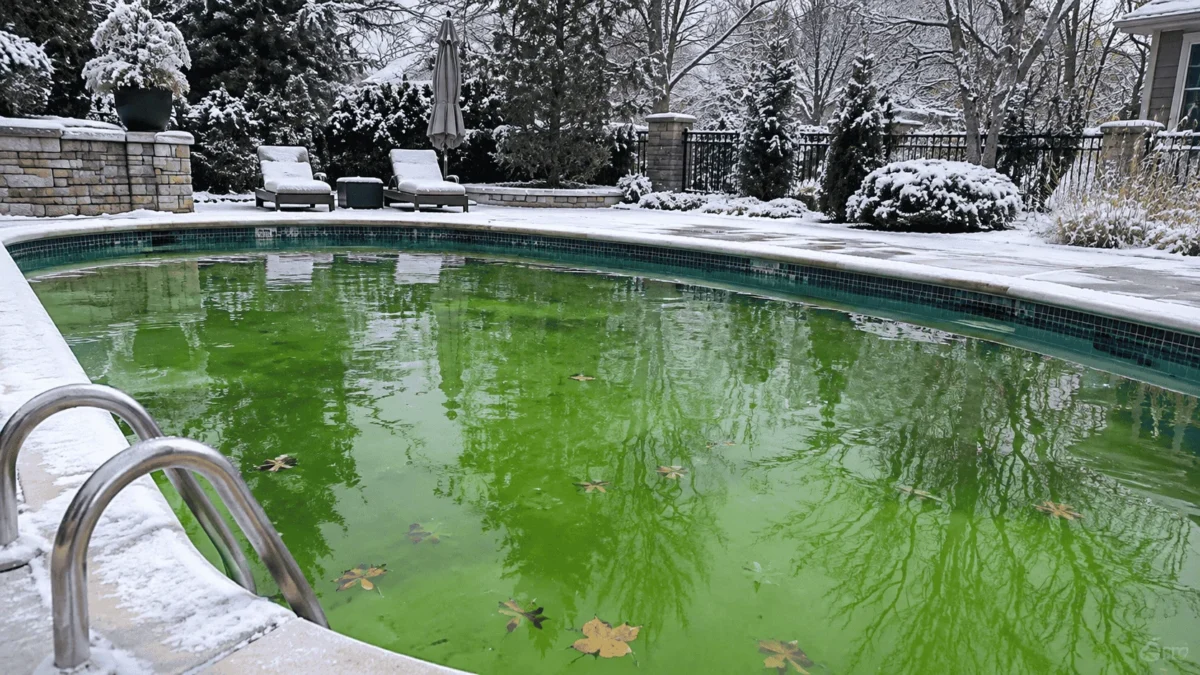
Green pool water in winter is usually caused by algae growth, low sanitizer levels, poor circulation, dirty filtration, or unbalanced pool chemistry. Cold weather does not automatically stop algae. If your pool is not tested and maintained during winter, the water can turn green, cloudy, or both.
The good news is that a green pool can usually be restored. The basic process is simple: test the water, remove debris, correct the chemistry, brush the pool, treat the algae, run the filter, and retest the water. Using a Pool Volume Calculator can also help determine the correct pool size and guide treatment amounts. The exact treatment depends on how severe the problem is and whether the pool remains open or has been winterized.
This guide explains why is my pool green, how to identify the cause, how to clear green water, what to do if the pool stays green after shocking, and how to prevent the problem during the winter season. It also covers common Pool Problems that can affect water quality during colder months.
Why Is My Pool Green in Winter?
If you are asking why is my pool green, algae is one of the most common reasons.
Pool water can become green when sanitizer levels fall too low to control algae. This can happen in winter because many homeowners reduce pool maintenance when swimming stops. Leaves, dirt, rainwater, and other organic material can also enter the pool and increase the demand for chlorine.
A pool can also become green when water is not moving properly through the circulation and filtration system.
Common causes include:
- Low free chlorine
- Poor water circulation
- Inadequate filtration
- Incorrect pH
- Organic debris
- Long periods without testing
- Algae already growing on pool surfaces
- Poor winterization
- Equipment or circulation problems
A greenish pool may start with only a slight tint. If the problem continues, it can become a dark green pool with cloudy water and visible algae.
What Does Green Pool Water Mean?
Green pool water normally indicates an algae or water-chemistry problem, but the color alone cannot identify the exact cause.
For example, green color pool water can be caused by algae, but water that is green while remaining clear may need a different diagnosis.
That is why testing should come before adding large amounts of chemicals. A Pool Chemistry Calculator can also help determine the appropriate chemical levels based on your pool’s specific measurements.
What Causes Green Pool Water?
There are several reasons a pool can turn green in winter.
1. Low Chlorine
Chlorine is one of the main tools used to control algae and microorganisms in swimming pool water.
When sanitizer levels fall too low, algae can multiply. A pool may look fine for several days and then suddenly become noticeably green.
2. Poor Circulation
Pool water needs adequate circulation so treated water can move throughout the pool.
Poor circulation can leave areas around steps, corners, walls, and the bottom with less effective chemical distribution. These areas can become places where algae begins to grow.
3. Dirty or Weak Filtration
A filter removes suspended particles from pool water.
If the filter is dirty, clogged, incorrectly operated, or unable to keep up with the amount of debris in the water, clearing a green pool can take longer.
4. Organic Debris
Leaves, grass, insects, dirt, and other organic material can consume sanitizer.
Winter storms can make this problem worse, especially when leaves remain in the pool for long periods.
5. Unbalanced Water Chemistry
Incorrect pH can affect how effectively chlorine works.
This is why simply adding more chlorine is not always the complete answer to a green pool water fix.
6. Infrequent Winter Maintenance
A pool that is not being used still needs the correct maintenance approach.
If you stop testing the water for weeks, a small chemistry problem can become a major algae problem.
My Pool Is Green and Cloudy: What Should I Do?
If my pool is green and cloudy, algae and suspended particles are likely involved.
The same applies if the pool is green and cloudy, the swimming pool is green and cloudy, or you have a green and cloudy swimming pool.
Cloudiness can remain after algae have been killed because dead algae and other fine particles still need to be removed from the water.
| Pool appearance | Possible cause | What to check |
|---|---|---|
| Green and cloudy | Algae + suspended particles | Chlorine, pH, filtration |
| Dark green pool | Heavy algae growth | Sanitizer, circulation, filter |
| Green but clear | Algae or another water issue | Full water test |
| Green after shocking | Remaining algae or poor filtration | Chemistry + filter |
| Slight green tint | Early algae or another water-quality issue | Water test |
If you have green cloudy pool water, do not judge recovery only by color. A pool can change from green to gray or cloudy as algae die before the water becomes clear again.
How to Clean a Green Pool
If you are searching for how to clean a green pool, use a step-by-step process rather than adding random chemicals.
Step 1: Stop Swimming
Do not use a green or cloudy pool until the water chemistry and clarity are suitable for swimming.
A cloudy pool can make it difficult to see the bottom, while inadequate sanitizer can indicate poor water quality.
Step 2: Remove Leaves and Debris
Skim the surface and remove leaves, insects, branches, and other visible debris.
This is an important first step in green pool cleaning because organic material can continue consuming sanitizer.
Step 3: Test the Water
Test the pool before starting the main treatment.
Important parameters may include:
- Free chlorine
- pH
- Total alkalinity
- Cyanuric acid/stabilizer where applicable
- Calcium hardness where applicable
Testing gives you a starting point.
Step 4: Correct the Chemistry
Bring the water chemistry into the appropriate range for your pool and sanitizer system.
This helps make the treatment more effective.
Step 5: Brush the Pool
Brush the walls, floor, steps, corners, and other surfaces.
If you are wondering how do you clean a pool that is green, brushing is an important part of the answer because algae can attach to pool surfaces.
Step 6: Treat the Algae
Use an appropriate chlorine treatment according to the product label and your pool’s measured chemistry.
Do not mix pool chemicals together. Always follow the manufacturer’s safety instructions.
Step 7: Run the Filter
Allow the filtration system to remove dead algae and suspended particles.
Clean or backwash the filter according to the equipment manufacturer’s instructions.
Step 8: Vacuum and Remove Settled Material
If dead algae settle on the pool floor, remove them using the appropriate vacuuming method for your pool system.
Step 9: Retest
After treatment and filtration, test the water again.
Do not stop simply because the water looks better. Proper chemistry and clarity matter too.
How to Fix a Green Pool
If you want to know how to fix a green pool, the key is to correct the cause rather than only treating the color.
The basic process is:
Test → Balance → Brush → Treat → Filter → Retest → Prevent
This same approach works when people search for how to fix a green swimming pool, how do you fix a green pool, or how do i fix a green pool.
A severe algae problem may need more treatment and filtration than a mild green tint. Regular Pool Maintenance can also help prevent the water from turning green again.
How Do You Fix Green Pool Water?
To understand how do you fix green pool water, first determine whether algae are responsible.
If algae are confirmed, remove debris, correct chemistry, brush the surfaces, use the appropriate sanitizer treatment, and maintain filtration.
If the water remains green after treatment, retest rather than repeatedly adding chemicals.
How to Get Rid of Green Pool Water
Many homeowners ask how to get rid of green pool water after discovering algae during winter.
The process can be divided into three simple stages:
Kill
Use the appropriate sanitizer treatment to control the algae.
Remove
Remove dead algae with brushing, filtration, vacuuming, and cleaning.
Prevent
Maintain proper water chemistry, circulation, filtration, and debris control.
This is also the basic answer to how to remove green algae from pool water.
If you are trying to get the green out of your pool, remember that killing algae and making the water clear are two separate parts of the process.
How to Clear Green Pool Water
If you want to know how to clear green pool water, the first question is how severe the algae problem is.
A lightly green pool may recover faster than a pool that has been neglected for weeks.
The general process is:
- Test the water.
- Remove debris.
- Adjust water chemistry.
- Brush all pool surfaces.
- Apply the appropriate sanitizer treatment.
- Run the filtration system.
- Clean the filter when necessary.
- Vacuum settled material.
- Retest the water.
- Continue filtration until the water becomes clear.
This explains how to clear a green pool and how to clear a green swimming pool without relying on a single chemical shortcut.
How to Clear Green Pool Water Fast
Searches for how to clear green pool water fast and how to clean a green pool in 24 hours are common because homeowners naturally want quick results.
However, there is no single guaranteed recovery time for every pool.
A lightly contaminated pool may improve quickly, while a heavily contaminated pool may need extended filtration and repeated testing.
The fastest safe approach is usually to identify the cause correctly and complete every stage of treatment instead of repeatedly adding chemicals without testing.
What If the Pool Water Looks Green but Clear?
Sometimes pool water looks green but clear.
If pool water clear but green, do not automatically assume there is a large algae bloom.
A green appearance can sometimes be associated with other water-quality issues, including metals or chemical imbalance.
If your pool water is green but remains unusually clear, check:
- Chlorine
- pH
- Stabilizer
- Recent chemical additions
- Source water
- Metal levels where appropriate
- Pool surfaces
This is why why is pool green cannot always be answered by looking at the water alone.
Why Does My Pool Keep Turning Green?
If you keep asking why does my pool keep turning green, there may be an underlying maintenance problem.
Recurring green water can indicate:
- Inadequate sanitizer
- Poor circulation
- Dirty filtration
- Incorrect pH
- Excess organic debris
- Insufficient testing
- Algae remaining on pool surfaces
- Poor winter maintenance
The same principle applies to why is my pool turning green, why did pool turn green, and why does pool water turn green.
If a pool repeatedly changes from clear to green, investigate the complete maintenance system instead of treating the color every time it appears.
Why Did My Pool Turn Green Overnight?
If you are wondering why did my pool turn green overnight, the change may have happened gradually but become visible very quickly.
For example, a pool may already have developing algae. A drop in sanitizer, heavy rain, leaves, or poor circulation can then make the green color much more obvious.
This can make it appear that the pool turned green overnight.
If my pool is green, check the water chemistry and equipment before assuming that the problem needs an extreme chemical treatment.
What If the Pool Is Still Green After Shocking?
One of the most common troubleshooting searches is after shocking pool still green.
If the pool is still green after shocking, possible reasons include:
- The algae growth was severe.
- Water chemistry was not suitable for treatment.
- Chlorine demand remained high.
- Circulation was poor.
- The filter was not removing dead algae effectively.
- Algae remained attached to pool surfaces.
- The green color has another cause.
Do not keep increasing chemical doses without testing.
Instead, check the chemistry, brush the pool, inspect circulation, clean the filter, and continue filtration as appropriate.
This also answers the common question I’ve tried everything and my pool is still green: go back to diagnosis rather than adding more products blindly.
How to Get a Green Pool Clear
If you are asking how do you get a green pool clear, remember that the process is not just about killing algae.
A pool can contain dead algae after treatment, which makes the water cloudy.
To how to get a green pool clear, focus on:
- Correct sanitizer treatment
- Proper filtration
- Brushing
- Vacuuming
- Debris removal
- Correct water chemistry
- Continued testing
The goal is to move the pool from green → cloudy/gray → clearer → clean and balanced.
That is also how to get your pool from green to clear without relying on appearance alone.
How to Get Rid of Green Algae in a Pool
Visible algae should be treated as a pool-water maintenance issue.
If you need to how to remove green algae from pool water, start by testing the chemistry and removing organic debris.
Then brush the pool surfaces and apply the appropriate sanitizer treatment.
Green algae in pool water can return if the underlying cause is not corrected.
For this reason, green pool treatment should always include prevention.
Common Places Algae Can Hide
Check:
- Pool walls
- Steps
- Corners
- Ladders
- Behind fittings
- Floor surfaces
- Poor-circulation areas
- Pool equipment where appropriate
Green Pool to Blue: How Long Does It Take?
People often want to know how quickly they can go from pool green to blue.
There is no universal time because recovery depends on:
- Pool size
- Algae severity
- Water chemistry
- Filtration capacity
- Circulation
- Amount of debris
- How long the pool has been green
A mild problem can improve quickly. A heavily contaminated pool can require more time.
The important goal is not simply a blue appearance. The water should also be properly treated, balanced, filtered, and clear enough for safe use.
What to Do When Your Pool Is Green
If you are asking what to do when your pool is green, start with these actions:
- Stop swimming.
- Test the water.
- Remove debris.
- Inspect circulation.
- Check the filter.
- Brush pool surfaces.
- Correct water chemistry.
- Apply appropriate treatment.
- Run filtration.
- Retest.
This also covers searches such as what to do if my pool is green, what to do when my pool is green, what to do if pool is green, and what do you do when your pool is green.
If what do i do if my pool is green is the question on your mind, do not panic. Most cases can be approached systematically.
My Pool Is Green: What Should I Do?
If my pool is green what do i do, begin with a water test.
If my pool is green what should i do, do not immediately pour several chemicals into the water.
If my pool is green what can i do, check the chemistry, debris, circulation, and filtration first.
If what do i do when my pool is green, the answer remains the same: diagnose first and treat second.
The same applies when my pool is very green. A very green pool may indicate a more advanced algae problem and may require more treatment and filtration time.
How to Clean Green Pool Water Step by Step
If you want how to clean a green pool step by step, use this checklist:
Green Pool Recovery Checklist
- Stop swimming.
- Remove leaves and debris.
- Test the water.
- Check the filter.
- Check circulation.
- Correct pH and other chemistry issues.
- Brush walls and floor.
- Apply the appropriate sanitizer treatment.
- Run filtration.
- Vacuum settled debris.
- Clean or backwash the filter as required.
- Retest the water.
- Continue filtration until clear.
- Maintain the pool to prevent another algae bloom.
This is a practical answer to how to clean a green pool step by step and how to clean green pool water.
Above Ground Pool Green Water: Does the Process Change?
If you have above ground pool green water, the same basic water-care principles apply.
An above-ground pool can still develop algae because of low sanitizer, poor circulation, debris, or incorrect chemistry.
However, always consider the specific manufacturer’s instructions for the pump, filter, liner, and other equipment.
The important point is that an above-ground pool should not be treated differently simply because it is above ground. The cause of the green water still needs to be identified.
Winter Pool Maintenance to Prevent Green Water
The best green pool fix is prevention.
Winter maintenance depends on whether the pool is being kept open or fully closed.
If the Pool Stays Open
Continue appropriate:
- Water testing
- Filtration
- Circulation
- Debris removal
- Sanitizer maintenance
- Equipment checks
Cold weather may reduce algae growth, but it does not guarantee that algae will disappear.
If the Pool Is Winterized
Follow the correct winterization procedure for the pool, equipment, cover, plumbing, and local climate.
Do not assume that putting on a cover alone prevents algae.
Why Winter Covers Matter
A pool cover can reduce debris entering the pool, but it does not replace proper water preparation and winter maintenance.
If water chemistry is poor before closing, the pool may still develop problems under the cover.
How to Prevent a Green Pool Next Winter
Once you have solved the current problem, prevention becomes the next goal.
Maintain the Right Sanitizer Level
Do not allow sanitizer levels to remain low for extended periods.
Test Regularly
Winter testing should not be ignored simply because the pool is not being used.
Keep Debris Out
Remove leaves and other organic material before they accumulate.
Maintain Circulation
Make sure the pump and circulation system are operating as intended.
Keep the Filter Clean
A properly maintained filter can remove particles and dead algae more effectively.
Brush Problem Areas
Corners, steps, walls, and low-circulation areas deserve attention.
Use a Proper Winter Plan
Your maintenance routine should match whether the pool is open, partially closed, or fully winterized.
Green Swimming Pool Water: What Pool Owners Should Remember
Green swimming pool water is a symptom, not a complete diagnosis.
The color can point toward algae, but other water-quality issues can produce a green appearance too.
Whether your swimming pool is green, your pool water green and cloudy, or the water has only a slight green tint, start with testing.
The most important steps are:
Test the water.
Find the cause.
Correct the chemistry.
Treat the problem.
Filter the water.
Retest.
Prevent recurrence.
That approach is much more reliable than choosing a chemical based only on the color of the water.
Frequently Asked Questions
Why is my swimming pool water green?
Why is my swimming pool water green? The most common cause is algae growth caused by low sanitizer, poor circulation, poor filtration, or unbalanced water chemistry.
How do you clean a green swimming pool?
How do you clean a green swimming pool? Remove debris, test and balance the water, brush the pool, apply an appropriate sanitizer treatment, run the filter, remove dead algae, and retest.
How do I fix a green swimming pool?
How do i fix a green swimming pool? Start with water testing, then correct chemistry, remove debris, brush surfaces, treat algae, and filter the pool until it clears.
How do I get rid of green pool water?
How do i get rid of green pool water? Identify the cause, treat algae when present, remove debris, brush the pool, and use filtration to remove dead algae and suspended particles.
How do you get a green swimming pool clear?
How to get a green swimming pool clear: kill the algae, remove dead material through filtration and cleaning, correct water chemistry, and continue testing until the water is balanced and clear.
What do you do if your pool is green?
What do you do if your pool is green? Stop swimming, test the water, remove debris, check circulation and filtration, correct chemistry, treat the cause, and retest.