
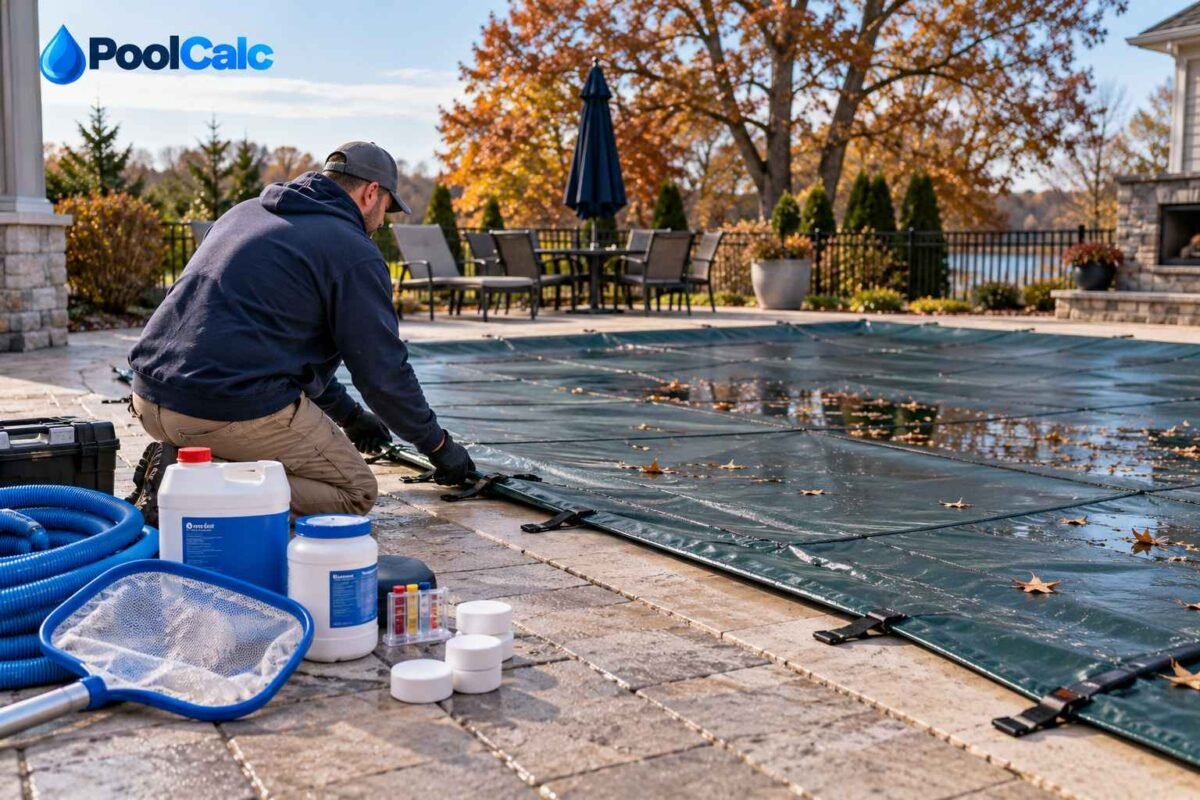
Closing a pool is the job where mistakes are most expensive and least visible. A shortcut taken in October does not show up until April, by which point it has cost either a fortnight of chemical treatment or a split pipe under the deck.
What winterizing is actually protecting against
Two quite different threats, and understanding which applies to you determines how much of this article matters.
The first is freeze damage. Water expands as it freezes, and water trapped in a pipe, a pump housing, a filter or a heater will split whatever contains it. This is the expensive failure, it is entirely preventable, and it is the reason winterizing exists as a procedure at all.
The second is water degradation. A pool left for five months without circulation or sanitiser becomes a very effective growing medium, and a pool closed with poor chemistry opens as a swamp. This is the failure that costs a fortnight in spring.
In the southern US, where hard freezes are rare, most pools are never fully closed — they run through winter at reduced hours. If that is your climate, the chemistry sections here still apply but the plumbing sections largely do not.
Close later than you think
The mirror image of the opening advice. Closing too early, while water is still warm, means five or six months of sitting in conditions that suit algae.
Wait until water temperature is consistently below about 60 °F. Below that, biological activity slows dramatically and whatever chlorine you leave behind lasts far longer. Close in early September while the water is still 75 °F and you are effectively leaving a warm, dark, unfiltered tank for the winter.
The constraint at the other end is frost. You need the job done before the first hard freeze, because water in the equipment during a freeze is precisely what this is meant to prevent. In most of the northern US that leaves a window somewhere in October.
Balance the water first, and properly
The chemistry you leave behind sits there for months with nothing circulating it, so it needs to be right rather than approximately right.
Bring total alkalinity into range first, then pH to about 7.2 to 7.6, then check calcium hardness. Water left slightly aggressive all winter will etch a plaster surface just as effectively as water left aggressive in July, and nobody is watching.
Calcium deserves particular attention at closing, because the pool is about to sit cold and still for months. Water at the low end of the range is the one that does damage, and a pool closed at 120 ppm calcium can lose a measurable amount of plaster over a winter. See calcium hardness.
Do this a few days before closing rather than on the day, so you can verify it actually landed where you wanted rather than dosing and walking away.
Shock, then let it come down
Shock the pool a few days before closing. The aim is to start the winter with nothing alive in the water and no organic backlog.
Then — and this is the part that gets skipped — let the level fall back before you cover it. Free chlorine above about 5 ppm sitting under a cover for months will degrade the cover material and can bleach a vinyl liner. Closing at 3 to 5 ppm gives you sanitiser without the damage.
A winter algaecide is worth adding at this point, and it is one of the few situations where algaecide genuinely earns its place. Chlorine will be gone within weeks; a long-life polymer algaecide keeps working for months. Avoid copper-based products, which stain — see pool stains.
The reason to care about closing chemistry is specific and worth stating plainly: a pool that runs out of chlorine early in the winter and sits at zero for months can develop ammonia, and an ammonia demand in spring consumes an extraordinary quantity of chlorine before anything registers on a test. That is the two-week opening nobody wants.
Clean it out completely
Everything organic left in the pool spends the winter decomposing and consuming whatever sanitiser you left.
- Brush the walls, floor, steps and waterline thoroughly.
- Vacuum the whole pool, to waste if it is heavily soiled rather than through the filter.
- Empty the skimmer and pump baskets.
- Clean the filter properly — backwash a sand or DE filter, or remove and hose a cartridge. A filter put away dirty grows things all winter.
- Remove and store the cleaner, the ladder, the rails and anything else that comes out.
The waterline is worth extra attention, because that is where body oils and sunscreen accumulate and it is exactly the band that will sit at the water surface all winter.
Lower the water — but only as far as you should
How far depends on your cover, and getting this wrong causes real damage in both directions.
With a mesh safety cover, lower the water to roughly 12 to 18 inches below the skimmer, because rain and melt water will pass straight through the cover and the level will rise over the winter.
With a solid cover, lower it less — usually 3 to 6 inches below the skimmer — because water is not coming in from above and a level that drops too far leaves the liner or surface exposed.
Do not drain the pool. An empty in-ground pool can float out of the ground if groundwater is high, and a plaster shell left dry can crack. Whatever problem you are solving, draining a pool for the winter is almost never the answer.
Never lower the water below the tile line on a plaster pool, and never leave a vinyl liner exposed above the waterline for months. Liners shrink and go brittle when they dry out, and a liner that has dried over a winter frequently will not stretch back.
Get every drop out of the equipment
This is the part that prevents the expensive failure, and it is unforgiving: a single line with water left in it is a single line that splits.
- Drain the pump. Remove the drain plugs, and take the lid off. Some water always remains; a shop vacuum clears the rest.
- Drain the filter. Plugs out, multiport valve to a neutral position, and leave it open all winter.
- Drain the heater. This is the most expensive component to replace, and it holds more water than people expect. Follow the manufacturer’s procedure.
- Blow out the lines. Clear every return and suction line with a blower or a shop vacuum until air bubbles appear at the fitting, then plug it while air is still flowing.
- Plug the returns and the skimmers. Winter plugs in every one.
- Add pool antifreeze to the lines if you are in a severe climate. Use pool antifreeze, never automotive antifreeze, which is toxic.
- Put a skimmer guard or a partly filled bottle in each skimmer to absorb the expansion if water does get in and freeze.
- Remove and store the salt cell, the chlorinator cartridge, and any sensors.
If you do one thing thoroughly, make it the line blowing. Splitting a return line under a concrete deck is a repair that involves breaking the deck, and it dwarfs every other cost discussed in this article.
For a first close, paying a professional and watching carefully is genuinely good value. The procedure is not difficult, but the consequences of missing a step are severe and are not discovered until spring.
Cover it
Which cover, and how it is secured, is covered in full in our guide to pool covers. The essentials for closing:
- A safety cover is the only option that is also a barrier. If children or animals have access to the yard, this matters more than any other consideration here.
- A winter tarpaulin is cheaper and keeps debris out, but it holds weight and is not a barrier.
- Use water bags, never bricks or blocks. A water bag gives way if someone falls onto the cover; a block does not.
- Fit a cover pump on any solid cover, and check it through the winter. Standing water is weight, and weight tears covers and pulls anchors.
- Lay a leaf net over the top during leaf fall and lift it off once the trees are bare.
Whatever you use, the barrier around the pool still matters through the winter. A closed pool with a tarpaulin on it is arguably more dangerous than an open one, because it looks solid and is not. The CPSC’s Pool Safely guidance applies year-round, not just in swimming season.
Check on it through the winter
A closed pool is not a finished job, and a check every few weeks takes ten minutes.
- Pump water off a solid cover before it accumulates.
- Clear heavy snow, which is far heavier than it looks.
- Check the cover is still properly secured after high winds.
- Look at the water level — a level that has dropped noticeably suggests a leak, and finding that in January is better than in April.
- Confirm nothing has shifted at the anchors.
Owners in milder regions who keep the pool open instead should keep the pump running whenever a freeze is forecast. Moving water is far harder to freeze than still water, and continuous circulation through a cold snap is the standard protection where full winterizing is not practical.
The mistakes that cost the most
Winterizing errors are unusual in that none of them announce themselves. Everything looks fine in October; the bill arrives in April.
Water left in a line. The expensive one. A return line under a concrete deck that splits over winter is a repair involving breaking the deck. Blow every line until air bubbles at the fitting, then plug it while air is still flowing.
A plug left in the pump or filter. Equally destructive and even easier to do. Remove every drain plug and put them somewhere you will find them in spring — taped inside the pump lid is the conventional answer.
Closing with poor chemistry. A pool closed with low chlorine and unbalanced water can run out of sanitiser within weeks and spend months as a growing medium. This is what produces a two-week opening.
Closing too early. Warm water plus five months of no circulation is the ideal condition for algae. Wait for water below about 60 °F.
Lowering the water too far. A vinyl liner that dries out over a winter frequently will not stretch back, and a liner replacement is one of the larger costs an above-ground or vinyl in-ground pool can incur.
Leaving the cover unattended. Water and snow accumulate, the weight pulls the cover in, and the whole winter’s debris goes into the pool at once.
Mild climates: not closing at all
Across much of the southern United States, full winterizing is neither necessary nor sensible, and the seasonal advice written for the north does not apply.
A pool kept open through winter needs less of everything: run time can often be halved, because cold water grows almost nothing, and chlorine demand falls sharply for the same reason. Testing can drop to weekly. The pool stays usable on warm days, and spring involves no opening at all.
The one thing that cannot be relaxed is freeze protection. Even in regions where hard freezes are rare, they happen, and a pool that is not winterized has water sitting in every pipe. The standard protection is to run the pump continuously whenever freezing temperatures are forecast — moving water is far harder to freeze than still water, and continuous circulation through a cold snap is what most southern pools rely on.
Many modern controllers include a freeze protection mode that starts the pump automatically below a set temperature. If yours has one, confirm it is enabled before winter rather than after.
Calculators
Work out your closing doses
Water Health Check
Enter your test results and see what is in range, what is not, and what to do first.
CalculateWhen should I close my pool?
Once water temperature is consistently below about 60 °F, but before the first hard freeze. Closing while the water is still warm gives algae five months of ideal conditions.
Do I need to drain the pool for winter?
No, and you should not. Lower the level as your cover type requires, but an empty in-ground pool can float out of the ground if groundwater is high, and a dry plaster shell can crack.
How much should I lower the water?
With a mesh safety cover, 12 to 18 inches below the skimmer, because rain passes through and the level rises. With a solid cover, only 3 to 6 inches, because nothing comes in from above.
Can I skip blowing out the lines if I add antifreeze?
No. Antifreeze supplements line blowing; it does not replace it. Water left in a line is what splits it, and antifreeze diluted by that water may not protect to the temperature you need.
What chlorine level should I close at?
Shock a few days before, then let it fall to around 3 to 5 ppm at the point of covering. Higher than that degrades cover material and can bleach a vinyl liner over several months.
Is winter algaecide worth it?
For a closed pool, yes — it is one of the few cases where algaecide clearly earns its cost, because chlorine will be gone within weeks while a long-life polymer algaecide keeps working for months. Avoid copper-based products, which stain.
Do I need to close the pool at all in a warm climate?
Often not. Many southern US pools run year-round at reduced hours, which avoids the whole procedure. Keep the pump running whenever a freeze is forecast, because moving water is much harder to freeze.
Should I pay someone to close it?
For the first one, it is usually worth it — the line-blowing step is where mistakes are expensive and invisible until spring. Watch closely, and most owners are comfortable doing it themselves afterwards.