
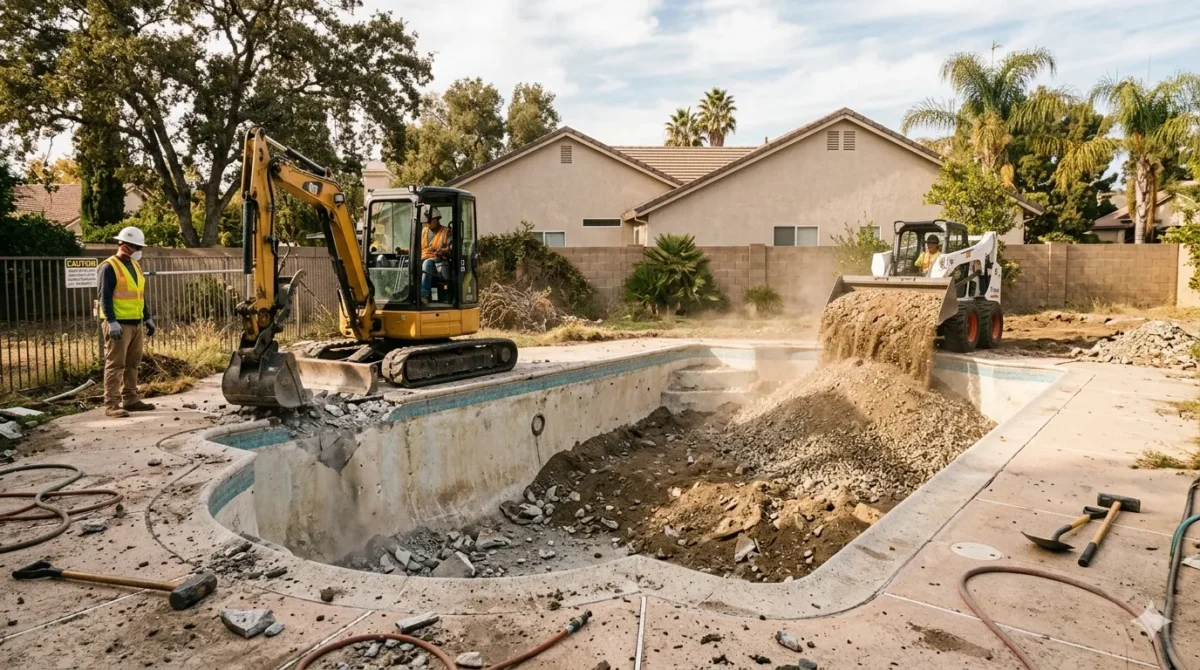
Filling in a pool — removing it and putting soil where the water was — runs from about $3,000 to $10,000 for a partial fill, and $9,000 to $19,000 if the whole structure comes out. What you pay depends far more on whether a machine can reach the back garden than on the size of the pool.
Looking for the cost of filling a pool with water? That is a different job and a much smaller bill — usually $60 to $250 from the tap. The pool filling cost calculator works it out for your volume and water rate.
Partial fill or full removal
Every quote you get will be one of two jobs, and the difference between them is several thousand dollars.
A partial fill — the cheaper and far more common option — breaks holes in the floor of the pool so water can drain through, collapses the top eighteen inches or so of wall into the hole, and fills the rest with soil and gravel. The bulk of the shell stays underground.
A full removal takes out every piece of concrete, steel and plumbing, hauls it away, and backfills with engineered soil compacted in layers. It costs roughly twice as much and takes two to three days longer.
| Job | Typical cost | Time | Leaves you with |
|---|---|---|---|
| Above-ground pool removal | $300–$800 | Half a day | Bare ground, ready to seed |
| Partial fill (in-ground) | $3,000–$10,000 | 2–4 days | Lawn or planting only |
| Full removal (in-ground) | $9,000–$19,000 | 4–7 days | Buildable land |
The distinction matters beyond the price. Land over a partially filled pool is not considered buildable, and in most places it cannot carry an extension, a garage or even a large shed. If there is any chance you will want to build there, the full removal is the only version that gets you that.
What actually drives the price
Access, more than anything else
This is the single largest variable and the one most people do not expect. An excavator needs roughly a ten-foot gap to reach the back garden. If your side return is narrower than that, the contractor either brings in a smaller machine and charges for the extra days, or takes down a section of fence and rebuilds it afterwards.
Where there is no vehicle access at all, the work goes to jackhammers and wheelbarrows, and the bill can double. It is worth measuring the narrowest point between your street and your pool before you ring anyone, because that number will be the first thing they ask for.
What the pool is made of
Vinyl liner pools are the cheapest to take out: the walls are steel or polymer panels that unbolt. Fiberglass shells come out in a few large pieces. Concrete and gunite are the most expensive — the shell has to be broken up before any of it moves, and broken concrete is heavy, which means more truckloads to the tip.
Where the rubble goes
Disposal is often a fifth of the total and it is charged by weight. A mid-sized concrete pool produces somewhere between 30 and 60 tons of material. Some contractors crush the concrete on site and use it as part of the backfill, which removes most of that cost — worth asking about directly, because it is rarely offered unprompted.
Fill material
A pool hole needs 50 to 100 cubic yards of fill. Ordinary soil is cheapest but settles; engineered fill compacted in six-inch layers costs more and is what a surveyor will want to see if the land is ever assessed. Skimping here is the most common cause of the problem in the next section.
Ground settling is the thing that goes wrong. Fill that was not compacted properly sinks over the following two or three winters, leaving a visible dish in the lawn and sometimes cracking a patio laid over it. Ask what compaction method is used and whether it is covered by any warranty before you accept a quote.
Permits and paperwork
Almost every US municipality requires a demolition permit for an in-ground pool, typically $50 to $500. The contractor usually pulls it, but confirm that in writing — if the work is done without one, the problem lands on you when you sell.
Utilities need marking before anyone digs. In the United States that is a free call to 811, and it has to happen a few working days ahead. Gas and electric lines to a pool heater are often shallow and not where anyone remembers putting them.
Most states also require you to disclose a filled-in pool when you sell the house, whichever method was used. Keep the permit, the invoice and any compaction report together — a buyer’s surveyor will ask, and having the paperwork turns an awkward question into a short one.
What it does to the value of the house
There is no single answer, and anyone who gives you one is guessing. In warm states where a pool is expected with a family home, removing it can reduce what the house fetches. In colder regions, where a pool is often seen as a short season and a long list of chores, taking it out can widen the pool of buyers and help.
What is more consistent is the effect of a broken pool. A green, cracked or non-functioning pool reliably costs more in lost offers than the removal would have cost. If the pool works and you simply do not use it, the sums are worth doing carefully. If it has failed, removal is usually the cheaper road.
Calculators
Before you decide: what does keeping it actually cost?
Plenty of people price up a removal because the pool feels like a money pit, without ever having worked out what the pit actually is. A typical in-ground pool runs somewhere between $1,200 and $3,000 a year once electricity, chemicals, water and repairs are counted — which means a $7,000 partial fill is roughly three to five years of ownership.
Sometimes the number changes the decision. A single-speed pump swapped for a variable-speed one, or a cover that cuts evaporation and heating, can take several hundred dollars a year off the bill — enough that the pool stops feeling like the problem it was.
How to get a quote worth comparing
- Say which job you want. Ask for partial and full as separate line items. A quote that does not say which one it is cannot be compared with anything.
- Measure your access. The narrowest gap between the street and the pool, in feet. Have it ready.
- Ask who pulls the permit and whether its cost is in the quote or on top.
- Ask about on-site crushing. If the concrete can stay as backfill, the disposal line should drop sharply.
- Ask what the surface is left as. Bare soil, graded soil and seeded lawn are three different prices, and assuming the best one is a common way to be surprised.
- Get three quotes. Spreads of several thousand dollars on identical work are normal in this trade.
Common questions
Can I fill in a pool myself?
Legally, in most places, yes — with a permit. In practice it is rarely worth it. The excavator hire, the fill delivery and the disposal fees come to a large share of a contractor’s price, and the part that is easy to get wrong is compaction, which is also the part that shows up years later as a sunken lawn. An above-ground pool is a genuine DIY job; an in-ground one usually is not.
How long does the work take?
Two to four days for a partial fill, four to seven for a full removal, assuming reasonable access and no rain. Add a week or two beforehand for the permit and the utility marking. The ground then needs a season or two to settle before anything heavy goes on top of it.
Do I have to tell a buyer the pool was filled in?
In most US states, yes — it is a material fact about the land. Rules vary, so check your own state’s disclosure requirements. Keeping the permit and the invoice makes this straightforward rather than awkward, and a buyer who can see the job was permitted and compacted will worry about it far less.
Can I build on the land afterwards?
Only after a full removal with engineered, compacted fill, and usually only with a soil report to prove it. Land over a partial fill will not normally be approved for a structure. If building there is on your mind at all, pay for the full removal — converting a partial fill later means digging the whole thing up again.
Is it cheaper to fill a pool with water instead?
Those are different questions, but the comparison is worth seeing. Filling a 20,000 gallon pool from the tap costs about $60 to $200 depending on your water rate; running it for a year costs $1,200 to $3,000. Removal is a one-off several thousand. Leaving a pool empty, incidentally, is the one option to avoid — an empty shell can lift out of the ground under groundwater pressure.