
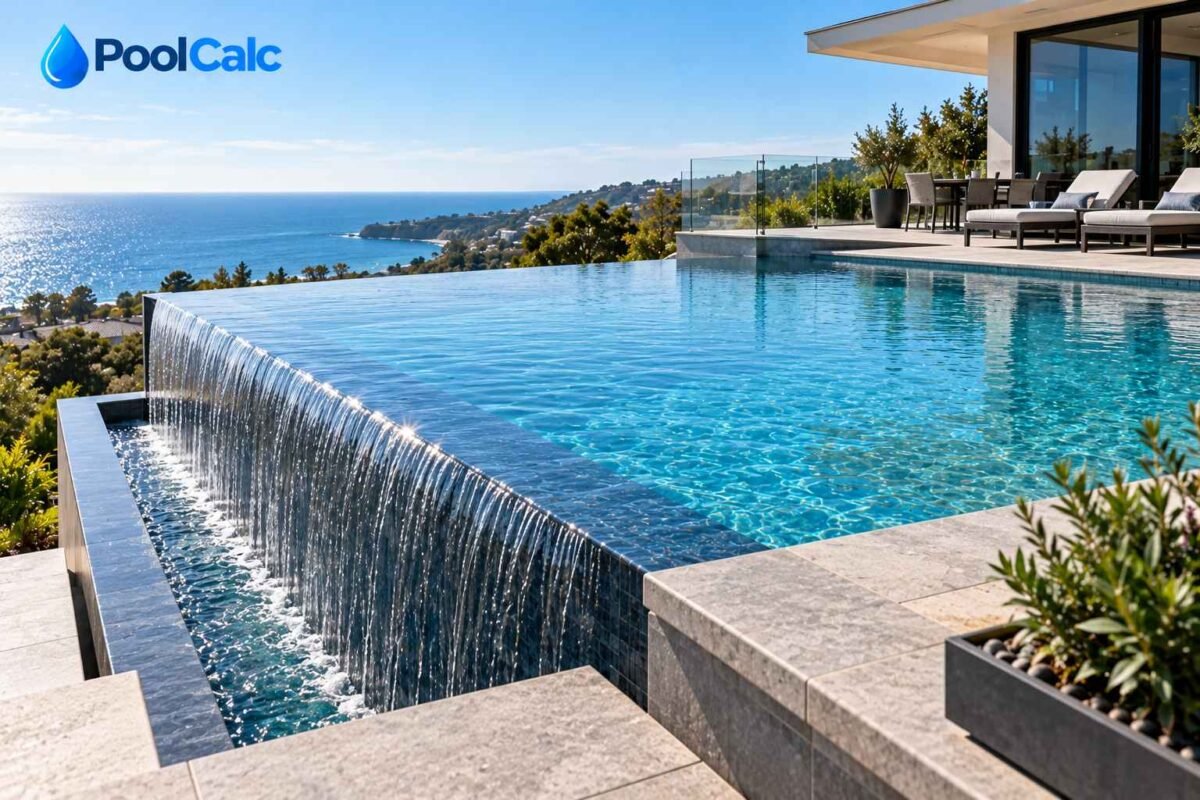
An infinity pool — also called a vanishing edge or negative edge — has one wall built fractionally below the water level, so water flows over it and appears to end in the view beyond. It is a genuine engineering feature, not a finish.
The water does not disappear. It falls into a catch basin hidden below the edge, and a second pump returns it to the pool continuously. That basin, that pump and that extra plumbing are what make an infinity pool a different proposition to maintain.
For water chemistry, the important consequence is aeration. Water falling over an edge and splashing into a basin drives carbon dioxide out of it, which pushes pH up continuously — the same effect a waterfall has, running all day.
At a glance
| Characteristic | Typical |
|---|---|
| Edge | One wall set marginally below water level |
| Catch basin | Hidden reservoir below the edge |
| Pumps | A second pump dedicated to the edge |
| pH tendency | Rises continuously from aeration |
| Water loss | Higher — more surface area and more splash |
Advantages and limitations
What works well
- The visual effect is unmatched where there is a view to borrow.
- The moving water is a feature in itself, visually and audibly.
- Constant circulation over the edge helps keep the surface clean.
- A genuine selling point on the right property.
What to weigh up
- Substantially more expensive to build — engineering, basin, extra plumbing.
- A second pump running whenever the edge is on, adding to the electricity bill.
- pH climbs continuously and needs frequent correction.
- Higher evaporation and water loss than a conventional pool.
- The edge must be dead level to within millimetres, or the effect fails visibly.
- More equipment means more that can go wrong.
Looking after one
- Test pH weekly at minimum. Constant aeration drives it up relentlessly.
- Keep alkalinity toward 80 ppm to slow the pH climb, and consider borates as a second buffer.
- Watch the catch basin level — it is where water loss shows up first.
- Clean the edge itself; scale and dirt on the lip spoil the sheet of water.
- Service both pumps, not just the main one.
What it costs to own
Building one costs considerably more than a conventional pool of the same size: the structural engineering, the catch basin, the second pump and the extra plumbing all add up, and the tolerance on the edge itself demands precise work.
Running costs are higher too. The edge pump adds to the electricity bill whenever it runs, evaporation is greater, and pH correction becomes a weekly rather than occasional job. Running the edge only when the pool is being looked at, rather than continuously, cuts all three.
Prices for pools vary enormously by region, access, ground conditions and specification, so no figure is quoted here. The Ownership Cost Calculator uses your own numbers instead of an average that would be wrong for most people.
Calculators for this pool
Questions people ask
Where does the water go?
Into a catch basin hidden below the edge, from which a second pump returns it to the pool. Nothing is lost except to evaporation and splash.
Why does my infinity pool’s pH keep rising?
Aeration. Water falling over the edge sheds carbon dioxide, and losing carbon dioxide raises pH. It is inherent to the design — expect to add acid regularly.
Do infinity pools use more water?
Yes. More surface area, constant movement and splash into the basin all increase evaporation compared with a still pool of the same size.
Can the edge run only sometimes?
Yes, and many owners do exactly that — running it when the pool is in use or on show, and switching it off otherwise. It cuts electricity, evaporation and pH drift together.