
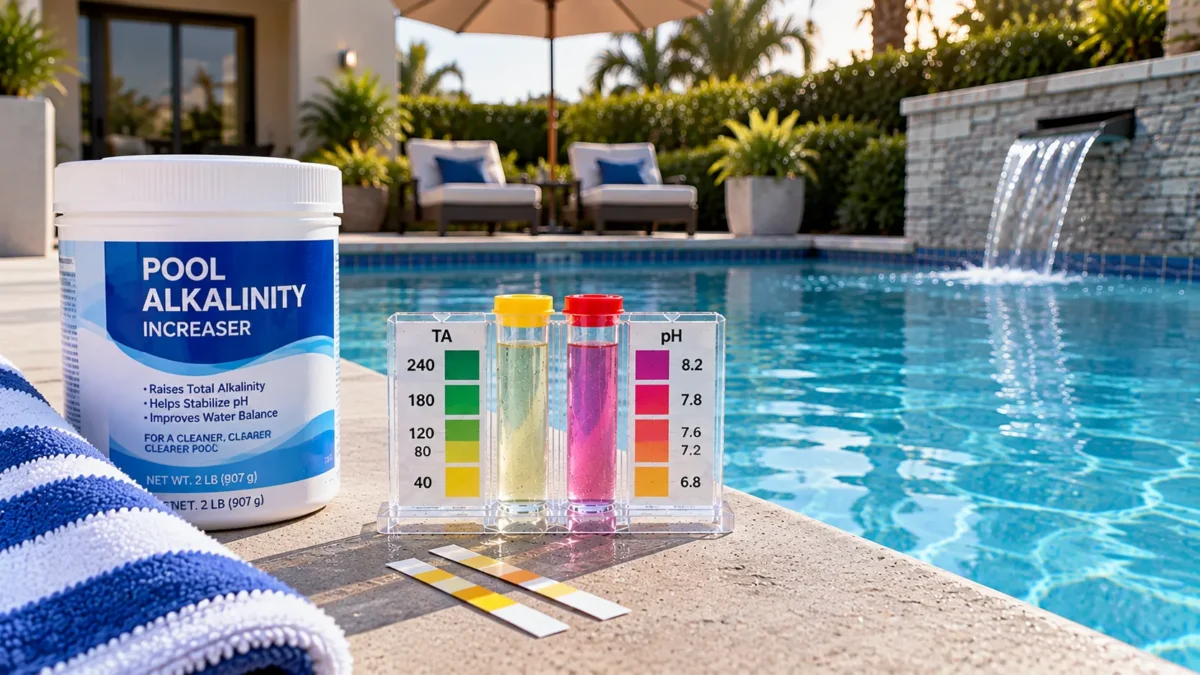
Total alkalinity below 80 ppm is why your pH will not sit still. Alkalinity is pH’s shock absorber — without enough of it, a rain shower or a single chemical dose sends pH swinging.
The symptom people notice is not the alkalinity reading. It is pH that reads 7.2 one day and 7.9 the next, with no obvious cause. That is “pH bounce”, and it is what low alkalinity looks like from the poolside.
The fix is simple and cheap: sodium bicarbonate, which is ordinary baking soda.
What causes it
- Heavy rain, which dilutes alkalinity and is acidic itself.
- Trichlor tablets, which are acidic and eat alkalinity over a season.
- Too much acid added while correcting high pH.
- Soft fill water, naturally low in alkalinity.
- Draining and refilling without re-balancing afterwards.
What to test first
Before adding anything, take a reading. Guessing at this stage is how a small problem becomes an expensive one.
| Test this | Why it matters |
|---|---|
| Total alkalinity | Below 80 ppm is the cause of the pH swings. |
| pH | Likely to be low, and moving around between tests. |
| Calcium hardness | Low alkalinity and low calcium together are aggressive toward plaster. |
How to fix it
- Work out the dose with the alkalinity calculator — 1.5 lbs of baking soda per 10,000 gallons raises alkalinity about 10 ppm.
- Add it in halves, a few hours apart, with the pump running. The water may cloud briefly; that is normal.
- Broadcast it across the surface rather than pouring it in one spot.
- Circulate for four hours and re-test.
- Check pH afterwards. Baking soda lifts it slightly, which is usually welcome when alkalinity was low.
- Aim for 80 to 120 ppm, and if your pH tends to climb, stop nearer 80.
Baking soda is one of the safest pool chemicals there is, but the same rule applies: add one product at a time and circulate before adding anything else. Never mix pool chemicals, and never add two products one after the other without circulating in between. Chlorine and acid together release chlorine gas. Always add chemical to water, never water to chemical.
Work out the numbers
These calculators give the figures for your pool rather than a rule of thumb.
Stopping it coming back
- Test alkalinity monthly, and after any heavy rain.
- Do not use trichlor tablets as your only chlorine source all season.
- Re-balance after draining and refilling.
- Correct alkalinity before pH, every time.
Questions people ask
What happens if alkalinity is too low?
pH becomes unstable and swings on anything — rain, a chemical dose, a busy weekend. Persistently low pH then corrodes metal and etches plaster.
How much baking soda do I need?
About 1.5 lbs per 10,000 gallons for every 10 ppm. A 20,000 gallon pool going from 70 to 100 ppm needs roughly 9 lbs. The calculator gives the figure for your pool.
Will baking soda raise my pH too?
Slightly, yes. That is usually helpful, since low alkalinity and low pH normally arrive together.
Why does my alkalinity keep dropping?
Trichlor tablets and repeated acid additions are the usual suspects, along with heavy rainfall. If it falls every month, look at what you are chlorinating with.